

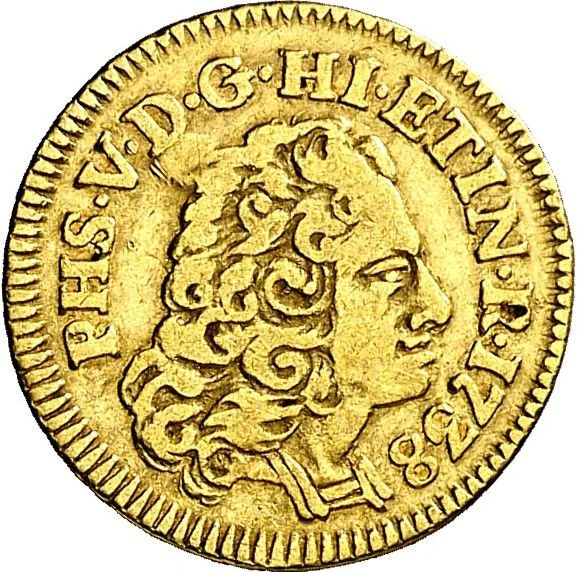
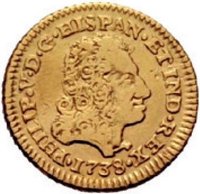
Obverse
Description:
King Philip V facing right.
Inscription:
PHS · V · D · G · HI · ET IND · R · 1738
Script: Latin
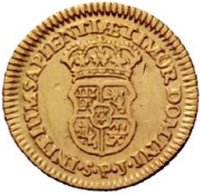
Reverse
Edge
Categories
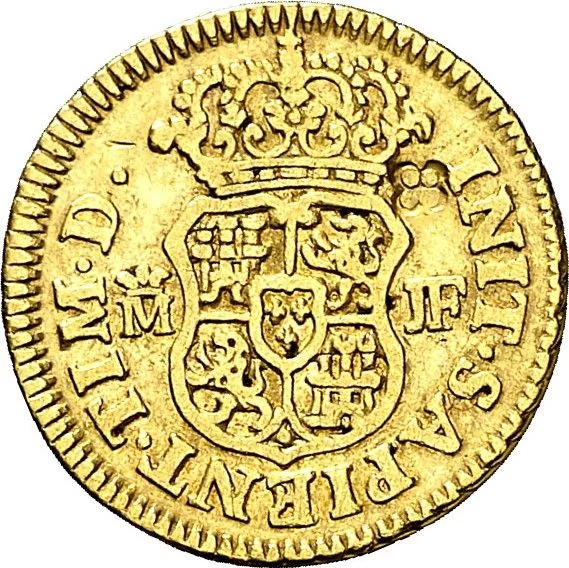
| Symbols> Coat of Arms |
Mints
| Name | Mark |
|---|---|
| Royal Mint of Madrid | (M) |
Mintings
| Year | Mint Mark | Mintage | Quality | Collection |
|---|---|---|---|---|
| 1738 | MJF | — |
Historical background
In 1738, Spain operated under a complex and strained monetary system, a legacy of its vast global empire and persistent fiscal pressures. The primary unit was the real, with eight reales making the famous "piece of eight" (real de a ocho), a silver coin that served as a key international currency. However, the system was bimetallic, relying on both silver from the Americas (primarily from Mexico and Peru) and gold (especially from New Granada, modern-day Colombia). The official mint standards were set by the 1730 ordinance, but the crown's chronic need for revenue, particularly to fund military campaigns in European conflicts like the War of the Polish Succession, led to repeated debasements and manipulations.
The currency situation was marked by significant instability and fragmentation. Throughout the early 18th century, successive kings had issued heavily debased vellón (copper) coinage to finance state debts, leading to inflation and a loss of public confidence. By 1738, a confusing mix of old and new coins of varying intrinsic values circulated simultaneously. This provoked frequent arbitrage, where good-quality full-weight coins were hoarded or exported, leaving poorer-quality money in domestic circulation—an early example of Gresham's Law ("bad money drives out good"). The problem was especially acute in provinces like Catalonia, which had its own monetary practices, creating internal exchange difficulties.
King Philip V's administration was aware of these issues and sought reform, but comprehensive stabilization remained elusive. The year 1738 fell within a period of attempted consolidation following the Bourbon accession, with efforts to centralize control over mints and unify the monetary system across Spain. However, the fundamental tension between the crown's immediate financial needs and the requirement for a sound, trustworthy currency was unresolved. The state's reliance on American silver shipments made the system vulnerable, setting the stage for future, more radical reforms that would culminate later in the century under kings Ferdinand VI and Charles III.
The currency situation was marked by significant instability and fragmentation. Throughout the early 18th century, successive kings had issued heavily debased vellón (copper) coinage to finance state debts, leading to inflation and a loss of public confidence. By 1738, a confusing mix of old and new coins of varying intrinsic values circulated simultaneously. This provoked frequent arbitrage, where good-quality full-weight coins were hoarded or exported, leaving poorer-quality money in domestic circulation—an early example of Gresham's Law ("bad money drives out good"). The problem was especially acute in provinces like Catalonia, which had its own monetary practices, creating internal exchange difficulties.
King Philip V's administration was aware of these issues and sought reform, but comprehensive stabilization remained elusive. The year 1738 fell within a period of attempted consolidation following the Bourbon accession, with efforts to centralize control over mints and unify the monetary system across Spain. However, the fundamental tension between the crown's immediate financial needs and the requirement for a sound, trustworthy currency was unresolved. The state's reliance on American silver shipments made the system vulnerable, setting the stage for future, more radical reforms that would culminate later in the century under kings Ferdinand VI and Charles III.
✨ Legendary