

1 thaler – Anhalt-Köthen
Add to wishlist
Circulating commemorative coins
Commemoration: Death of Amoena Amalia of Bentheim
Germany
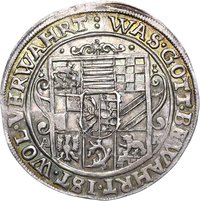
Obverse
Description:
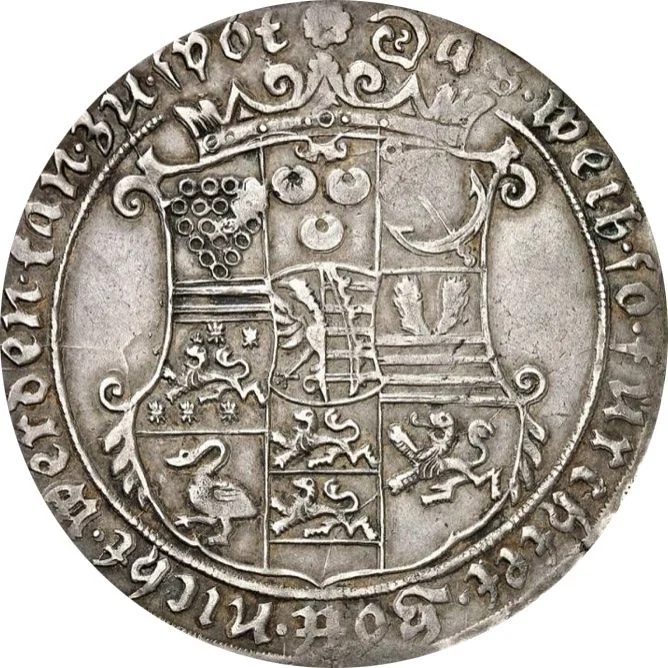
Arms of Bentheim-Tecklenburg and Anhalt encircled by legend.
Inscription:
✿Das·Weib.so.fürchtet.Gott.nicht.kan.zu.spot
Script: Latin (Fraktur blackletter)
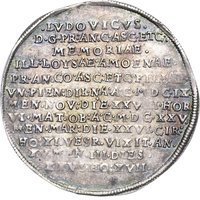
Reverse
Description:
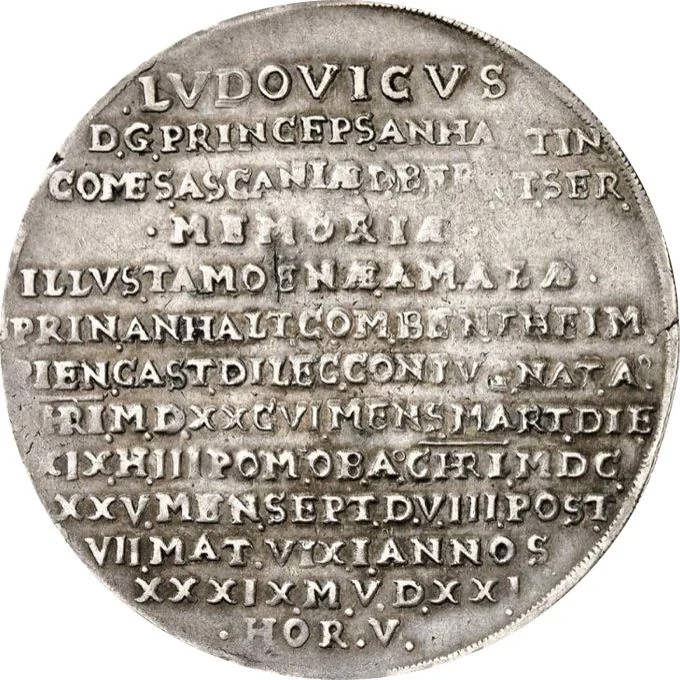
Inscription date: end of bar 9 to start of bar 10.
Inscription:
.LUDOVICVS.
D.G.PRINCEPS.ANHALTIN
COMES.ASCANIÆ.D.BER.ⲈT.SER.
.MEMORIÆ.
ILLVS.TAMOËNÆ.AMALÆ.
PRIN.ANHALT.COM.BENTHEIM.
PIEN.CAST.DILEC.CONIVGNAT.A.
GHRI.M.D.XXCVI.MENS.MART.DIE.
XIX.H.III.POM.OB.Ao.CHRI.MDC.
XXV.MEN.SEPT.D.V.III.POST.
VII.MAT.VIXI.ANNOS
XXXIX.M.V.D.XX.I
.HOR.V.
D.G.PRINCEPS.ANHALTIN
COMES.ASCANIÆ.D.BER.ⲈT.SER.
.MEMORIÆ.
ILLVS.TAMOËNÆ.AMALÆ.
PRIN.ANHALT.COM.BENTHEIM.
PIEN.CAST.DILEC.CONIVGNAT.A.
GHRI.M.D.XXCVI.MENS.MART.DIE.
XIX.H.III.POM.OB.Ao.CHRI.MDC.
XXV.MEN.SEPT.D.V.III.POST.
VII.MAT.VIXI.ANNOS
XXXIX.M.V.D.XX.I
.HOR.V.
Script: Latin
Edge
Mintings
| Year | Mint Mark | Mintage | Quality | Collection |
|---|---|---|---|---|
| 1625 | — | — |
Historical background
In 1625, the currency situation in the small central German principality of Anhalt-Köthen was one of severe instability and debasement, a microcosm of the wider monetary crisis gripping the Holy Roman Empire during the early stages of the Thirty Years' War. The war, which began in 1618, had placed enormous fiscal strain on all territories, as they were forced to fund military contributions and fortifications. Like many other states, Anhalt-Köthen resorted to manipulating its coinage to generate immediate revenue, reducing the precious metal content in its issued coins while maintaining their face value—a practice known as Kipper- und Wipperzeit (the clipping and culling period).
This period saw a proliferation of lightweight, small-denomination coins, particularly Kreuzers and Groschen, which flooded local markets. The debased currency from Anhalt-Köthen and neighboring states circulated widely, driving out older, full-weight coins that were either hoarded or melted down. The result was rampant inflation, a collapse in public trust in the currency, and severe disruption to everyday commerce and wage values. Prices for essential goods soared, causing significant hardship for the population, while the principality's own financial credibility was damaged.
While Prince Louis I of Anhalt-Köthen was a noted patron of the arts and a member of the scholarly Fruchtbringende Gesellschaft, his administration could not escape the Empire-wide economic maelstrom. The situation was compounded by the lack of a centralized imperial monetary authority, leaving individual princes to compete in a race to the bottom. Although imperial ordinances sought to restore order, effective enforcement was impossible amidst the war's chaos, leaving Anhalt-Köthen entangled in a destructive cycle of currency debasement that would only begin to be resolved later in the century.
This period saw a proliferation of lightweight, small-denomination coins, particularly Kreuzers and Groschen, which flooded local markets. The debased currency from Anhalt-Köthen and neighboring states circulated widely, driving out older, full-weight coins that were either hoarded or melted down. The result was rampant inflation, a collapse in public trust in the currency, and severe disruption to everyday commerce and wage values. Prices for essential goods soared, causing significant hardship for the population, while the principality's own financial credibility was damaged.
While Prince Louis I of Anhalt-Köthen was a noted patron of the arts and a member of the scholarly Fruchtbringende Gesellschaft, his administration could not escape the Empire-wide economic maelstrom. The situation was compounded by the lack of a centralized imperial monetary authority, leaving individual princes to compete in a race to the bottom. Although imperial ordinances sought to restore order, effective enforcement was impossible amidst the war's chaos, leaving Anhalt-Köthen entangled in a destructive cycle of currency debasement that would only begin to be resolved later in the century.
✨ Legendary