

1 Thaler – Anhalt-Köthen
Circulating commemorative coins
Commemoration: Death of the Son of Ludwig
Germany

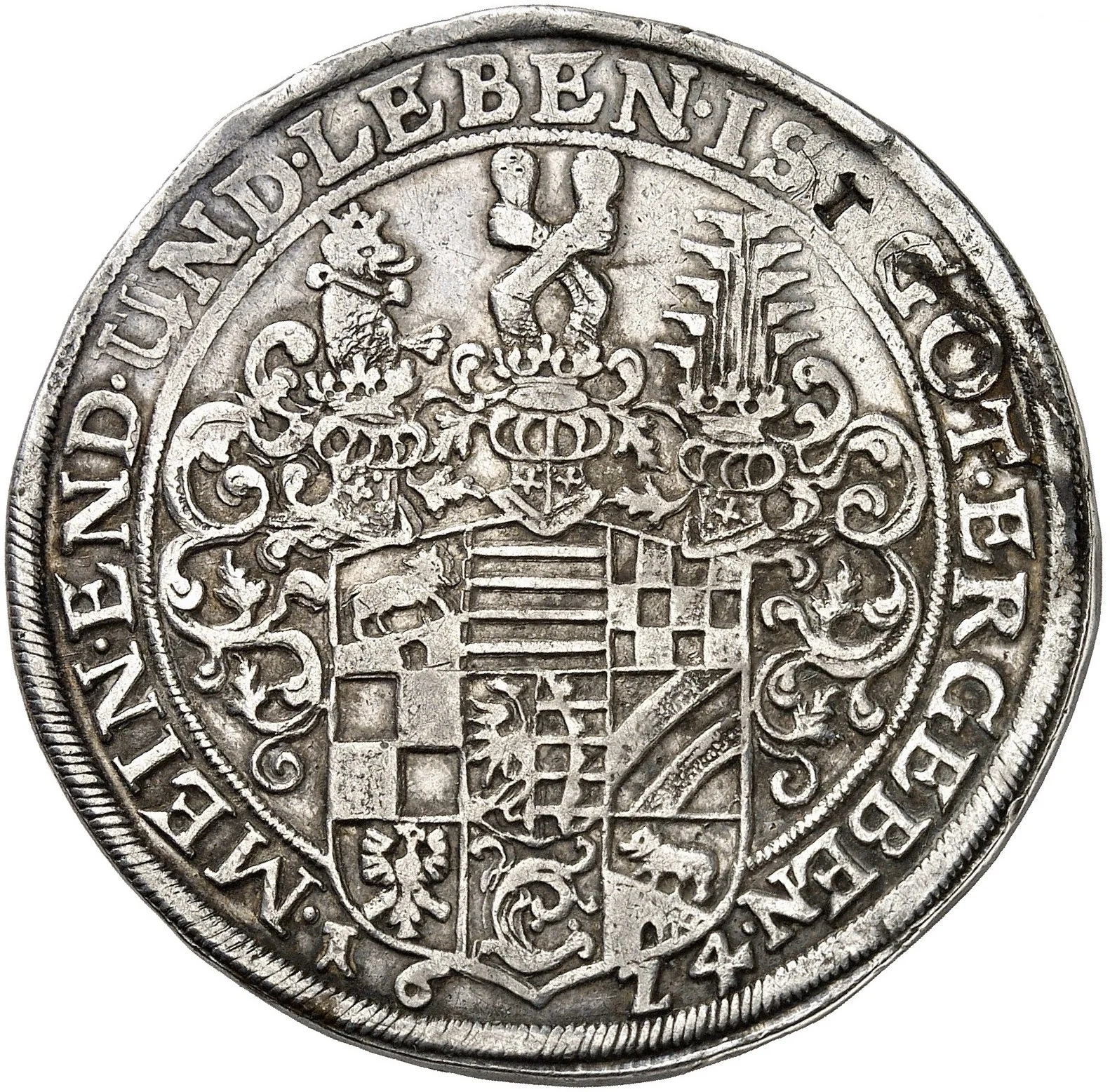
Obverse
Description:
Helmeted arms with ninefold date.
Inscription:
.MEIN.END.UND.LEBEN.IST.GOT.ERGEBEN.
16 24
16 24
Script: Latin
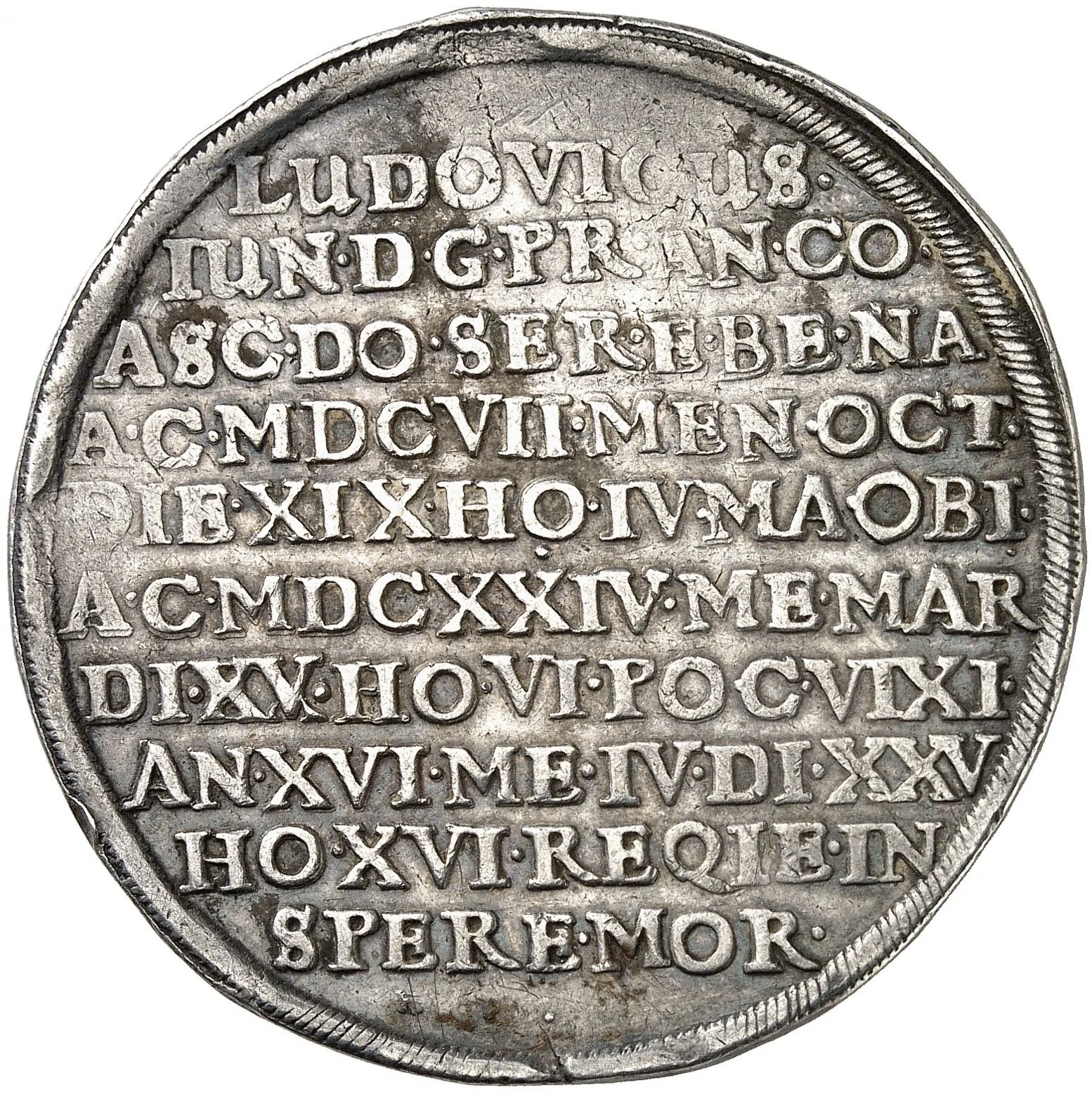
Reverse
Description:
10-line poem
Inscription:
LUDOVICUS.
IUN.D.G.PR.AN.CO.
ASC.DO.SER.E.BE..NA.
A:C.MDCVII.MEN.OCT.
DIE.XIX.HO.IV.MA.OBI.
A.C.MDCXXIV.ME.MAR.
DI.XV.HO.VI.POC.VIXI.
AN.XVI.ME.IV.DI.XXV
HO.XVI.REQIE.IN
SPERE.MOR
IUN.D.G.PR.AN.CO.
ASC.DO.SER.E.BE..NA.
A:C.MDCVII.MEN.OCT.
DIE.XIX.HO.IV.MA.OBI.
A.C.MDCXXIV.ME.MAR.
DI.XV.HO.VI.POC.VIXI.
AN.XVI.ME.IV.DI.XXV
HO.XVI.REQIE.IN
SPERE.MOR
Script: Latin
Edge
Categories
| Event> Death anniversary |
Mints
| Name | Mark |
|---|---|
| Eisleben | — |
Mintings
| Year | Mint Mark | Mintage | Quality | Collection |
|---|---|---|---|---|
| 1624 | — | — |
Historical background
In 1624, the currency situation in the small central German principality of Anhalt-Köthen was defined by the severe economic pressures of the early Thirty Years' War (1618-1648). The war had disrupted trade, caused widespread devastation, and placed immense financial strain on all territories as they struggled to fund military contributions and fortifications. Like other states within the Holy Roman Empire, Anhalt-Köthen faced the dual challenge of maintaining its own fiscal solvency while operating within the complex, multi-layered monetary system of the Empire, where numerous states minted their own coins.
The period was marked by rampant currency debasement, a practice where ruling authorities reduced the precious metal content in coins to create more money from the same amount of bullion. While the Reichstag had issued imperial currency ordinances (Reichsmünzordnungen) to standardize coinage, enforcement was weak. Neighboring and more powerful states, particularly the Duchy of Brunswick-Wolfenbüttel under the notorious "Kipper and Wipper" princes, were aggressively debasing their coinage. This flooded the region with inferior money, forcing Anhalt-Köthen to either debase its own currency to avoid seeing its good coins hoarded or exported, or to suffer economic disadvantage.
Consequently, Prince Louis I of Anhalt-Köthen, despite being a respected patron of the arts and a member of the literary Fruchtbringende Gesellschaft, would have been compelled to engage in limited debasement simply to meet urgent wartime expenses and to prevent the principality's treasury from being drained by the influx of neighbouring bad coinage. The situation created inflation, eroded public trust in coinage, and made everyday commerce difficult, reflecting the broader monetary chaos that gripped the Empire during the destructive "Kipper and Wipper" inflationary period (c. 1621-1623), the immediate aftermath of which was still felt in 1624.
The period was marked by rampant currency debasement, a practice where ruling authorities reduced the precious metal content in coins to create more money from the same amount of bullion. While the Reichstag had issued imperial currency ordinances (Reichsmünzordnungen) to standardize coinage, enforcement was weak. Neighboring and more powerful states, particularly the Duchy of Brunswick-Wolfenbüttel under the notorious "Kipper and Wipper" princes, were aggressively debasing their coinage. This flooded the region with inferior money, forcing Anhalt-Köthen to either debase its own currency to avoid seeing its good coins hoarded or exported, or to suffer economic disadvantage.
Consequently, Prince Louis I of Anhalt-Köthen, despite being a respected patron of the arts and a member of the literary Fruchtbringende Gesellschaft, would have been compelled to engage in limited debasement simply to meet urgent wartime expenses and to prevent the principality's treasury from being drained by the influx of neighbouring bad coinage. The situation created inflation, eroded public trust in coinage, and made everyday commerce difficult, reflecting the broader monetary chaos that gripped the Empire during the destructive "Kipper and Wipper" inflationary period (c. 1621-1623), the immediate aftermath of which was still felt in 1624.
✨ Legendary