

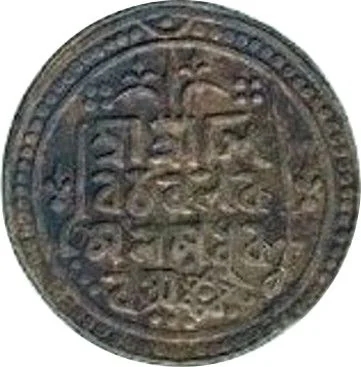
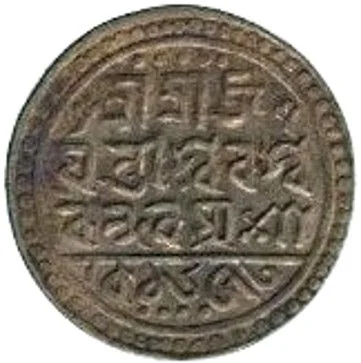
1 rupee – Jaintia Kingdom
Add to wishlist
India
Context
Year: 1731
Nepal - Saka era Year:: 1653
Country: India
Issuer: Jaintia Kingdom
Ruler: Borgohain Syiem Sutnga II
Currency:
Demonetized: Yes
Material
References
KM: #
Numista: #423075
Value
Bullion value: $25.00
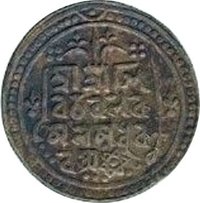
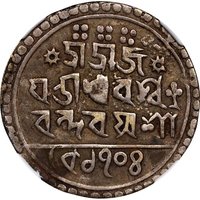
Obverse
Description:
King’s titles and blessing.
Script: Devanagari
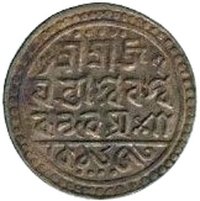
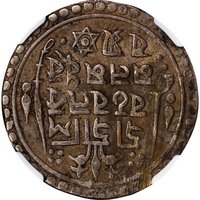
Reverse
Description:
Date and state lettering.
Script: Devanagari
Edge
Plain
Mintings
| Year | Mint Mark | Mintage | Quality | Collection |
|---|---|---|---|---|
| 1731 | — | — |
Historical background
In 1731, the Jaintia Kingdom, nestled in the rugged hills between the Brahmaputra Valley and the Sylhet plains, operated within a complex economic system that was both monetized and deeply rooted in barter. While the kingdom engaged in regional trade, its internal economy was not dominated by a single, sovereign coinage. Instead, the currency situation was characterized by the circulation of multiple external silver coins, primarily the Mughal Rupee and its regional variants from Bengal and Assam. These coins entered the kingdom through trade in luxury goods, salt, and the famed limestone from the region, serving as the medium for significant transactions and state treasury reserves.
Alongside this imported coinage, the everyday economy functioned on a sophisticated system of barter and local standards of value. The most important of these was the Cowrie shell, which served as a ubiquitous small-change currency for common market exchanges and tax payments. Furthermore, specific commodities held standardized monetary value; notably, iron in the form of flat, hoe-shaped ingots (known as mairam) and hand-woven textiles were used as units of account and for settling debts. This multi-layered system allowed the kingdom to participate in the broader monetary networks of Mughal India while maintaining a resilient and self-sufficient local economy.
The political context of 1731 is crucial to understanding this monetary landscape. The Jaintia Kingdom, under its Syiem (king), was navigating a period of relative independence but increasing pressure. While not formally under Mughal rule, it paid a periodic peshkash (tribute) to the Mughal faujdar of Sylhet, often in silver rupees or valued goods. This tributary relationship ensured a steady, if controlled, flow of imperial coinage into the royal coffers. Thus, the currency situation reflected the kingdom's hybrid position: a hill state with its own ancient economic traditions, yet pragmatically integrated into the monetary and political spheres of the plains-based empires.
Alongside this imported coinage, the everyday economy functioned on a sophisticated system of barter and local standards of value. The most important of these was the Cowrie shell, which served as a ubiquitous small-change currency for common market exchanges and tax payments. Furthermore, specific commodities held standardized monetary value; notably, iron in the form of flat, hoe-shaped ingots (known as mairam) and hand-woven textiles were used as units of account and for settling debts. This multi-layered system allowed the kingdom to participate in the broader monetary networks of Mughal India while maintaining a resilient and self-sufficient local economy.
The political context of 1731 is crucial to understanding this monetary landscape. The Jaintia Kingdom, under its Syiem (king), was navigating a period of relative independence but increasing pressure. While not formally under Mughal rule, it paid a periodic peshkash (tribute) to the Mughal faujdar of Sylhet, often in silver rupees or valued goods. This tributary relationship ensured a steady, if controlled, flow of imperial coinage into the royal coffers. Thus, the currency situation reflected the kingdom's hybrid position: a hill state with its own ancient economic traditions, yet pragmatically integrated into the monetary and political spheres of the plains-based empires.

✨ Legendary