

1 giulio – Papal States
Add to wishlist
Vatican City
Context
Year: 1672
Country: Vatican City
Issuer: Papal States
Ruler: Clement X
Currency:
(1534—1835)
Demonetized: Yes
Material
Weight: 3.08 g
Silver Weight:: 2.82 g
Shape: Round
Composition: 91.7% Silver
Standard: Gold tenth ounce
Magnetic: No
References
KM: #
Numista: #113619
Value
Bullion value: $7.09
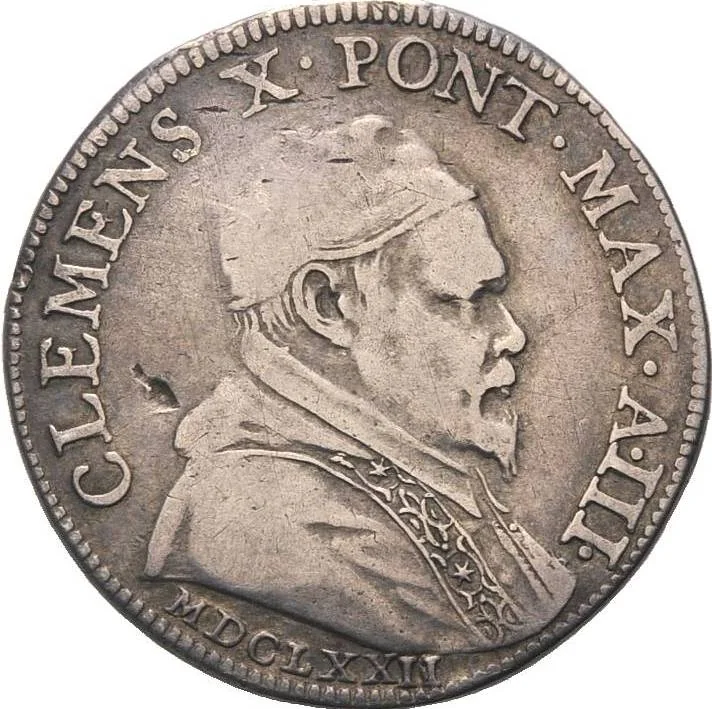
Obverse
Description:
Bust of Pope Clement X in profile, wearing zucchetto, mozzetta, and pallium.
Inscription:
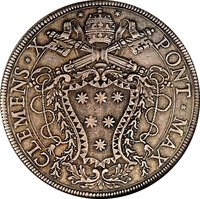
CLEMENS X · PONT · MAX · A · III ·
MDCLXXII
MDCLXXII
Script: Latin
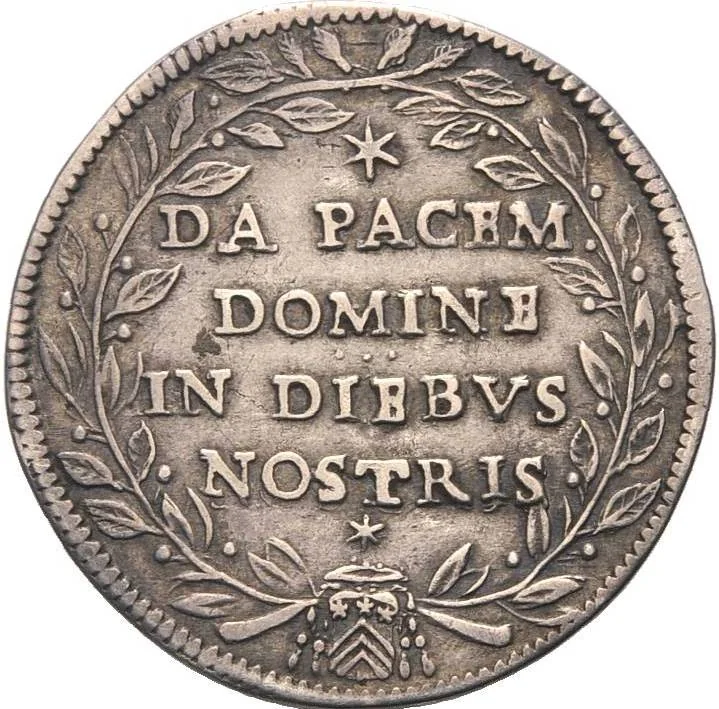
Reverse
Description:
Four-line inscription. Six-pointed stars above and below. Central coat of arms with galero, tassels, and laurel wreath.
Inscription:
DA PACEM
DOMINE
IN DIEBVS
NOSTRIS
DOMINE
IN DIEBVS
NOSTRIS
Script: Latin
Edge
Categories
| Person> Monarch |
| Person> Religious figure |
| Object> Hat |
| Mustache/Beard |
| Symbols> Coat of Arms |
| Symbol> Wreath |
Mintings
| Year | Mint Mark | Mintage | Quality | Collection |
|---|---|---|---|---|
| 1672 | — | — |
Historical background
In 1672, the Papal States operated under a complex and strained monetary system, a legacy of centuries of fragmented Italian coinage and persistent fiscal challenges. The primary unit was the papal scudo, a silver coin, which existed alongside a bewildering array of subsidiary coins, including giuli, baiochi, and quattrini. Crucially, the system was bimetallic, with a gold scudo d'oro also in circulation, but the fixed exchange rate between gold and silver often failed to reflect volatile market values, leading to chronic instability. Furthermore, the numerous independent Italian mints and the circulation of foreign coins, particularly Spanish pieces of eight, created a chaotic environment where the value of money could vary significantly from one city-state to another within the Pope's territories.
This monetary confusion was exacerbated by the papacy's chronic budget deficits, driven by the costs of maintaining Rome's grandeur, administering the states, and funding military defenses. To raise revenue, Popes often resorted to debasement—reducing the precious metal content in coins while maintaining their face value. This practice, a form of hidden taxation, eroded public trust in the currency and spurred inflation, as merchants demanded more coins for goods. While Pope Clement X (reigned 1670-1676) was not the most aggressive in this regard, he inherited a treasury depleted by his predecessor Alexander VII's ambitious building projects and faced the ongoing financial strain of maintaining neutrality amidst European power struggles.
Consequently, the economic reality in 1672 was one of underlying fragility. While not in a state of acute crisis that year, the monetary system was fundamentally weak, prone to hoarding of good coinage (Gresham's Law), and a burden on commerce. The Papal States' finances were propped up not by a sound fiscal system but by lucrative income from spiritual dues, taxes like the datario, and loans from Roman bankers. Thus, the currency situation reflected the broader paradox of the Papal States: it was a sovereign temporal power with the spiritual wealth of the Catholic Church, yet it struggled with the mundane economic inefficiencies and fiscal shortfalls common to early modern Italian states.
This monetary confusion was exacerbated by the papacy's chronic budget deficits, driven by the costs of maintaining Rome's grandeur, administering the states, and funding military defenses. To raise revenue, Popes often resorted to debasement—reducing the precious metal content in coins while maintaining their face value. This practice, a form of hidden taxation, eroded public trust in the currency and spurred inflation, as merchants demanded more coins for goods. While Pope Clement X (reigned 1670-1676) was not the most aggressive in this regard, he inherited a treasury depleted by his predecessor Alexander VII's ambitious building projects and faced the ongoing financial strain of maintaining neutrality amidst European power struggles.
Consequently, the economic reality in 1672 was one of underlying fragility. While not in a state of acute crisis that year, the monetary system was fundamentally weak, prone to hoarding of good coinage (Gresham's Law), and a burden on commerce. The Papal States' finances were propped up not by a sound fiscal system but by lucrative income from spiritual dues, taxes like the datario, and loans from Roman bankers. Thus, the currency situation reflected the broader paradox of the Papal States: it was a sovereign temporal power with the spiritual wealth of the Catholic Church, yet it struggled with the mundane economic inefficiencies and fiscal shortfalls common to early modern Italian states.
✨ Legendary