

2 rupees – Arcot
Add to wishlist
India
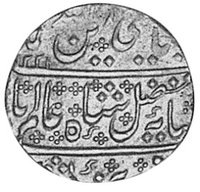
Obverse
Description:
Persian couple of Shah Alam II.
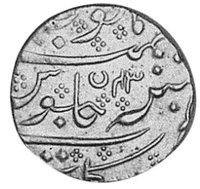
Reverse
Description:
Persian - Julus mint.
Edge
Mints
| Name | Mark |
|---|---|
| Arcot | — |
Mintings
| Year | Mint Mark | Mintage | Quality | Collection |
|---|---|---|---|---|
| 1768 | — | — |
Historical background
In 1768, the Carnatic region of South India, with Arcot as its capital, was in a state of profound political and monetary instability. The Nawab of Arcot, Muhammad Ali Khan Wallajah, was a key British ally, but his authority was heavily compromised. His regime was deeply indebted to the British East India Company and to private European creditors, a situation stemming from the costs of earlier wars and the Company's own political machinations. This debt, which would balloon into the infamous "Arcot Debt," crippled the Nawab's treasury and made his administration a puppet whose revenues were increasingly pledged to foreign interests.
This political fragility directly corrupted the currency system. The Nawab's mint in Arcot continued to produce the local silver rupee, but its integrity was under severe pressure. To meet his crippling financial obligations, the Nawab was often forced to engage in currency debasement—reducing the silver content in coins to create more nominal money from limited bullion. Furthermore, the region was flooded with a chaotic variety of coins: older Mughal rupees, newer Arcot rupees of uncertain purity, and currencies from other Indian powers and European trading companies. This multiplicity created a complex and unreliable exchange environment, hindering trade and daily commerce.
Consequently, the monetary landscape was one of distrust and exploitation. Merchants and money-changers had to constantly assay coins, leading to wide variations in exchange rates and premiums for coins known to be of full weight. The British, both the Company and its individual servants, often used their political leverage to manipulate this system for profit, further draining wealth from the region. Thus, in 1768, Arcot's currency was not just an economic tool but a stark symbol of a political order in collapse, where fiscal desperation and colonial extraction had eroded the very medium of exchange.
This political fragility directly corrupted the currency system. The Nawab's mint in Arcot continued to produce the local silver rupee, but its integrity was under severe pressure. To meet his crippling financial obligations, the Nawab was often forced to engage in currency debasement—reducing the silver content in coins to create more nominal money from limited bullion. Furthermore, the region was flooded with a chaotic variety of coins: older Mughal rupees, newer Arcot rupees of uncertain purity, and currencies from other Indian powers and European trading companies. This multiplicity created a complex and unreliable exchange environment, hindering trade and daily commerce.
Consequently, the monetary landscape was one of distrust and exploitation. Merchants and money-changers had to constantly assay coins, leading to wide variations in exchange rates and premiums for coins known to be of full weight. The British, both the Company and its individual servants, often used their political leverage to manipulate this system for profit, further draining wealth from the region. Thus, in 1768, Arcot's currency was not just an economic tool but a stark symbol of a political order in collapse, where fiscal desperation and colonial extraction had eroded the very medium of exchange.

✨ Legendary