

2 Pfennigs – Austrian Empire
Austria
Context
Years: 1634–1635
Country: Austria 
Issuer: Austrian Empire
Ruler: Ferdinand II
Currency:
(1520—1754)
Demonetized: Yes
Material
References
KM: #Click to copy to clipboard377
Numista: #422520
Value
Bullion value: $1.50
Obverse
Description:
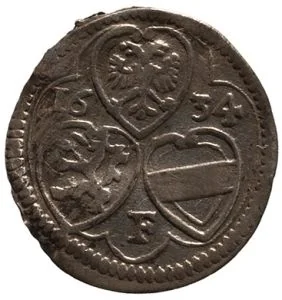
Three heart-shaped shields: the imperial eagle above, Styria left, Austria right, with the year and monogram between them.
Inscription:
16 - 34
F
F
Reverse
Description:
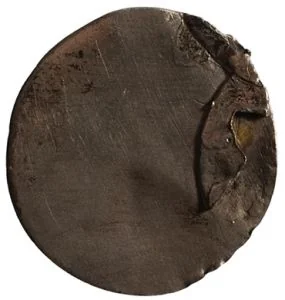
Blank
Edge
Mints
| Name | Mark |
|---|---|
| Graz | — |
Mintings
| Year | Mint Mark | Mintage | Quality | Collection |
|---|---|---|---|---|
| 1634 | — | — | ||
| 1635 | — | — |
Historical background
In 1634, the Austrian Habsburg monarchy, a constituent part of the Holy Roman Empire, was embroiled in the devastating Thirty Years' War (1618-1648). The financial demands of maintaining large mercenary armies were catastrophic, leading to a state of severe fiscal crisis. To meet these endless expenses, the Habsburg emperors, notably Ferdinand II, resorted to the debasement of coinage on a massive scale. This involved drastically reducing the precious metal content (silver) in coins while officially maintaining their face value, a form of currency manipulation that functioned as a brutal, hidden tax on the population.
The primary vehicle for this debasement was the Kipper- und Wipperzeit (literally "Tipper and See-saw time"), a period of rampant currency speculation and monetary chaos that peaked in the early 1620s. While its most intense phase had slightly subsided by 1634, its consequences were deeply entrenched. The empire's monetary system was flooded with unstable, low-value coins, such as debased Kreuzers and Groschen, which drove good, full-weight silver coins out of circulation (Gresham's Law). This resulted in a multi-tiered currency system where the value of money was highly unstable and varied wildly by region, causing price inflation, market disruption, and a profound loss of public trust in coinage.
Consequently, by 1634, the Austrian economy operated in a climate of monetary uncertainty. Trade was hampered as merchants struggled with fluctuating values, and the rural and urban poor suffered immensely as their wages and savings were eroded by inflation. While imperial authorities attempted to stabilize the currency through ordinances, the relentless financial pressures of the ongoing war made genuine reform impossible. The currency situation thus remained a symptom of the broader crisis, reflecting the Habsburg monarchy's struggle for survival, paid for by the economic ruin of its subjects.
The primary vehicle for this debasement was the Kipper- und Wipperzeit (literally "Tipper and See-saw time"), a period of rampant currency speculation and monetary chaos that peaked in the early 1620s. While its most intense phase had slightly subsided by 1634, its consequences were deeply entrenched. The empire's monetary system was flooded with unstable, low-value coins, such as debased Kreuzers and Groschen, which drove good, full-weight silver coins out of circulation (Gresham's Law). This resulted in a multi-tiered currency system where the value of money was highly unstable and varied wildly by region, causing price inflation, market disruption, and a profound loss of public trust in coinage.
Consequently, by 1634, the Austrian economy operated in a climate of monetary uncertainty. Trade was hampered as merchants struggled with fluctuating values, and the rural and urban poor suffered immensely as their wages and savings were eroded by inflation. While imperial authorities attempted to stabilize the currency through ordinances, the relentless financial pressures of the ongoing war made genuine reform impossible. The currency situation thus remained a symptom of the broader crisis, reflecting the Habsburg monarchy's struggle for survival, paid for by the economic ruin of its subjects.

✨ Legendary