

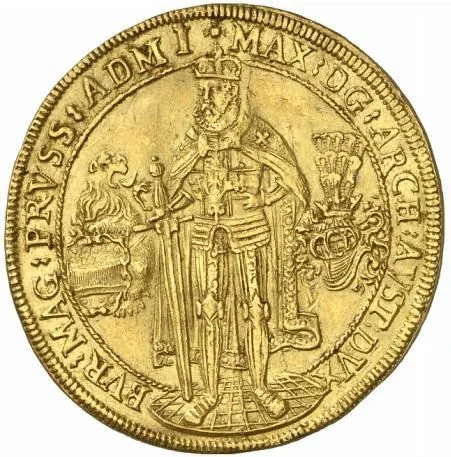

Obverse
Description:
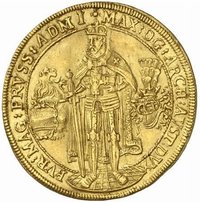
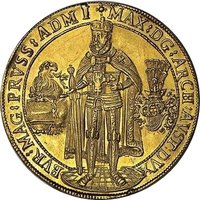
Maximilian III stands in armor, facing slightly left, with a mantle, helmet, and sword. The Teutonic Order cross is on his torso. A great helm and a lion-held Austrian shield flank him within a braided circle, his feet dividing the circle and the legend.
Inscription:
+ MAX : DG : ARCH : AVST : DVX BVR : MAG : PRVSS : ADMI
Script: Latin
Reverse
Description:
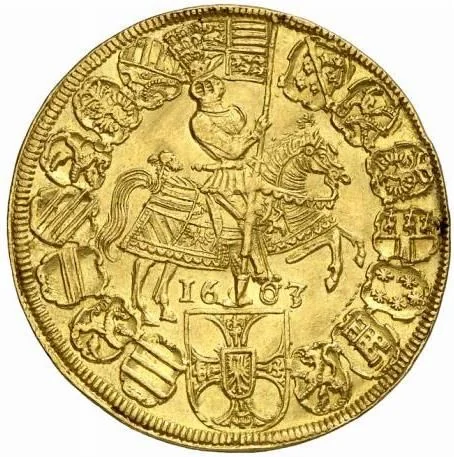
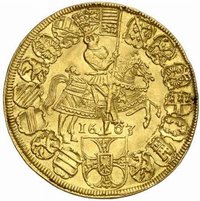
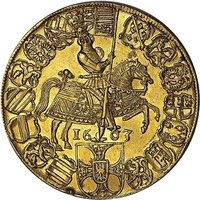
An armored knight on horseback faces right, wearing a great helm and carrying a banner. He is encircled by 14 small shields of arms (Alsace, Habsburg, Prussia, Carinthia, Lower Austria, Castile, Leon, Teutonic Order, Hungary, Bohemia, Austria, Ancient Burgundy, Styria, Carniola, Gorizia). Below is a larger shield of the Teutonic Order with Tyrol at its center, topped by a date.
Inscription:
16 03
Script: Latin
Edge
Categories
| Animal> Horse |
| Object> Armour |
| Symbols> Coat of Arms |
| Animal> Feline |
| Animal> Bird> Eagle |
| Building> Castle or fortification |
Mints
| Name | Mark |
|---|---|
| Hall | — |
Mintings
| Year | Mint Mark | Mintage | Quality | Collection |
|---|---|---|---|---|
| 1603 | — | — |
Historical background
In 1603, the Teutonic Order, governing the Duchy of Prussia as a fief of the Polish Crown, faced a complex and deteriorating currency situation. The state was entangled in the wider monetary crisis plaguing the Polish-Lithuanian Commonwealth, characterized by a flood of debased coinage from neighboring states. The primary issue was the influx of inferior foreign coins, particularly lightweight schillings and groschen, which drove better, full-weight Prussian coins out of circulation according to Gresham's Law. This led to a severe shortage of reliable small change, disrupting local markets and trade in cities like Königsberg.
The Order’s monetary sovereignty was also constrained by its feudal obligations to Poland. While it minted its own coins at the Königsberg mint, major monetary policy often required alignment with or permission from the Polish king, Sigismund III Vasa. Internally, the Order's finances were strained by administrative costs and the maintenance of its network of commandries, limiting its capacity to implement a decisive recoinage or to absorb the costs of withdrawing bad currency. The situation created tension between the need for stable commerce and the political and economic realities of vassalage.
Consequently, the year 1603 saw a period of monetary instability and inflationary pressure that eroded public trust. The Teutonic authorities, under Grand Master Margrave Joachim Frederick of Brandenburg (who was also the Lutheran Administrator of the Archbishopric of Magdeburg), were likely grappling with proposals for currency reform. However, any effective solution would have required difficult political negotiations with the Polish crown and neighboring entities to control the cross-border flow of debased coins, a challenge that underscored the Order's diminishing autonomy in the early 17th century.
The Order’s monetary sovereignty was also constrained by its feudal obligations to Poland. While it minted its own coins at the Königsberg mint, major monetary policy often required alignment with or permission from the Polish king, Sigismund III Vasa. Internally, the Order's finances were strained by administrative costs and the maintenance of its network of commandries, limiting its capacity to implement a decisive recoinage or to absorb the costs of withdrawing bad currency. The situation created tension between the need for stable commerce and the political and economic realities of vassalage.
Consequently, the year 1603 saw a period of monetary instability and inflationary pressure that eroded public trust. The Teutonic authorities, under Grand Master Margrave Joachim Frederick of Brandenburg (who was also the Lutheran Administrator of the Archbishopric of Magdeburg), were likely grappling with proposals for currency reform. However, any effective solution would have required difficult political negotiations with the Polish crown and neighboring entities to control the cross-border flow of debased coins, a challenge that underscored the Order's diminishing autonomy in the early 17th century.
✨ Legendary