

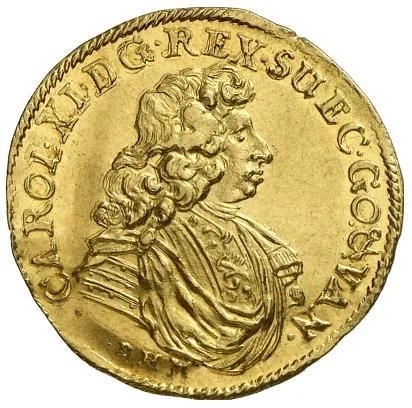
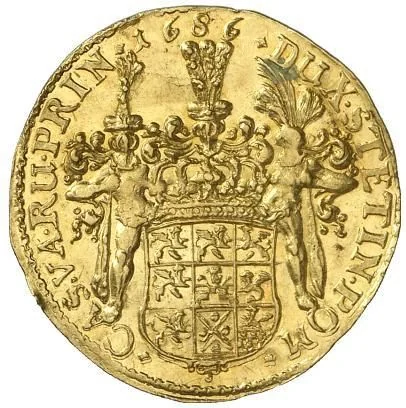
1 Ducat – Swedish dominion of Pomerania
Sweden
Context
Year: 1686
Country: Sweden 
Issuer: Swedish dominion of Pomerania
Ruler: Charles XI
Currency:
(1630—1815)
Demonetized: Yes
References
KM: #Click to copy to clipboard313.1
Numista: #420109
Value
Bullion value: $575.40
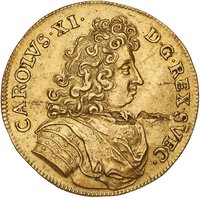
Obverse
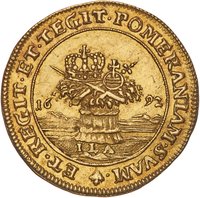
Reverse
Edge
Mints
| Name | Mark |
|---|---|
| Szczecin | — |
Mintings
| Year | Mint Mark | Mintage | Quality | Collection |
|---|---|---|---|---|
| 1686 | — | — |
Historical background
In 1686, the currency situation in Swedish Pomerania was complex and challenging, reflecting the province's position as a territorial outlier within the Swedish Empire. The local monetary system was a fragmented mix of circulating coins, dominated not by a unified Swedish currency but by a plethora of German and regional issues. The most important unit of account was the Lübsch Mark, based on the monetary standard of the nearby Hanseatic city of Lübeck, alongside various Reichsthalers, Gute Groschen, and Schilling coins. This created constant difficulties in trade and taxation, as values had to be constantly calculated and recalculated between different standards.
Swedish authorities struggled to exert control over this chaotic system. While Swedish coinage, such as Carolin d’or and riksdaler, was present, it circulated alongside and in competition with coins from Brandenburg, Poland, and local German states. Debasement of coinage by various neighboring princes was a persistent problem, leading to inflation and loss of confidence. The Swedish government attempted to fix exchange rates by ordinance, but these measures were often ineffective on the ground, as the economic reality of the region was deeply integrated with the German hinterland rather than the Swedish homeland.
Ultimately, the monetary disarray of 1686 was symptomatic of Sweden's broader administrative challenge: governing a German territory with its own entrenched economic traditions. The lack of a dominant, imposed Swedish currency underscored the limits of central power and the province's de facto economic autonomy. This situation would persist until more forceful monetary reforms were undertaken in the early 18th century, though complete standardization remained elusive throughout Swedish rule.
Swedish authorities struggled to exert control over this chaotic system. While Swedish coinage, such as Carolin d’or and riksdaler, was present, it circulated alongside and in competition with coins from Brandenburg, Poland, and local German states. Debasement of coinage by various neighboring princes was a persistent problem, leading to inflation and loss of confidence. The Swedish government attempted to fix exchange rates by ordinance, but these measures were often ineffective on the ground, as the economic reality of the region was deeply integrated with the German hinterland rather than the Swedish homeland.
Ultimately, the monetary disarray of 1686 was symptomatic of Sweden's broader administrative challenge: governing a German territory with its own entrenched economic traditions. The lack of a dominant, imposed Swedish currency underscored the limits of central power and the province's de facto economic autonomy. This situation would persist until more forceful monetary reforms were undertaken in the early 18th century, though complete standardization remained elusive throughout Swedish rule.
✨ Legendary