

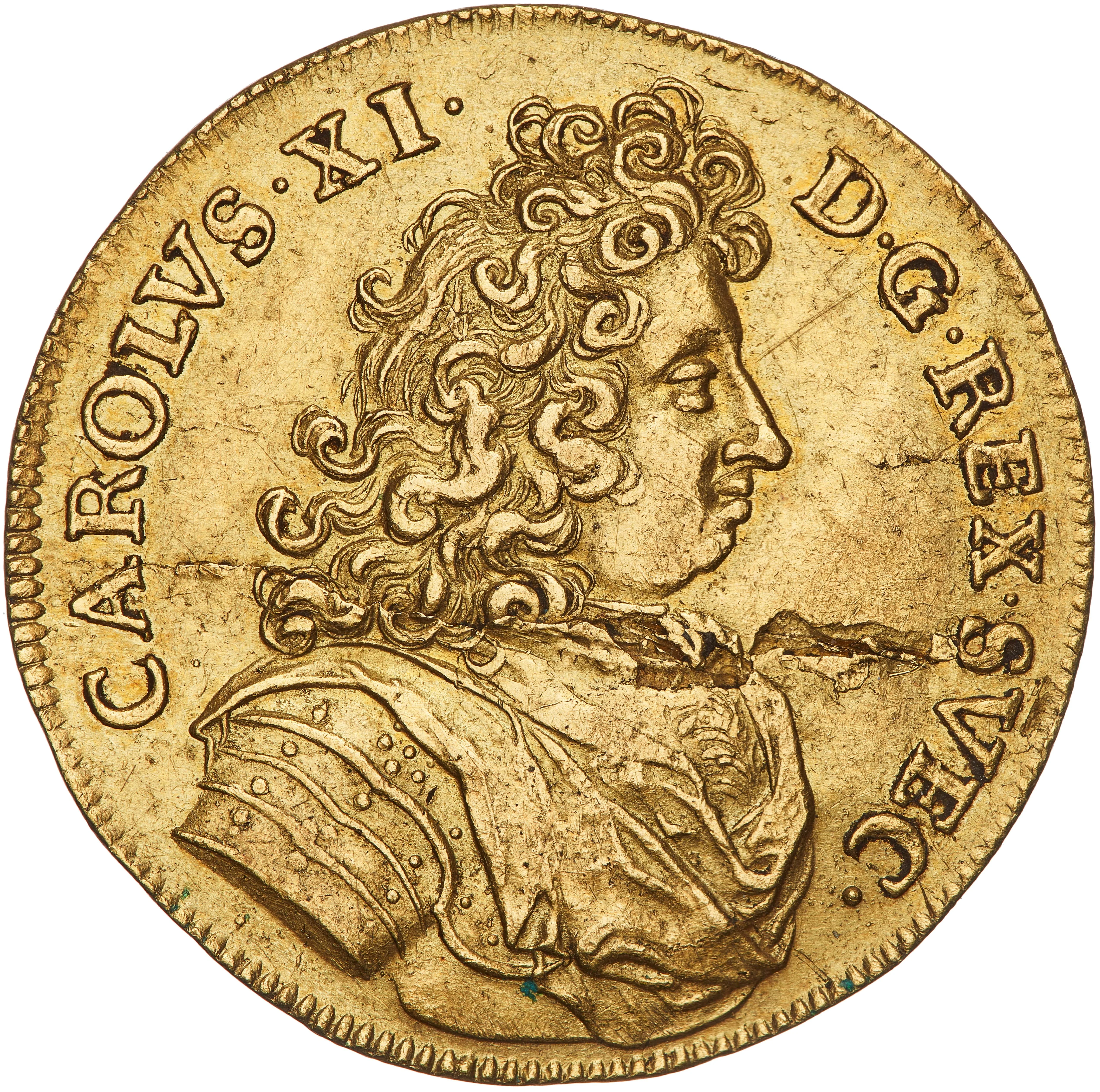
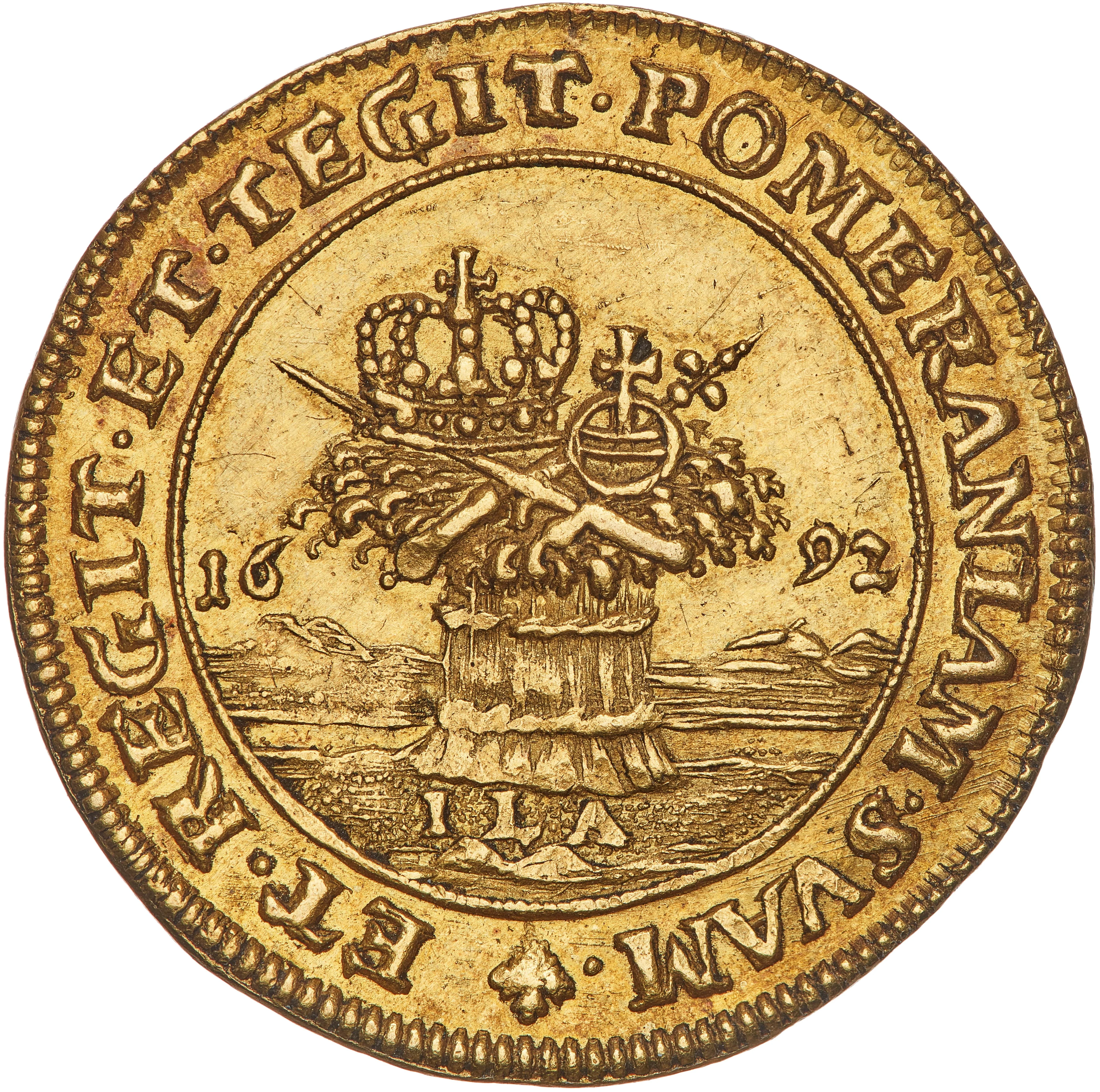
2 Ducats – Swedish dominion of Pomerania
Sweden
Context
Years: 1688–1697
Country: Sweden 
Issuer: Swedish dominion of Pomerania
Ruler: Charles XI
Currency:
(1630—1815)
Demonetized: Yes
Material
References
KM: #Click to copy to clipboard342
Numista: #420107
Value
Bullion value: $1150.80
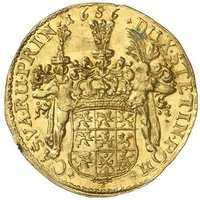
Obverse
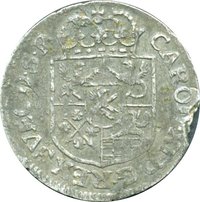
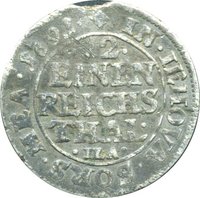
Reverse
Description:
Wheat sheaf encircling crown, orb, sword, and scepter.
Inscription:
ET REGIT ET TEGIT POMERANIAM SVAM
16 92
ILA
16 92
ILA
Script: Latin
Edge
Mints
| Name | Mark |
|---|---|
| Szczecin | — |
Mintings
| Year | Mint Mark | Mintage | Quality | Collection |
|---|---|---|---|---|
| — | — | — | ||
| 1692 | — | — | ||
| 1693 | — | — | ||
| 1694 | — | — | ||
| 1696 | — | — | ||
| 1697 | — | — |
Historical background
In 1688, the currency situation in Swedish Pomerania was complex and challenging, reflecting the territory's position as a Swedish dominion within the Holy Roman Empire. The province operated within a multi-layered monetary system, where official Swedish coinage, such as copper daler and silver riksdaler, coexisted with a plethora of circulating regional and foreign coins. These included various German Thalers, Gulden, and smaller local denominations from neighbouring states like Brandenburg and Mecklenburg, leading to constant difficulties with exchange rates and valuations in daily trade.
This monetary fragmentation was exacerbated by the economic strain of the recent Scanian War (1675-1679), which had left the Swedish state financially weakened. The Swedish government, seeking to extract revenue from its German possessions, often viewed Pomerania's coinage through a fiscal lens, at times engaging in debasement or manipulating exchange rates to its advantage. This practice, combined with the inherent confusion of multiple circulating currencies, created an unstable environment for commerce and fostered distrust among merchants and the local population.
Consequently, the year 1688 fell within a period of ongoing monetary disorder. While attempts at regulation were made, effective control over the currency circulation remained elusive. The situation underscored the practical limitations of Swedish authority in Pomerania, where local economic life was still deeply integrated into the broader German monetary sphere, leaving the province to navigate the persistent problems of currency heterogeneity and inflationary pressures.
This monetary fragmentation was exacerbated by the economic strain of the recent Scanian War (1675-1679), which had left the Swedish state financially weakened. The Swedish government, seeking to extract revenue from its German possessions, often viewed Pomerania's coinage through a fiscal lens, at times engaging in debasement or manipulating exchange rates to its advantage. This practice, combined with the inherent confusion of multiple circulating currencies, created an unstable environment for commerce and fostered distrust among merchants and the local population.
Consequently, the year 1688 fell within a period of ongoing monetary disorder. While attempts at regulation were made, effective control over the currency circulation remained elusive. The situation underscored the practical limitations of Swedish authority in Pomerania, where local economic life was still deeply integrated into the broader German monetary sphere, leaving the province to navigate the persistent problems of currency heterogeneity and inflationary pressures.
✨ Legendary