

2½ Baiocchi – Papal States
Vatican City
Context
Years: 1796–1797
Country: Vatican City 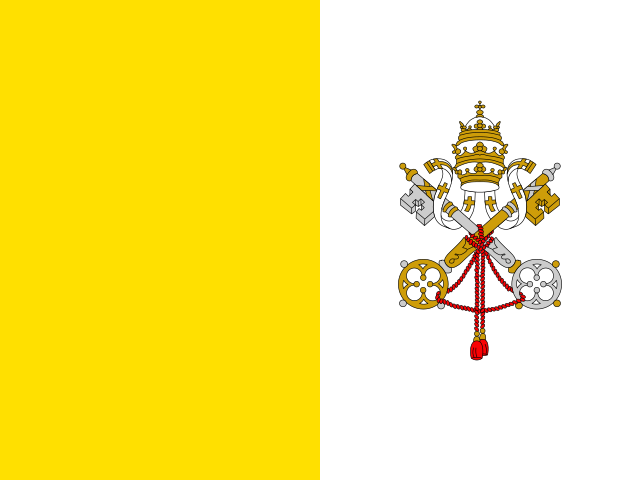
Issuer: Papal States
Ruler: Pius VI
Currency:
(1534—1835)
Demonetized: Yes
Material
References
KM: #Click to copy to clipboard1240
Numista: #41989
Obverse
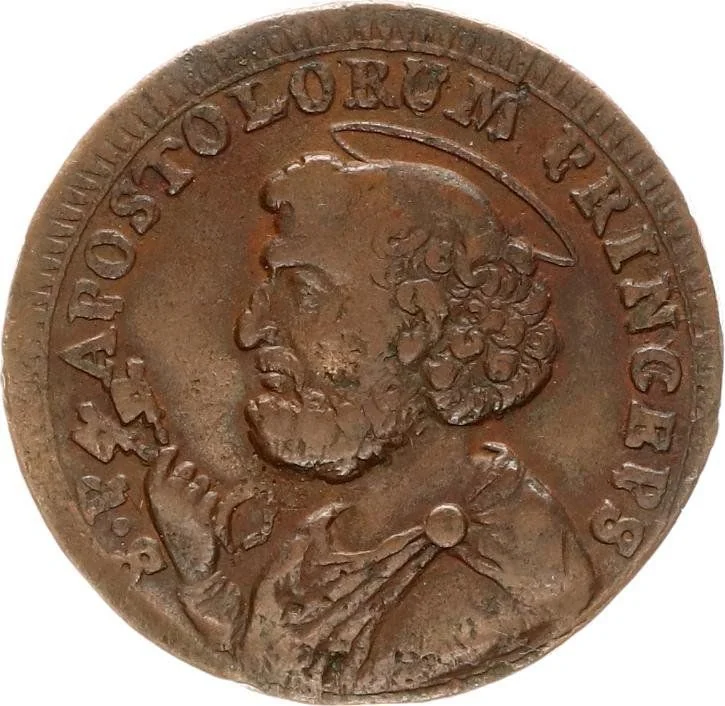
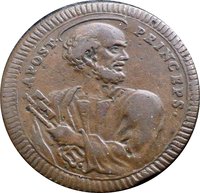
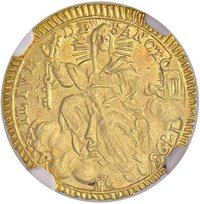
Description:
St. Peter holding keys, facing left.
Inscription:
S·P APOSTOLORVM PRINCEPS
Script: Latin
Engraver: Tommaso Mercandetti
Reverse
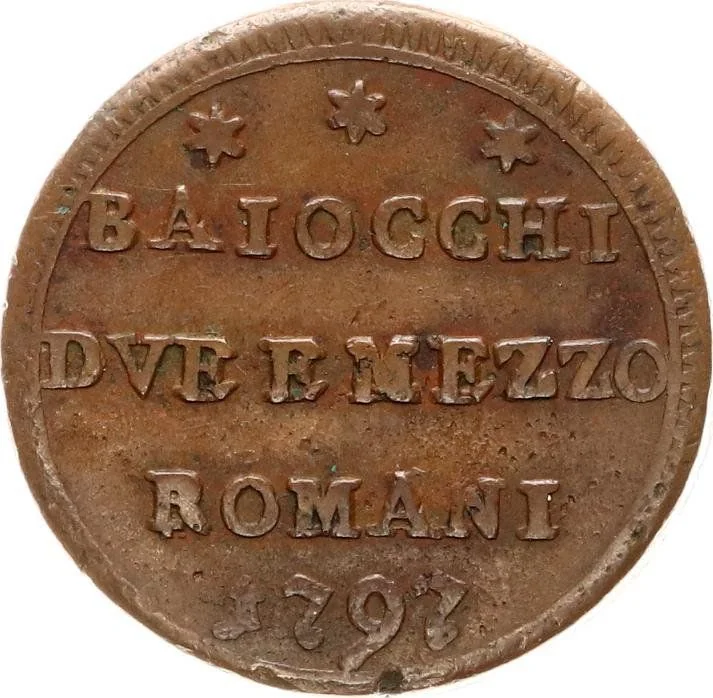
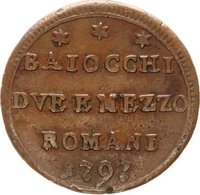
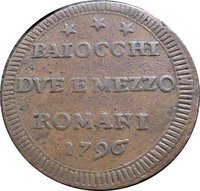
Description:
Value and date under three stars.
Inscription:
BAIOCCHI
DVE E MEZZO
ROMANI
1797
DVE E MEZZO
ROMANI
1797
Script: Latin
Engraver: Tommaso Mercandetti
Edge
Plain
Categories
| Person> Religious figure |
| Mustache/Beard |
Mints
| Name | Mark |
|---|---|
| Rome | — |
Mintings
| Year | Mint Mark | Mintage | Quality | Collection |
|---|---|---|---|---|
| 1796 | — | — | ||
| 1797 | — | — |
Historical background
In 1796, the Papal States found itself in a precarious monetary situation, caught between a legacy of medieval complexity and the pressures of impending war. The state's currency system was fragmented and archaic, with a multitude of coins in circulation from various Italian and European mints, alongside locally issued scudi, baiochi, and quattrini. This lack of standardization created confusion in trade and public finance, while the papal government, under Pope Pius VI, struggled with chronic budgetary deficits. These shortfalls were exacerbated by a reliance on outdated tax farms and the costs of maintaining temporal sovereignty, leading to repeated debasements of coinage to raise short-term revenue, which further eroded public trust in the currency.
The year 1796 marked a direct crisis, as Napoleon Bonaparte's victorious Italian Campaign swept through northern Italy, bringing the French Revolutionary armies to the borders of the Papal States. The Treaty of Tolentino in February 1797 would formalize the crisis, but throughout 1796, the threat was immediate and financial. The papal treasury was drained to fund urgent military mobilization and fortifications, while Napoleon imposed massive war indemnities and the seizure of precious metals and artistic treasures to fund his campaign. This external looting, combined with internal panic, precipitated a severe liquidity crisis, as specie (gold and silver coin) was hoarded or extracted from the economy.
Consequently, the monetary landscape of 1796 was one of destabilization and anticipation of collapse. The intrinsic value of circulating coinage became highly volatile, and the state's ability to manage its currency evaporated under military duress. The situation laid bare the economic vulnerabilities of the theocratic state, whose financial structures were ill-equipped to handle the shock of modern warfare and revolutionary politics. The events of this year directly paved the way for the formal French occupation of Rome in 1798, the proclamation of a Roman Republic, and the complete dissolution of the Papal States' monetary autonomy for a period.
The year 1796 marked a direct crisis, as Napoleon Bonaparte's victorious Italian Campaign swept through northern Italy, bringing the French Revolutionary armies to the borders of the Papal States. The Treaty of Tolentino in February 1797 would formalize the crisis, but throughout 1796, the threat was immediate and financial. The papal treasury was drained to fund urgent military mobilization and fortifications, while Napoleon imposed massive war indemnities and the seizure of precious metals and artistic treasures to fund his campaign. This external looting, combined with internal panic, precipitated a severe liquidity crisis, as specie (gold and silver coin) was hoarded or extracted from the economy.
Consequently, the monetary landscape of 1796 was one of destabilization and anticipation of collapse. The intrinsic value of circulating coinage became highly volatile, and the state's ability to manage its currency evaporated under military duress. The situation laid bare the economic vulnerabilities of the theocratic state, whose financial structures were ill-equipped to handle the shock of modern warfare and revolutionary politics. The events of this year directly paved the way for the formal French occupation of Rome in 1798, the proclamation of a Roman Republic, and the complete dissolution of the Papal States' monetary autonomy for a period.
⭐ Rare