

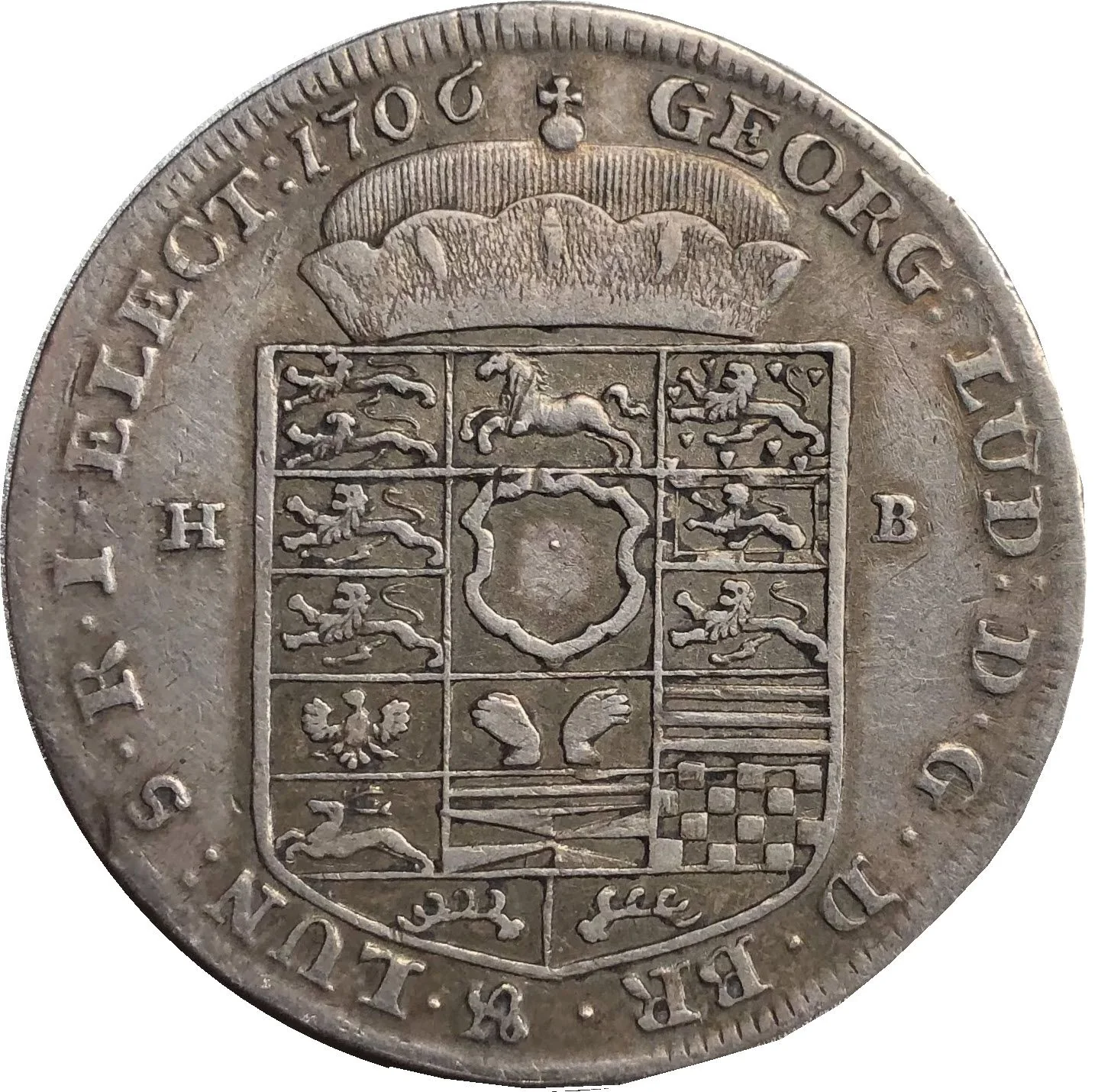

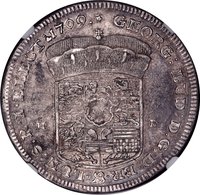
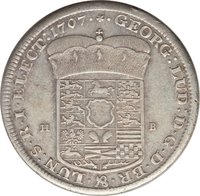
Obverse
Description:
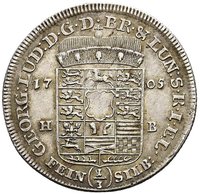
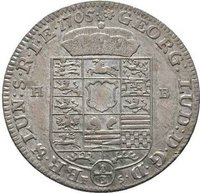
Crest dividing initials, surrounded by legend ending in date.
Inscription:
GEORG: LUD : D . G . D . BR . & LUN: S . R . I . ELECT:1706
HB
HB
Script: Latin
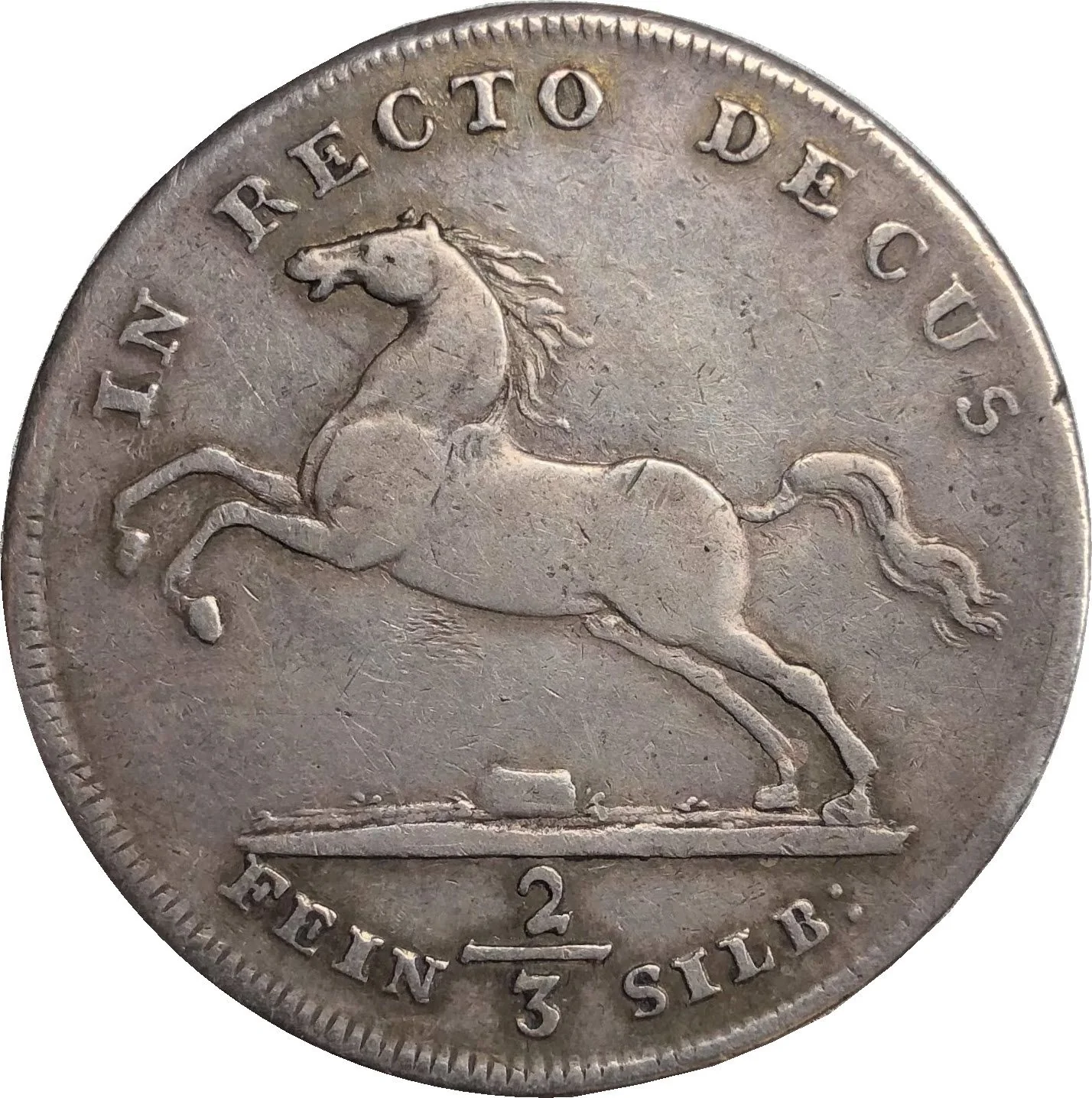
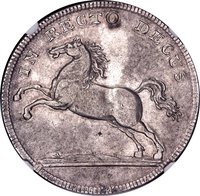
Reverse
Description:
Leaping horse left, legend above, value below.
Inscription:
IN RECTO DECUS
2/3
FEIN SILB:
2/3
FEIN SILB:
Script: Latin
Edge
Reeded.
Mints
| Name | Mark |
|---|---|
| Clausthal | — |
| Zellerfeld | — |
Mintings
| Year | Mint Mark | Mintage | Quality | Collection |
|---|---|---|---|---|
| 1705 | — | — | ||
| 1706 | — | — | ||
| 1707 | — | — | ||
| 1708 | — | — | ||
| 1709 | — | — | ||
| 1710 | — | — | ||
| 1711 | — | — |
Historical background
In 1705, the currency situation in the Duchy of Brunswick-Lüneburg, specifically the Principality of Calenberg (with its capital in Hanover), was characterized by severe instability and complexity. The region was part of the fragmented Holy Roman Empire, where numerous states minted their own coins, leading to a chaotic circulation of diverse domestic and foreign currencies. The primary accounting unit was the Thaler, but everyday transactions were conducted in a confusing array of smaller denominations like Mariengroschen and Pfennige, whose values relative to the Thaler fluctuated wildly between territories.
This monetary fragmentation was exacerbated by the deliberate debasement of coinage, a common practice for rulers needing to finance state expenditures, notably the military campaigns of the War of the Spanish Succession (1701-1714). Elector George Louis (the future King George I of Great Britain), as ruler of Calenberg-Hannover, faced immense fiscal pressure from his involvement in this conflict. To raise funds, the state often reduced the precious metal content in coins, leading to inflation, loss of public trust, and the hoarding of older, higher-value coins (Gresham's Law).
Consequently, the year 1705 fell within a period of significant economic strain for the populace. Trade was hindered by uncertainty over exchange rates, and prices were unstable. While a comprehensive monetary reform was urgently needed, major stabilizing measures for Hanover would only materialize later, notably with the Konventionsmünzfuß of 1753. Thus, in 1705, the currency system remained a patchwork of depreciating coins, causing practical difficulties for commerce and daily life within the principality.
This monetary fragmentation was exacerbated by the deliberate debasement of coinage, a common practice for rulers needing to finance state expenditures, notably the military campaigns of the War of the Spanish Succession (1701-1714). Elector George Louis (the future King George I of Great Britain), as ruler of Calenberg-Hannover, faced immense fiscal pressure from his involvement in this conflict. To raise funds, the state often reduced the precious metal content in coins, leading to inflation, loss of public trust, and the hoarding of older, higher-value coins (Gresham's Law).
Consequently, the year 1705 fell within a period of significant economic strain for the populace. Trade was hindered by uncertainty over exchange rates, and prices were unstable. While a comprehensive monetary reform was urgently needed, major stabilizing measures for Hanover would only materialize later, notably with the Konventionsmünzfuß of 1753. Thus, in 1705, the currency system remained a patchwork of depreciating coins, causing practical difficulties for commerce and daily life within the principality.
✨ Legendary