

1 goldgulden – Reuss-Gera
Add to wishlist
Germany
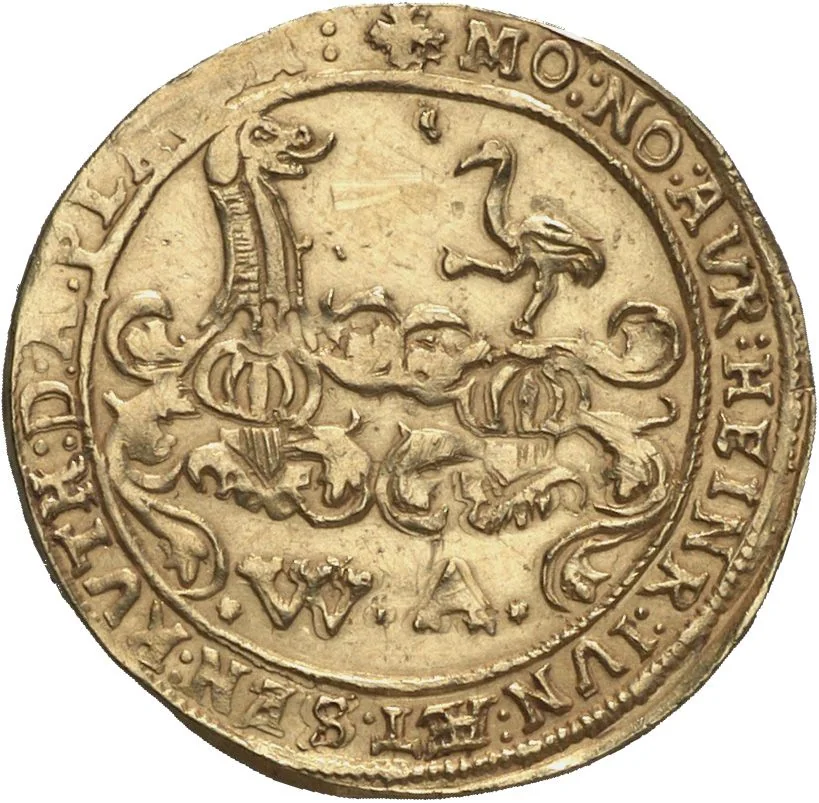
Obverse
Description:
Dog-helmet and crane-helmet.
Inscription:
MO:NO:AVR:HEINR:IVN:ÆT.SEN:RVTH:D:A:PLAVEN
.W.A.
.W.A.
Script: Latin
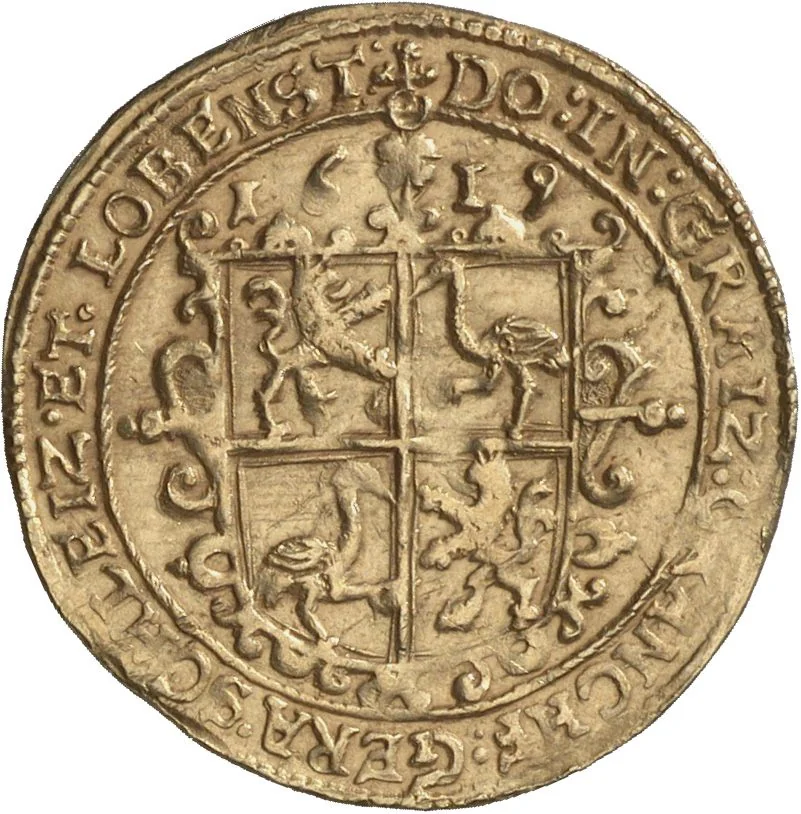
Reverse
Description:
Quadruple arms.
Inscription:
DO:IN:GRAIZ:CRANCHF·GERA·SCHLEIZ·ET·LOBENST
16 19
16 19
Script: Latin
Edge
Mints
| Name | Mark |
|---|---|
| Saalfeld | — |
Mintings
| Year | Mint Mark | Mintage | Quality | Collection |
|---|---|---|---|---|
| 1619 | — | — |
Historical background
In 1619, the small Ernestine duchy of Reuss-Gera, located in the fractious political landscape of Thuringia, operated within a complex and fragmented monetary system. Like most states within the Holy Roman Empire, it did not possess exclusive rights to mint its own coinage. Instead, it participated in the overarching regulatory framework of the Reichsmünzordnung (Imperial Coinage Ordinance), which aimed to standardize currency across the Empire's hundreds of territories. In practice, however, the system was strained, and regional monetary blocs, particularly the Kreis (Imperial Circle) to which Reuss-Gera belonged, held significant influence over the actual coins in circulation.
The currency situation on the ground was one of considerable confusion. While larger, standardized silver coins like Reichsthaler and Gulden were used for major transactions and state finance, daily commerce was conducted with a bewildering variety of smaller coins. These included locally minted Groschen and Pfennige, as well as coins from neighboring Saxon and Bohemian mints that flowed across borders. The onset of the Thirty Years' War in 1618 dramatically exacerbated existing pressures, as warring powers began to debase coinage to fund their armies, leading to the early stages of the Kipper- und Wipperzeit—a period of severe currency manipulation and inflation.
For the rulers of Reuss-Gera, monetary policy was a constant balancing act between asserting sovereign prerogative, adhering to imperial and Kreis agreements, and managing the practical economic needs of their territory. The year 1619 thus represents a precarious moment just before the full monetary chaos of the war would descend, with the duchy’s economy reliant on a fragile patchwork of imperial standards, regional agreements, and circulating foreign coinage that was increasingly vulnerable to devaluation and instability.
The currency situation on the ground was one of considerable confusion. While larger, standardized silver coins like Reichsthaler and Gulden were used for major transactions and state finance, daily commerce was conducted with a bewildering variety of smaller coins. These included locally minted Groschen and Pfennige, as well as coins from neighboring Saxon and Bohemian mints that flowed across borders. The onset of the Thirty Years' War in 1618 dramatically exacerbated existing pressures, as warring powers began to debase coinage to fund their armies, leading to the early stages of the Kipper- und Wipperzeit—a period of severe currency manipulation and inflation.
For the rulers of Reuss-Gera, monetary policy was a constant balancing act between asserting sovereign prerogative, adhering to imperial and Kreis agreements, and managing the practical economic needs of their territory. The year 1619 thus represents a precarious moment just before the full monetary chaos of the war would descend, with the duchy’s economy reliant on a fragile patchwork of imperial standards, regional agreements, and circulating foreign coinage that was increasingly vulnerable to devaluation and instability.
✨ Legendary