

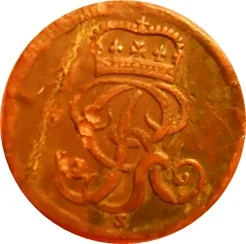
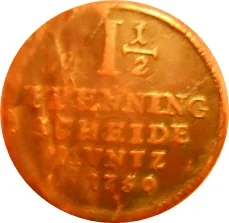
1½ Pfennig – Brunswick-Lüneburg-Calenberg-Hannover
Germany

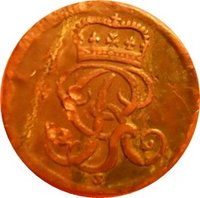
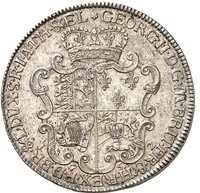
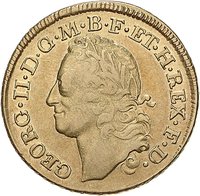
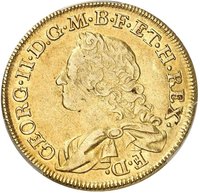
Obverse
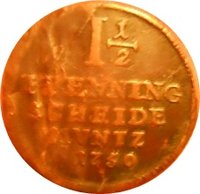
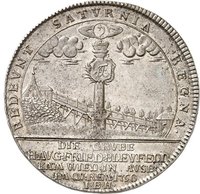
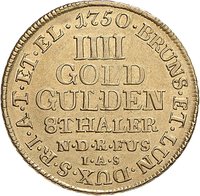
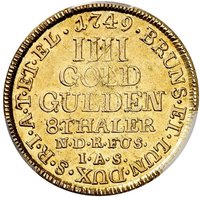
Reverse
Edge
Mints
| Name | Mark |
|---|---|
| Clausthal | — |
Mintings
| Year | Mint Mark | Mintage | Quality | Collection |
|---|---|---|---|---|
| 1750 | — | — |
Historical background
In 1750, the currency situation in the Duchy of Brunswick-Lüneburg, specifically the Principality of Calenberg (with its capital in Hanover), was complex and fragmented, reflecting the broader monetary disarray of the Holy Roman Empire. The territory did not have a uniform, sovereign coinage system. Instead, circulation was dominated by the Reichsthaler, a theoretical imperial standard, and its fractional coins (Gute Groschen, Mariengroschen), but these existed alongside a multitude of physical coins from other German states and foreign currencies like French Louis d'or and Dutch ducats. The value of money was not intrinsic but based on constantly fluctuating conversion rates (Kurant vs. Species), creating a confusing and unstable environment for trade and daily life.
This confusion was exacerbated by the personal union with Great Britain, as the Elector of Hanover was also King George II of England. While this connection brought international commerce, it did not simplify the domestic monetary landscape. The government in Hanover struggled to control the circulation of debased coins and the outflow of full-weight silver specie. A key reference point was the Conventionsgeld system, established by the 1753 Leipzig Mint Treaty, which Hanover would soon join, aiming to standardize the Reichsthaler at 1/10 of a Cologne silver mark. However, in 1750, this standardization was still being implemented and contested.
Consequently, merchants, officials, and the public had to navigate a daily reality of weighing coins, consulting exchange tables, and dealing with the frequent devaluation of small change. The state's minting activity was limited and often reactive, unable to fully impose order. The monetary situation was therefore one of persistent uncertainty, acting as a drag on economic development and presenting an ongoing administrative challenge for the Hanoverian government, which sought greater control over its fiscal sovereignty in the years leading into the Seven Years' War.
This confusion was exacerbated by the personal union with Great Britain, as the Elector of Hanover was also King George II of England. While this connection brought international commerce, it did not simplify the domestic monetary landscape. The government in Hanover struggled to control the circulation of debased coins and the outflow of full-weight silver specie. A key reference point was the Conventionsgeld system, established by the 1753 Leipzig Mint Treaty, which Hanover would soon join, aiming to standardize the Reichsthaler at 1/10 of a Cologne silver mark. However, in 1750, this standardization was still being implemented and contested.
Consequently, merchants, officials, and the public had to navigate a daily reality of weighing coins, consulting exchange tables, and dealing with the frequent devaluation of small change. The state's minting activity was limited and often reactive, unable to fully impose order. The monetary situation was therefore one of persistent uncertainty, acting as a drag on economic development and presenting an ongoing administrative challenge for the Hanoverian government, which sought greater control over its fiscal sovereignty in the years leading into the Seven Years' War.
✨ Legendary