

10 Kreuzers – Landgraviate of Hesse-Darmstadt
Context
Years: 1726–1733
Issuer: Landgraviate of Hesse-Darmstadt
Ruler: Ernest Louis
Currency:
(1568—1805)
Demonetized: Yes
Material
References
KM: #Click to copy to clipboard148
Numista: #40346
Value
Bullion value: $6.36
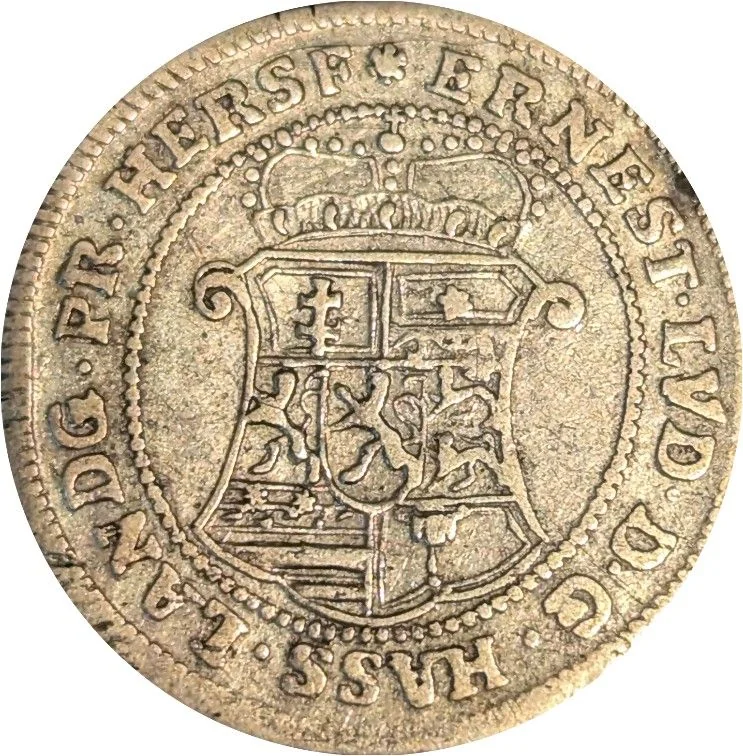
Obverse
Description:
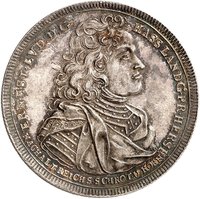
Crowned coat of arms with surrounding legend.
Inscription:
ERNEST. LVD. D. G. HASS. LANDG. PR. HERSF
Script: Latin
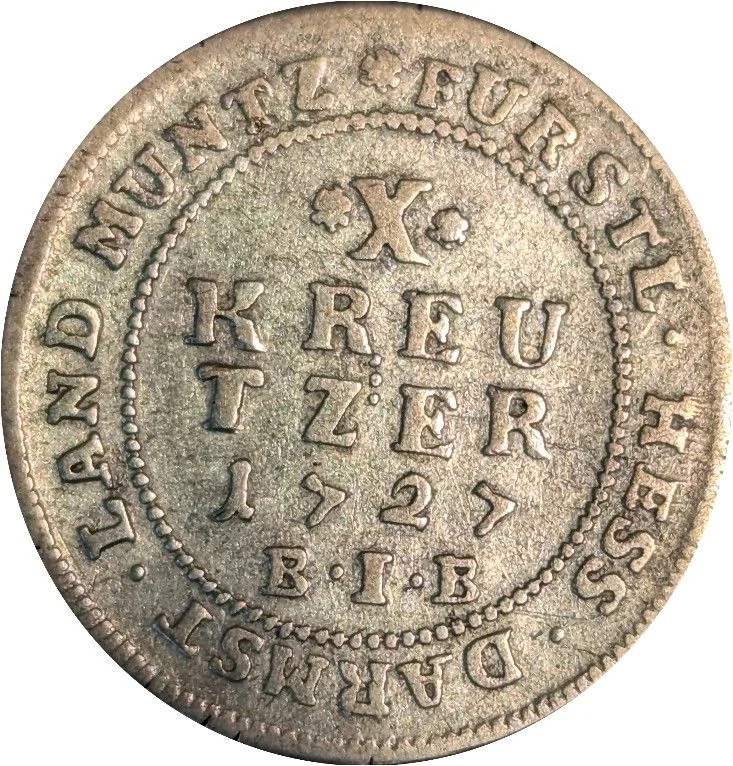
Reverse
Description:
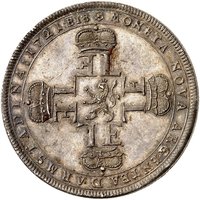
Centered name and date, encircled legend.
Inscription:
FURSTL.HESS.DARMST.LAND.MUNTZ
*X*
KREU
TZER
1727
B.I.B
*X*
KREU
TZER
1727
B.I.B
Script: Latin
Edge
Mints
| Name | Mark |
|---|---|
| Darmstadt | — |
Mintings
| Year | Mint Mark | Mintage | Quality | Collection |
|---|---|---|---|---|
| 1726 | — | — | ||
| 1727 | — | — | ||
| 1728 | — | — | ||
| 1729 | — | — | ||
| 1733 | — | — |
Historical background
In 1726, the currency situation in the Landgraviate of Hesse-Darmstadt was characterized by fragmentation and instability, common across the Holy Roman Empire. The landgraviate did not have a monopoly on coinage; multiple authorities within its borders, including the landgrave himself, the nobility, and ecclesiastical institutions, exercised minting rights. This resulted in a circulation of numerous different coins, not only local issues but also those from neighboring states and even debased or counterfeit pieces, making trade and taxation administratively difficult.
Economically, the period was marked by the aftermath of the War of the Spanish Succession and the burdens of maintaining a court, which strained public finances. Landgrave Ernst Ludwig, a noted patron of the arts and sciences, faced significant debt. While not engaging in the severe "Kipper und Wipper" debasement crisis of the previous century, there was persistent pressure to derive seigniorage profit from minting. This often meant issuing coins with slightly less intrinsic silver or gold content than their face value, a practice that eroded public trust in the currency and complicated commerce with trading partners.
Consequently, the monetary system operated on a dual track: official Reichsthaler and Gulden denominations, as nominally defined by Imperial ordinances, existed alongside a daily reality of fluctuating exchange rates between countless specific coins. Merchants and money changers were essential to navigate this complex landscape. The situation in 1726 was one of managed confusion, highlighting the landgraviate's limited sovereign control over its own economy and setting the stage for future, though incremental, attempts at monetary standardization later in the 18th century.
Economically, the period was marked by the aftermath of the War of the Spanish Succession and the burdens of maintaining a court, which strained public finances. Landgrave Ernst Ludwig, a noted patron of the arts and sciences, faced significant debt. While not engaging in the severe "Kipper und Wipper" debasement crisis of the previous century, there was persistent pressure to derive seigniorage profit from minting. This often meant issuing coins with slightly less intrinsic silver or gold content than their face value, a practice that eroded public trust in the currency and complicated commerce with trading partners.
Consequently, the monetary system operated on a dual track: official Reichsthaler and Gulden denominations, as nominally defined by Imperial ordinances, existed alongside a daily reality of fluctuating exchange rates between countless specific coins. Merchants and money changers were essential to navigate this complex landscape. The situation in 1726 was one of managed confusion, highlighting the landgraviate's limited sovereign control over its own economy and setting the stage for future, though incremental, attempts at monetary standardization later in the 18th century.
⭐ Rare