

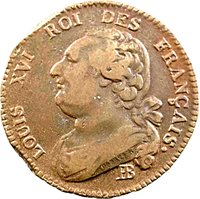
Obverse
Description:
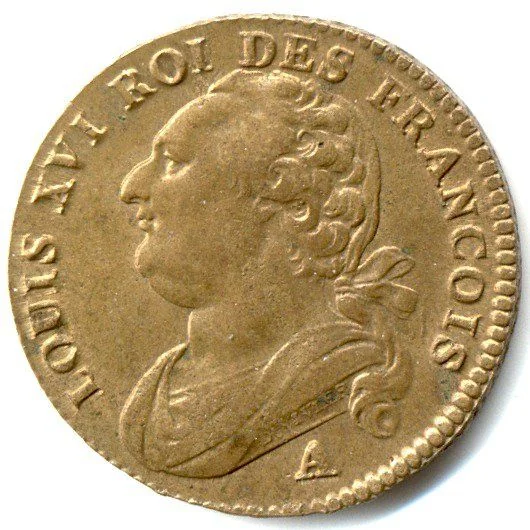
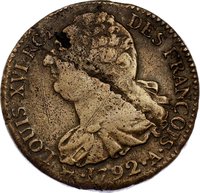
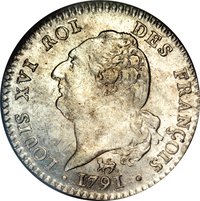
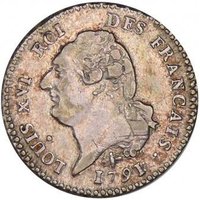
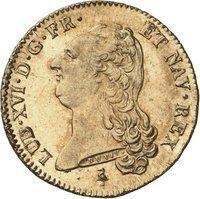
Louis XVI bust facing left, draped and bareheaded, hair tied with a ribbon. DUVIVIER on bust edge; workshop letter below.
Inscription:
LOUIS XVI ROI DES FRANCOIS
DUVIVIER
A
DUVIVIER
A
Script: Latin
Engraver: Pierre-Benjamin Duvivier
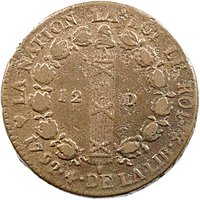
Reverse
Description:
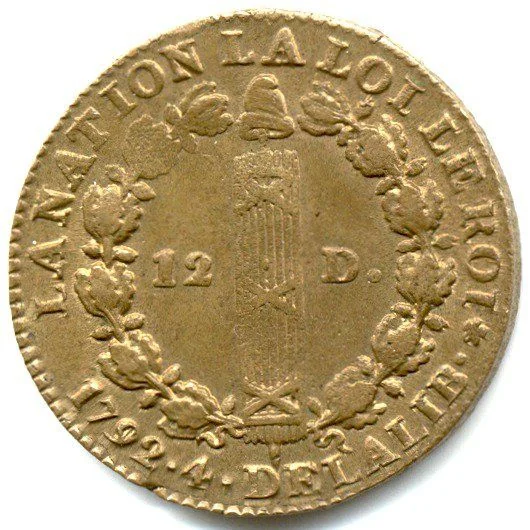
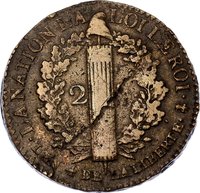
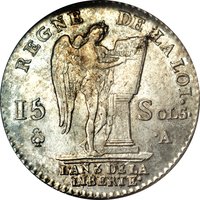
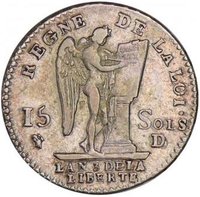
Fasces with Phrygian cap between oak branches; 1 2 on each side.
Inscription:
LA NATION LA LOI LE ROI
12 D•
1792•4• DE LA LIB
12 D•
1792•4• DE LA LIB
Script: Latin
Engraver: Pierre-Benjamin Duvivier
Edge
Plain
Mints
Mintings
| Year | Mint Mark | Mintage | Quality | Collection |
|---|---|---|---|---|
| 1791 | ○A | — | ||
| 1791 | ○AA | — | ||
| 1791 | ○T | 194,100 | ||
| 1791 | Å | — | ||
| 1791 | Ḁ | — | ||
| 1791 | A | — | ||
| 1791 | A○ | — | ||
| 1791 | AA | 1,254,480 | ||
| 1791 | B | 5,625,904 | ||
| 1791 | BB | 198,750 | ||
| 1791 | D | 1,645,451 | ||
| 1791 | I | 1,202,820 | ||
| 1791 | K | 3,622,900 | ||
| 1791 | L | 250,372 | ||
| 1791 | M | 2,192,240 | ||
| 1791 | MA | — | ||
| 1791 | N | 758,439 | ||
| 1791 | Q | 100,729 | ||
| 1791 | R | 141,250 | ||
| 1791 | T | 183,220 | ||
| 1791 | T○ | — | ||
| 1791 | W | 539,275 | ||
| 1792 | ○W | — | ||
| 1792 | N | 1,980,384 | ||
| 1792 | Q | 3,038,396 | ||
| 1792 | R | 3,076,132 | ||
| 1792 | T | — | ||
| 1792 | T○ | 1,570,128 | ||
| 1792 | W | 366,450 | ||
| 1792 | W○ | 733,320 | ||
| 1792 | ○○D | — | ||
| 1792 | ○A | — | ||
| 1792 | ○D | — | ||
| 1792 | ○I | — | ||
| 1792 | ○T | — | ||
| 1792 | Å | — | ||
| 1792 | Ḁ | — | ||
| 1792 | A | 7,828,080 | ||
| 1792 | A○ | — | ||
| 1792 | AA | 2,799,737 | ||
| 1792 | B | 1,784,640 | ||
| 1792 | BB | — | ||
| 1792 | D | 6,386,695 | ||
| 1792 | D○ | 4,019,640 | ||
| 1792 | H | 322,958 | ||
| 1792 | I | 2,257,636 | ||
| 1792 | I○ | 698,404 | ||
| 1792 | K | 8,278,006 | ||
| 1792 | L | 314,194 | ||
| 1792 | M | 2,620,523 | ||
| 1792 | MA | 1,522,622 | ||
| 1792 | 🐄 | 696,167 | ||
| 1793 | A | 12,449,940 | ||
| 1793 | A○ | — | ||
| 1793 | B | — | ||
| 1793 | D | 1,603,120 | ||
| 1793 | D○ | 3,837,970 | ||
| 1793 | K | 3,757,182 | ||
| 1793 | L | 134,056 | ||
| 1793 | M | 79,080 | ||
| 1793 | ○A | — | ||
| 1793 | ○MA○ | — | ||
| 1793 | Å | — | ||
| 1793 | Ḁ | — | ||
| 1793 | MA | — | ||
| 1793 | N | 327,240 | ||
| 1793 | R | 414,845 | ||
| 1793 | T | 1,820,840 | ||
| 1793 | T○ | — | ||
| 1793 | W | 1,878,837 | ||
| 1793 | W○ | — | ||
| 1793 | 🐄 | 1,737,972 |
Historical background
In 1791, France was in the throes of a profound financial and monetary crisis, the roots of which stretched back to the bankrupt monarchy of the Ancien Régime. The revolutionary government, the National Constituent Assembly, inherited a colossal debt and a severe shortage of specie (gold and silver coin). To address this, they had famously nationalized church lands in 1789, using them as backing for a new paper currency: the assignat. Initially conceived as interest-bearing bonds, these were transformed into mandatory legal tender in 1790, flooding the economy with paper money to pay creditors and fund the Revolution.
The situation by 1791 was one of dangerous transition and growing instability. While the assignats initially restored some liquidity and facilitated the sale of biens nationaux (nationalized lands), their over-issuance had already begun to trigger inflation and a loss of public confidence. A critical divide emerged between those who saw the paper currency as a necessary revolutionary tool and those, like the more conservative financiers, who demanded a return to sound metallic currency. The Assembly's policies were contradictory, attempting to enforce the assignat's acceptance while also passing decrees that inadvertently highlighted its weakness, such as requiring taxes to be paid in assignats, which then accelerated their circulation and depreciation.
Thus, the currency landscape of 1791 was a precarious experiment on the brink of failure. The assignat was becoming unmoored from its land-backed promise, as the sheer volume in circulation far exceeded the value of the properties for sale. This early stage of depreciation sowed economic uncertainty, fueled social unrest over rising prices, and set the stage for the catastrophic hyperinflation that would engulf France in the coming years. The monetary policy was not just an economic issue but a deeply political one, reflecting the revolutionary struggle to create a new order while battling the financial ghosts of the old.
The situation by 1791 was one of dangerous transition and growing instability. While the assignats initially restored some liquidity and facilitated the sale of biens nationaux (nationalized lands), their over-issuance had already begun to trigger inflation and a loss of public confidence. A critical divide emerged between those who saw the paper currency as a necessary revolutionary tool and those, like the more conservative financiers, who demanded a return to sound metallic currency. The Assembly's policies were contradictory, attempting to enforce the assignat's acceptance while also passing decrees that inadvertently highlighted its weakness, such as requiring taxes to be paid in assignats, which then accelerated their circulation and depreciation.
Thus, the currency landscape of 1791 was a precarious experiment on the brink of failure. The assignat was becoming unmoored from its land-backed promise, as the sheer volume in circulation far exceeded the value of the properties for sale. This early stage of depreciation sowed economic uncertainty, fueled social unrest over rising prices, and set the stage for the catastrophic hyperinflation that would engulf France in the coming years. The monetary policy was not just an economic issue but a deeply political one, reflecting the revolutionary struggle to create a new order while battling the financial ghosts of the old.
Series: 1791 France circulation coins

🌱 Very Common