

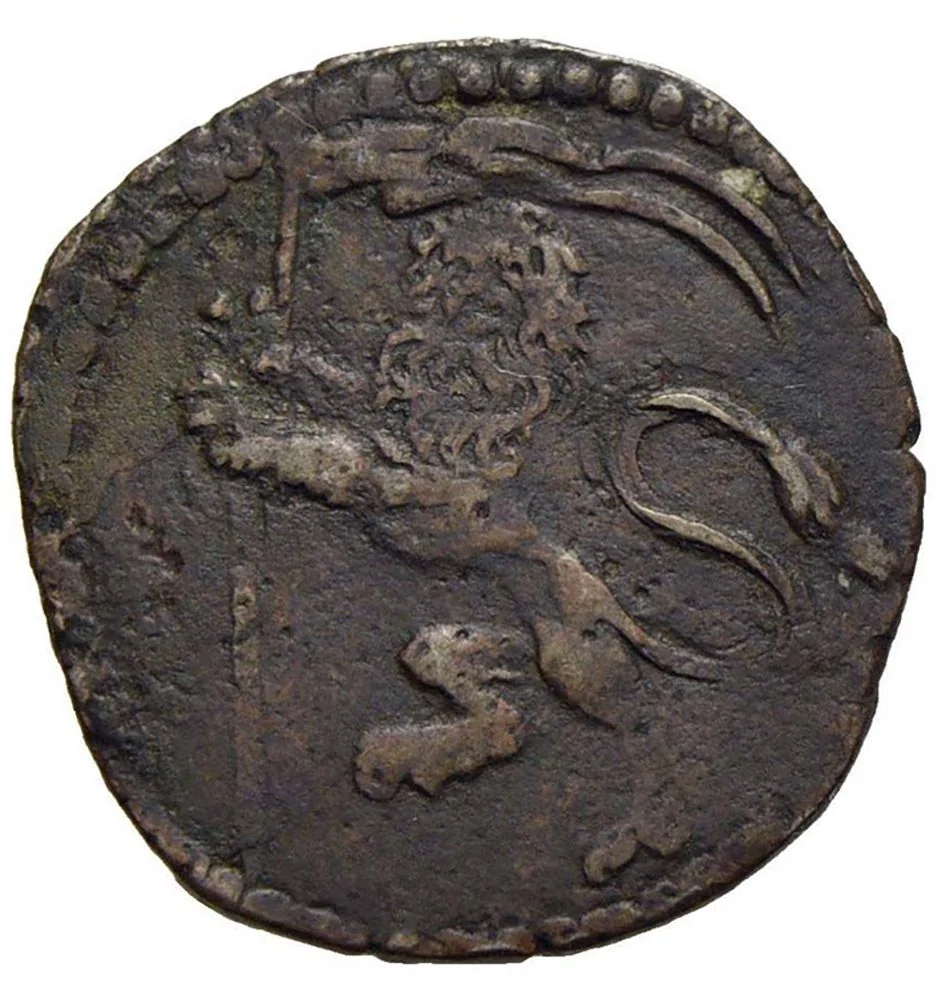
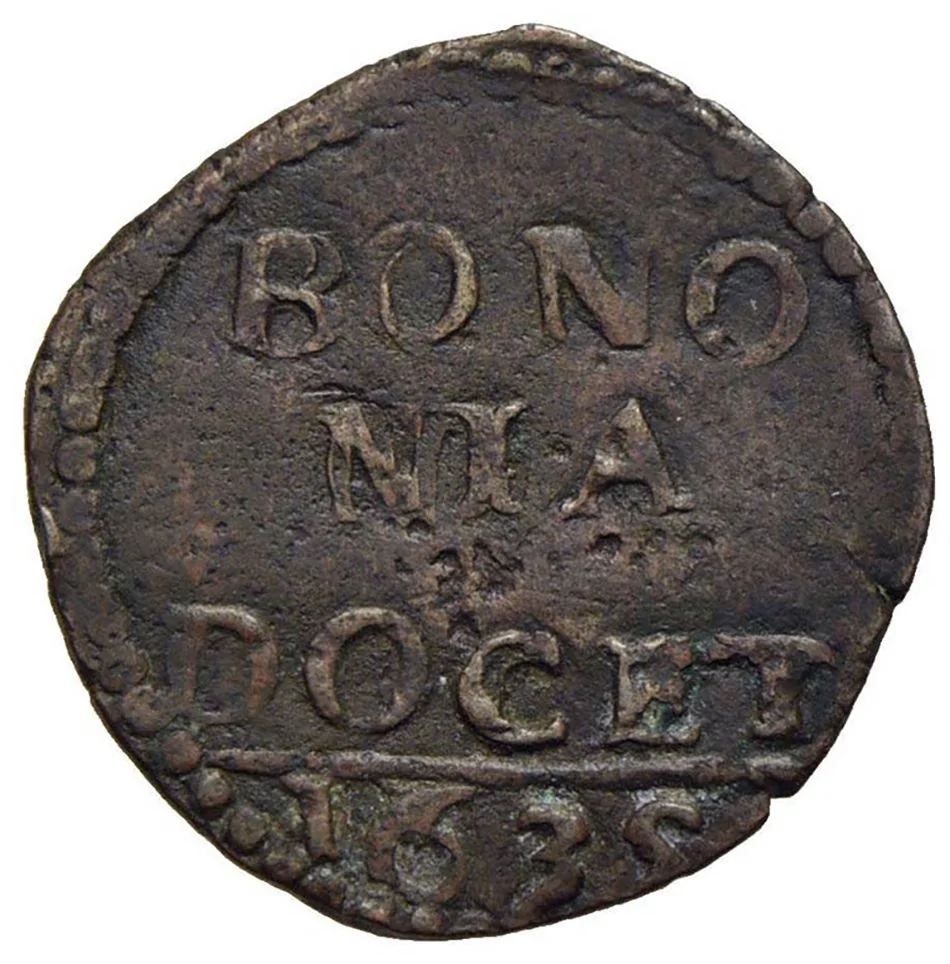
1 Quattrino – Bologna
Italy
Context
Years: 1624–1643
Country: Italy 
Issuer: Bologna
Ruler: Urban VIII
Currency:
(1534—1835)
Demonetized: Yes
Material
Diameter: 20 mm
Weight: 2.6 g
Shape: Irregular round
Composition: Copper
Magnetic: No
Alignment: Coin alignment
flip
References
KM: #Click to copy to clipboard32
Numista: #399588
Obverse
Description:
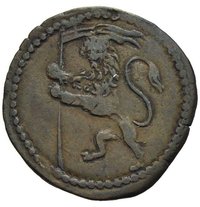
Rampant lion holding a banner.
Reverse
Edge
Plain
Mints
| Name | Mark |
|---|---|
| Bologna | — |
Mintings
| Year | Mint Mark | Mintage | Quality | Collection |
|---|---|---|---|---|
| 1624 | — | — | ||
| 1625 | — | — | ||
| 1626 | — | — | ||
| 1629 | — | — | ||
| 1630 | — | — | ||
| 1633 | — | — | ||
| 1635 | — | — | ||
| 1636 | — | — | ||
| 1638 | — | — | ||
| 1640 | — | — | ||
| 1642 | — | — | ||
| 1643 | — | — |
Historical background
In 1624, Bologna operated within the complex monetary landscape of the Papal States, of which it was a key second city. Officially, the currency system was bimetallic, based on the Papal scudo d’oro (gold scudo) and the giulio and baiocco in silver and billon. However, the reality was one of profound disorder. Decades of debasement by various Italian states and the influx of clipped, worn, and counterfeit foreign coins, especially from neighboring Spanish-controlled Milan, created a chronic shortage of good specie. This led to a widespread practice of merchants and vendors assigning their own premium on transactions with "good" money, effectively creating multiple exchange rates for the same nominal coin.
The city’s authorities, the Senato and the Magistrato delle Monete, were engaged in a constant and losing battle to enforce monetary stability. Their primary tool was the periodic issuance of grida (public edicts) that fixed the legal value of the myriad of circulating coins—from Papal giuli and paoli to Venetian ducatoni and Spanish reales. The grida of 1624 would have been one such attempt, forcefully setting exchange rates and threatening severe penalties for those who refused to accept full-weight coins at face value. Yet, these decrees were often ignored in daily practice, as the intrinsic silver or gold content of a coin remained the true determinant of its value in commerce.
This chaotic environment created significant economic strain, particularly for the lower classes and those on fixed incomes. Wages were often set in nominal amounts, but prices in the marketplace fluctuated according to the perceived quality of the coinage offered, leading to de facto inflation and social tension. Thus, the currency situation in 1624 Bologna was not merely a financial issue but a source of daily friction, undermining trust in both the monetary system and the ability of the papal administration to guarantee one of the fundamental pillars of civic economic life.
The city’s authorities, the Senato and the Magistrato delle Monete, were engaged in a constant and losing battle to enforce monetary stability. Their primary tool was the periodic issuance of grida (public edicts) that fixed the legal value of the myriad of circulating coins—from Papal giuli and paoli to Venetian ducatoni and Spanish reales. The grida of 1624 would have been one such attempt, forcefully setting exchange rates and threatening severe penalties for those who refused to accept full-weight coins at face value. Yet, these decrees were often ignored in daily practice, as the intrinsic silver or gold content of a coin remained the true determinant of its value in commerce.
This chaotic environment created significant economic strain, particularly for the lower classes and those on fixed incomes. Wages were often set in nominal amounts, but prices in the marketplace fluctuated according to the perceived quality of the coinage offered, leading to de facto inflation and social tension. Thus, the currency situation in 1624 Bologna was not merely a financial issue but a source of daily friction, undermining trust in both the monetary system and the ability of the papal administration to guarantee one of the fundamental pillars of civic economic life.
✨ Legendary