

Schelling – Lordship of Reckheim
Belgium
Context
Years: 1612–1619
Country: Belgium 
Issuer: Lordship of Reckheim
Ruler: Matthias
Currency:
(1553—1665)
Demonetized: Yes
Material
Weight: 3.9 g
Silver weight: 3.90 g
Shape: Irregular round
Composition: Silver
Magnetic: No
Technique: Hammered
References
KM: #Click to copy to clipboard11
Numista: #397255
Value
Bullion value: $10.81
Obverse
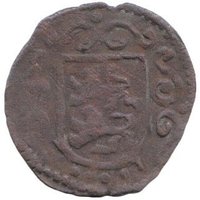
Description:
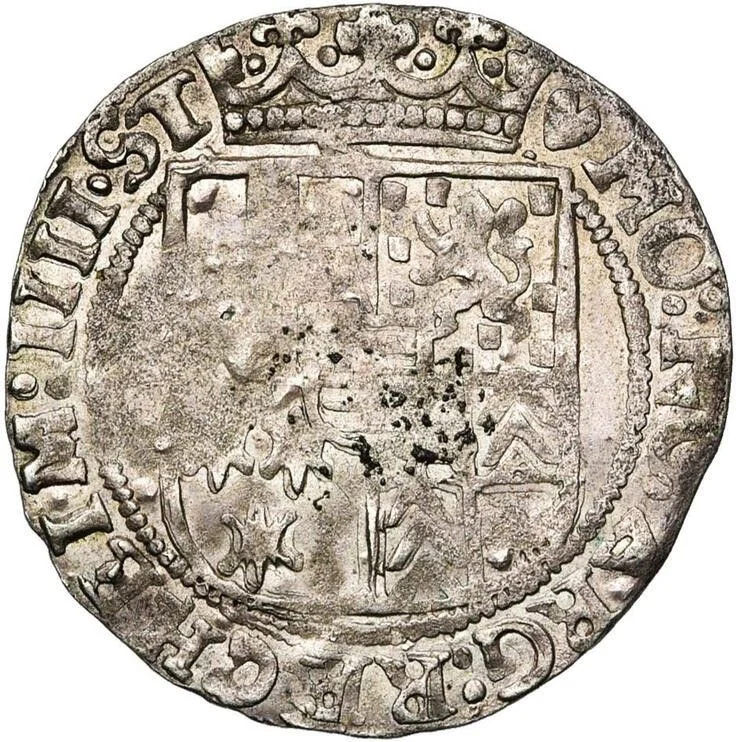
Shield with crown within beaded circle.
Inscription:
MO • NO • ARG • RECHEIM • IIII • ST
Script: Latin
Reverse
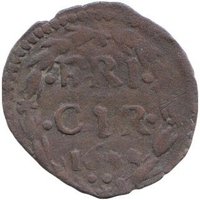
Description:
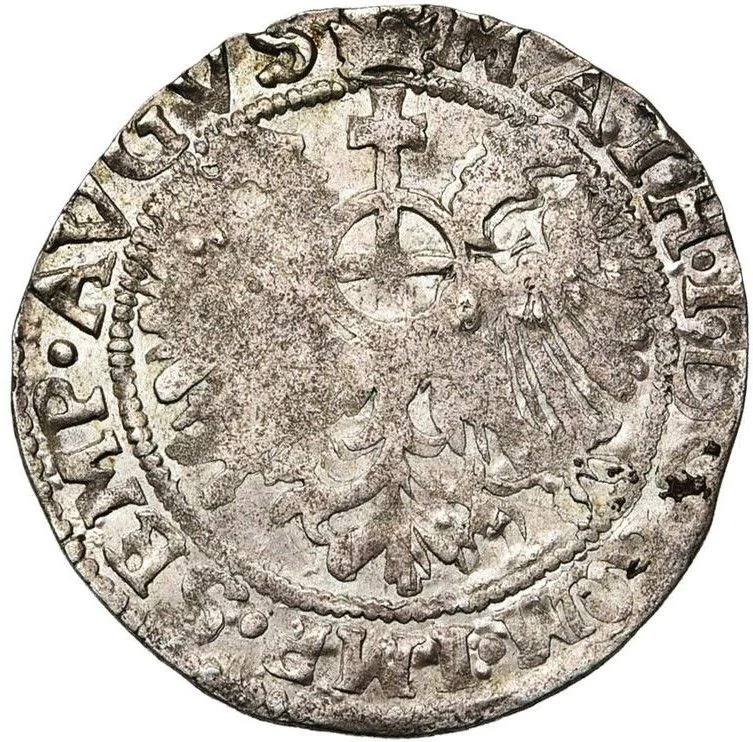
Double-headed eagle clutching an imperial orb.
Inscription:
MATH • I • D • G • ROM • IMP • SEMP • AVGVS
Script: Latin
Edge
Categories
| Symbols> Coat of Arms |
| Symbol> Double-headed eagle |
Mints
| Name | Mark |
|---|---|
| Rekem, Reckheim | — |
Mintings
| Year | Mint Mark | Mintage | Quality | Collection |
|---|---|---|---|---|
| — | — | — |
Historical background
In 1612, the Lordship of Reckheim, a small but strategically located territory within the Holy Roman Empire, operated under a complex and strained monetary system. Officially, it was part of the Reichsthaler zone, bound by imperial ordinances that standardized coinage to facilitate trade across the Empire's fractured political landscape. The theoretical standard was the Reichsthaler, a large silver coin containing approximately 25 grams of fine silver, which was subdivided into 24 Groschen or 288 Pfennigs. However, Reckheim's local economy primarily functioned with a flood of smaller, debased regional coins from neighboring lordships and bishoprics, leading to chronic confusion and disputes over exchange rates.
The currency situation was acutely problematic due to the practice of "Kipper und Wipper" (clipping and swiping), a wave of currency debasement that was beginning to sweep through the German states. Princes and mint lords, often in covert partnerships with mint masters, would issue coins with reduced silver content while mandating their face value remained the same, profiting from the seigniorage. For Reckheim, this meant its borders were assailed by waves of inferior coinage from rival territories, driving good, full-weight Reichsthalers out of circulation (Gresham's Law in action) and causing rampant price inflation for essential goods. The local populace grew deeply distrustful of coinage, often weighing and testing even small coins in daily transactions.
Lord Wilhelm IV von Reckheim faced a dire fiscal dilemma. To meet his rising debts and military expenses, he was tempted to engage in debasement himself by striking his own lightweight coins, a short-term solution that would further erode economic stability. The alternative—enforcing strict currency ordinances and refusing bad coins—risked stifling what little trade remained and provoking conflict with powerful neighboring debasers. Thus, in 1612, Reckheim's currency was a microcosm of the Empire's wider decay: nominally governed by imperial law, but in reality a battleground of competitive devaluation, sowing economic hardship and social unrest on the eve of the devastating Thirty Years' War.
The currency situation was acutely problematic due to the practice of "Kipper und Wipper" (clipping and swiping), a wave of currency debasement that was beginning to sweep through the German states. Princes and mint lords, often in covert partnerships with mint masters, would issue coins with reduced silver content while mandating their face value remained the same, profiting from the seigniorage. For Reckheim, this meant its borders were assailed by waves of inferior coinage from rival territories, driving good, full-weight Reichsthalers out of circulation (Gresham's Law in action) and causing rampant price inflation for essential goods. The local populace grew deeply distrustful of coinage, often weighing and testing even small coins in daily transactions.
Lord Wilhelm IV von Reckheim faced a dire fiscal dilemma. To meet his rising debts and military expenses, he was tempted to engage in debasement himself by striking his own lightweight coins, a short-term solution that would further erode economic stability. The alternative—enforcing strict currency ordinances and refusing bad coins—risked stifling what little trade remained and provoking conflict with powerful neighboring debasers. Thus, in 1612, Reckheim's currency was a microcosm of the Empire's wider decay: nominally governed by imperial law, but in reality a battleground of competitive devaluation, sowing economic hardship and social unrest on the eve of the devastating Thirty Years' War.
✨ Legendary