

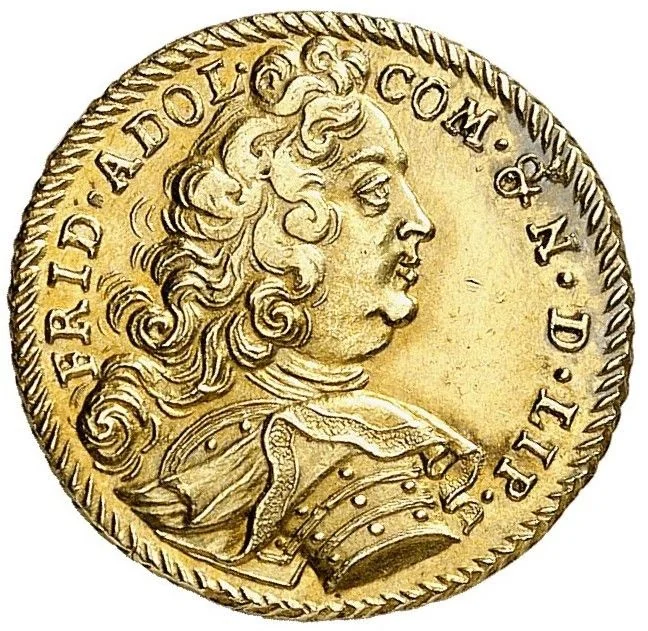
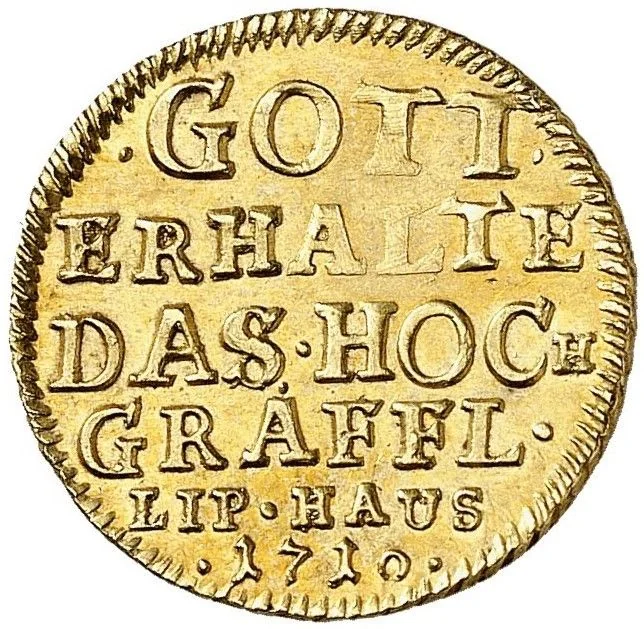
1 Ducat (Birthday) – County of Lippe-Detmold
Circulating commemorative coins
Commemoration: 43. Birthday
Context
Material
References
KM: #Click to copy to clipboard119
Numista: #394764
Value
Bullion value: $574.47
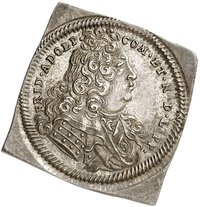
Obverse
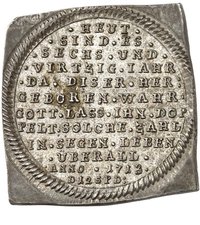
Reverse
Edge
Mints
| Name | Mark |
|---|---|
| Detmold | — |
Mintings
| Year | Mint Mark | Mintage | Quality | Collection |
|---|---|---|---|---|
| 1710 | — | — |
Historical background
In 1710, the County of Lippe-Detmold, like many small German states within the Holy Roman Empire, faced a complex and challenging currency situation. The region operated within a fragmented monetary system where the official currency, the Reichsthaler, coexisted with a plethora of circulating coins from neighboring states and older, debased local issues. Count Friedrich Adolf (r. 1697–1718) governed a territory still recovering from the economic devastation of the Thirty Years' War and subsequent conflicts, which placed constant fiscal strain on the county's finances.
The core problem was the chronic shortage of high-value, "good" coinage for state expenses and trade, contrasted with an influx of inferior, small-denomination coins used in everyday life. This often led to the practice of Kipper- und Wipperzeit tactics, where authorities might debase coinage (reducing precious metal content) to generate seigniorage profit, thereby fueling inflation and public distrust. While the major wave of debasement had peaked a century earlier, the temptation remained, and maintaining the standard of Lippe's own coinage against fluctuating regional values required constant vigilance.
Consequently, daily commerce in Detmold's markets was a practical ordeal, requiring merchants and citizens to navigate a confusing array of coins whose actual value depended on intricate exchange rates and metal assays. The county's monetary policy was thus a tightrope walk: attempting to secure enough sound currency to fund the court and administration while managing a circulating medium that was inherently unstable, subject to the policies of larger neighbors and the broader economic currents of the Empire. This instability ultimately hindered economic growth and complicated recovery in the early 18th century.
The core problem was the chronic shortage of high-value, "good" coinage for state expenses and trade, contrasted with an influx of inferior, small-denomination coins used in everyday life. This often led to the practice of Kipper- und Wipperzeit tactics, where authorities might debase coinage (reducing precious metal content) to generate seigniorage profit, thereby fueling inflation and public distrust. While the major wave of debasement had peaked a century earlier, the temptation remained, and maintaining the standard of Lippe's own coinage against fluctuating regional values required constant vigilance.
Consequently, daily commerce in Detmold's markets was a practical ordeal, requiring merchants and citizens to navigate a confusing array of coins whose actual value depended on intricate exchange rates and metal assays. The county's monetary policy was thus a tightrope walk: attempting to secure enough sound currency to fund the court and administration while managing a circulating medium that was inherently unstable, subject to the policies of larger neighbors and the broader economic currents of the Empire. This instability ultimately hindered economic growth and complicated recovery in the early 18th century.
✨ Legendary