

4 kreuzers – Franconian Circle
Add to wishlist
Germany
Context
Year: 1625
Country: Germany
Issuer: Franconian Circle
Ruler: Ferdinand II
Currency:
Demonetized: Yes
Material
References
KM: #
Numista: #394023
Value
Bullion value: $6.78
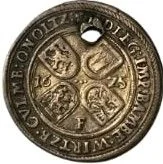
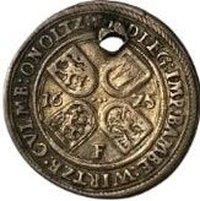
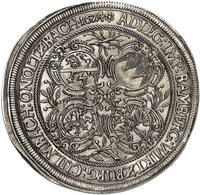
Obverse
Description:
Four flat-topped shields encircled by text.
Inscription:
ADLE(R): IMP:BAMBE:WIRZB:CULMB:(U)NOLTZ
Script: Latin
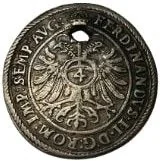
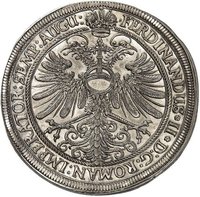
Reverse
Description:
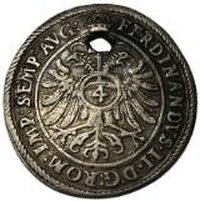
Imperial eagle with value 4, encircled by Ferdinand II's titles.
Inscription:
FERDINANDVS. II D. G. - ROMA. IMP. SEMP. AVG.
Script: Latin
Edge
Mints
| Name | Mark |
|---|---|
| Fürth | F |
Mintings
| Year | Mint Mark | Mintage | Quality | Collection |
|---|---|---|---|---|
| 1625 | — | — |
Historical background
In 1625, the currency situation within the Franconian Circle, a key administrative district of the Holy Roman Empire, was one of profound instability and debasement, deeply entangled in the turmoil of the Thirty Years' War. The region, comprising numerous ecclesiastical and secular states like the Prince-Bishopric of Würzburg and the Margraviate of Brandenburg-Ansbach, lacked a unified monetary authority. This fragmentation led to a chaotic mosaic of circulating coins—Reichsthalers, guilders, kreuzers, and hellers from various mints—each with fluctuating intrinsic values based on their silver content. The war’s immense financial demands pressured local rulers to repeatedly debase their coinage, a practice known as Kipper- und Wipperzeit, where coins were minted with less precious metal to fund armies, causing rampant inflation and a loss of public trust.
The economic consequences were severe. The proliferation of "bad" debased money drove "good" full-value coins out of circulation, as described by Gresham's Law, crippling everyday commerce and savings. Peasants and merchants faced skyrocketing prices for basic goods, while creditors were repaid in worthless currency, leading to widespread impoverishment and social distress. While the Circle’s Diet (Kreistag) issued regulations to standardize currency and curb these practices, enforcement was nearly impossible amidst the war’s chaos and the conflicting interests of its member states, each prioritizing short-term fiscal survival over collective monetary stability.
Therefore, the currency situation in 1625 was not merely an economic issue but a symptom of the Empire’s deeper political disintegration. The absence of a strong central power to enforce monetary policy left the Circle vulnerable to the destructive financial strategies of its own members and the occupying armies passing through. This monetary anarchy eroded the region’s economic foundations, exacerbating the war’s devastation and hindering any coherent response to the crisis, a pattern repeated across much of the Holy Roman Empire during this period.
The economic consequences were severe. The proliferation of "bad" debased money drove "good" full-value coins out of circulation, as described by Gresham's Law, crippling everyday commerce and savings. Peasants and merchants faced skyrocketing prices for basic goods, while creditors were repaid in worthless currency, leading to widespread impoverishment and social distress. While the Circle’s Diet (Kreistag) issued regulations to standardize currency and curb these practices, enforcement was nearly impossible amidst the war’s chaos and the conflicting interests of its member states, each prioritizing short-term fiscal survival over collective monetary stability.
Therefore, the currency situation in 1625 was not merely an economic issue but a symptom of the Empire’s deeper political disintegration. The absence of a strong central power to enforce monetary policy left the Circle vulnerable to the destructive financial strategies of its own members and the occupying armies passing through. This monetary anarchy eroded the region’s economic foundations, exacerbating the war’s devastation and hindering any coherent response to the crisis, a pattern repeated across much of the Holy Roman Empire during this period.
✨ Legendary