

1 Thaler – Franconian Circle
Germany
Context
Year: 1624
Country: Germany 
Issuer: Franconian Circle
Ruler: Ferdinand II
Currency:
Demonetized: Yes
References
KM: #Click to copy to clipboard9
Numista: #354689
Value
Bullion value: $80.75
Obverse
Description:
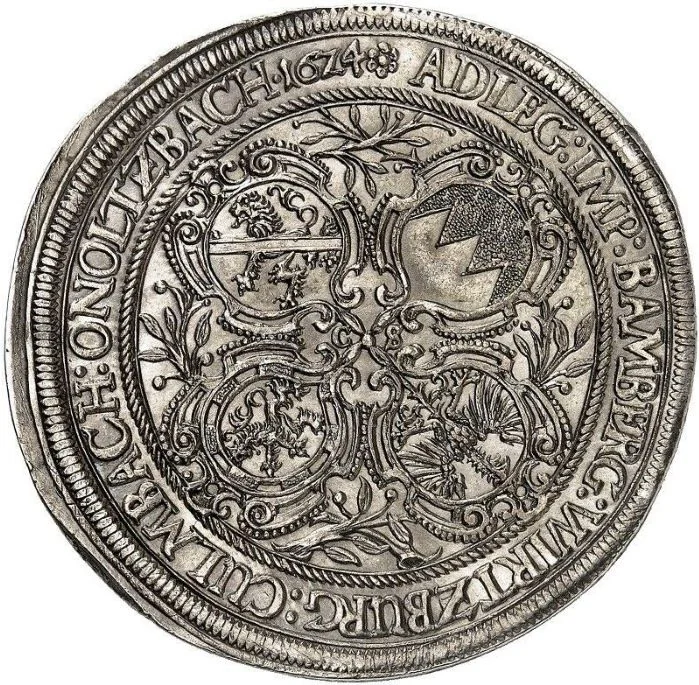
Four oval arms in X-form baroque frames, encircled by palm sprays with date in legend.
Inscription:
ADLEG : IMP : BAMBERG : WIRTZBURG : CULMBACH : ONOLTZBACH : 16Z4
C S
C S
Script: Latin
Reverse
Description:
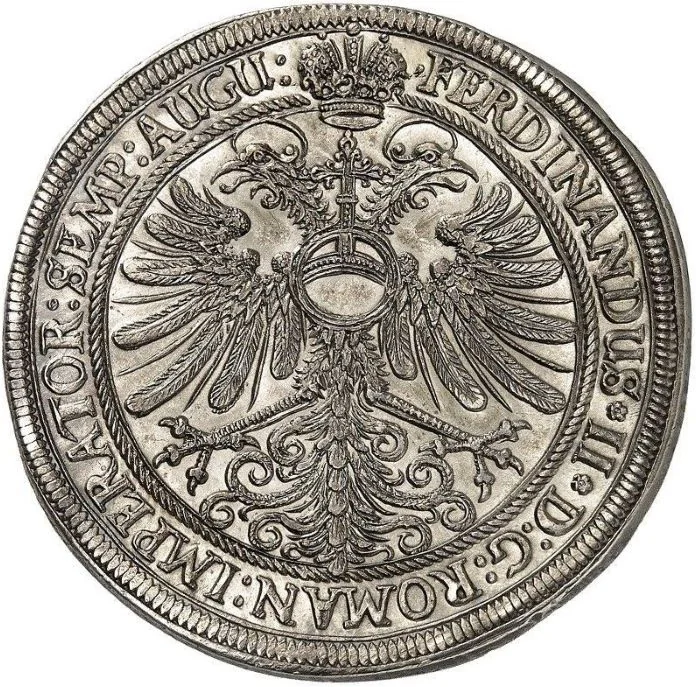
Imperial eagle with crown, orb on breast, bearing Ferdinand II's titles.
Inscription:
• FERDINANDUS II D : G : ROMAN : IMPERATOR : SEMP : AUGU :
Script: Latin
Edge
Mints
| Name | Mark |
|---|---|
| Fürth | — |
Mintings
| Year | Mint Mark | Mintage | Quality | Collection |
|---|---|---|---|---|
| 1624 | CS | — |
Historical background
In 1624, the Franconian Circle, a defensive and administrative union of ecclesiastical and secular territories within the Holy Roman Empire, was grappling with severe monetary disorder exacerbated by the early stages of the Thirty Years' War. The region, like much of the Empire, suffered from the proliferation of debased coinage, as various member states—from the Prince-Bishopric of Würzburg to the Imperial City of Nuremberg—exercised their minting rights to raise funds for war. This led to a "race to the bottom," where territories competed to issue coins with lower silver content, flooding the market with unstable and unreliable currency.
The situation was a textbook example of the Kipper- und Wipperzeit (the clipping and swindling period), a crisis of confidence where bad money drove out good. Older, full-weight coins were hoarded or melted down, while the new, inferior coins circulated at artificially high face values, causing rampant price inflation and crippling everyday trade. This monetary anarchy disrupted the Circle's internal economy, harmed creditors, and created social unrest among peasants and laborers whose buying power evaporated.
Despite the Circle's constitutional framework for cooperation, effective collective action to standardize currency remained elusive in 1624. While the Reichstag had issued imperial minting ordinances, enforcement was weak amidst the war's pressures. The Circle's own attempts to regulate currency were often undermined by the immediate financial needs of its individual members, leaving the monetary landscape fragmented and unstable. This economic turmoil weakened the region's resilience just as the military conflict, particularly the campaigns of Count Tilly, began to directly impact Franconian territory.
The situation was a textbook example of the Kipper- und Wipperzeit (the clipping and swindling period), a crisis of confidence where bad money drove out good. Older, full-weight coins were hoarded or melted down, while the new, inferior coins circulated at artificially high face values, causing rampant price inflation and crippling everyday trade. This monetary anarchy disrupted the Circle's internal economy, harmed creditors, and created social unrest among peasants and laborers whose buying power evaporated.
Despite the Circle's constitutional framework for cooperation, effective collective action to standardize currency remained elusive in 1624. While the Reichstag had issued imperial minting ordinances, enforcement was weak amidst the war's pressures. The Circle's own attempts to regulate currency were often undermined by the immediate financial needs of its individual members, leaving the monetary landscape fragmented and unstable. This economic turmoil weakened the region's resilience just as the military conflict, particularly the campaigns of Count Tilly, began to directly impact Franconian territory.
✨ Legendary