

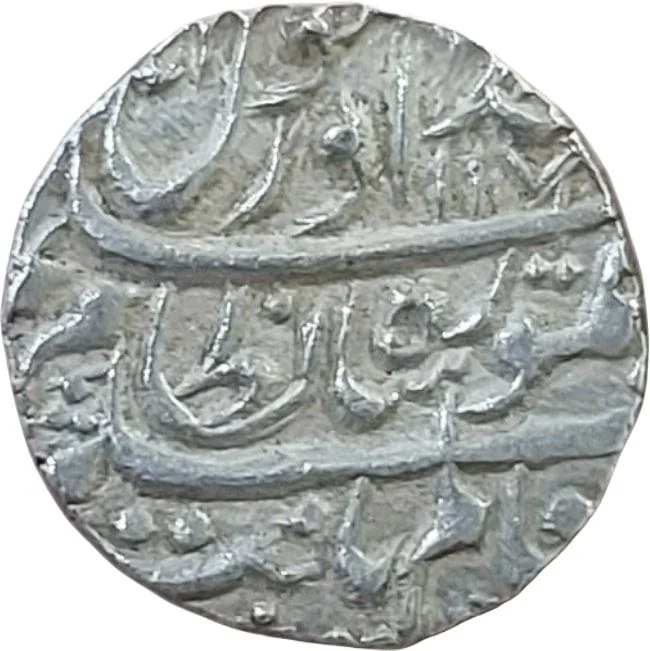
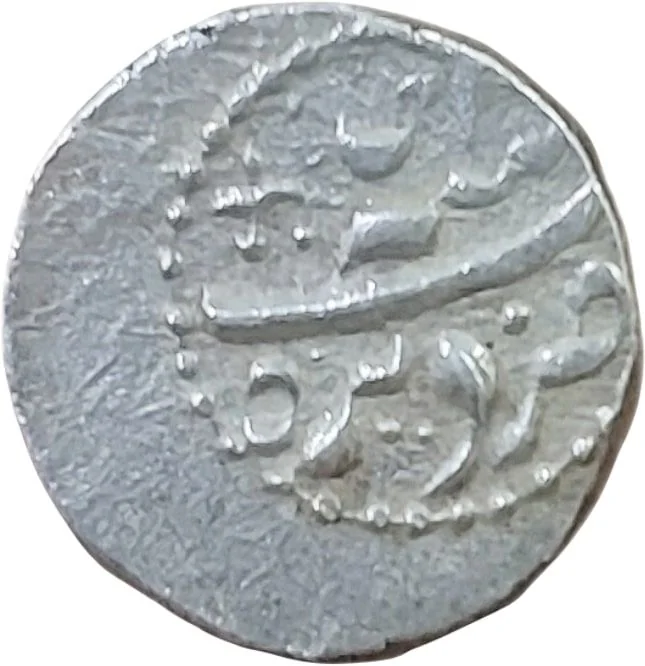
1 Rupee – Punjab
Afghanistan
Context
Year: 1758
Islamic (Hijri) Year: 1171
Country: Afghanistan 
Issuer: Punjab
Currency:
(1747—1891)
Demonetized: Yes
Material
Diameter: 21 mm
Weight: 11.4 g
Silver weight: 11.40 g
Shape: Irregular round
Composition: Silver
Magnetic: No
Technique: Hammered
References
KM: #Click to copy to clipboard318
Numista: #392788
Value
Bullion value: $32.95
Obverse
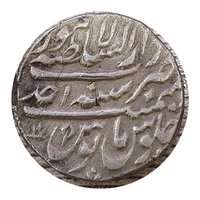
Description:
Taimur Shah, Nizam Sikka, 1171 AH.
Inscription:
١١٧١بحکم خدا و رسول نام
تیمور شاہ نظام
سکّہ بعلم یافت
تیمور شاہ نظام
سکّہ بعلم یافت
Script: Persian
Reverse
Edge
Plain
Mints
| Name | Mark |
|---|---|
| Dera | — |
Mintings
| Year | Mint Mark | Mintage | Quality | Collection |
|---|---|---|---|---|
| 1758 | — | — |
Historical background
In 1758, the currency situation in Punjab was a complex and fragmented system, reflecting the region's turbulent political landscape. Following the invasion of Ahmad Shah Durrani in 1757, the province was nominally under Afghan suzerainty, but effective control was contested between the Durrani Empire, the weakening Mughal administration, and emerging Sikh misls (confederacies). This political instability meant there was no single, authoritative currency. Instead, the monetary system was a chaotic mix of Mughal-era silver rupees (from the mints of Lahore, Multan, and Delhi), Persian and Afghan coins brought by invaders, and various local and feudal issues, leading to wide variations in weight, purity, and acceptance.
The primary circulating medium was the silver rupee, but its value and reliability were severely undermined. Continuous warfare and looting, particularly the devastating sack of Lahore and Sirhind by Ahmad Shah Durrani, drained the region of precious metals, causing coin shortages and debasement. Trade and taxation were disrupted, which in turn stifled the regular minting and distribution of standardized currency. Merchants and the peasantry faced great uncertainty, often having to weigh and assay coins for each transaction, while also dealing with the circulation of worn, clipped, and counterfeit coins.
Amidst this disorder, the Sikh misls began to assert their own economic autonomy, a crucial development in 1758. Following their recapture of Lahore from Afghan agents in that year, the Sikhs started to strike their own coins as a direct symbol of political sovereignty. These early Sikh issues, often minted in the names of Guru Nanak and Guru Gobind Singh, were physically crude but politically significant. They represented a deliberate challenge to the monetary authority of both the Mughals and the Afghans, planting the seeds for a more unified Sikh currency that would later emerge under Maharaja Ranjit Singh. Thus, the currency scene was one of competing symbols of power, marking a transition from Mughal collapse to the rise of new regional powers.
The primary circulating medium was the silver rupee, but its value and reliability were severely undermined. Continuous warfare and looting, particularly the devastating sack of Lahore and Sirhind by Ahmad Shah Durrani, drained the region of precious metals, causing coin shortages and debasement. Trade and taxation were disrupted, which in turn stifled the regular minting and distribution of standardized currency. Merchants and the peasantry faced great uncertainty, often having to weigh and assay coins for each transaction, while also dealing with the circulation of worn, clipped, and counterfeit coins.
Amidst this disorder, the Sikh misls began to assert their own economic autonomy, a crucial development in 1758. Following their recapture of Lahore from Afghan agents in that year, the Sikhs started to strike their own coins as a direct symbol of political sovereignty. These early Sikh issues, often minted in the names of Guru Nanak and Guru Gobind Singh, were physically crude but politically significant. They represented a deliberate challenge to the monetary authority of both the Mughals and the Afghans, planting the seeds for a more unified Sikh currency that would later emerge under Maharaja Ranjit Singh. Thus, the currency scene was one of competing symbols of power, marking a transition from Mughal collapse to the rise of new regional powers.
✨ Legendary