

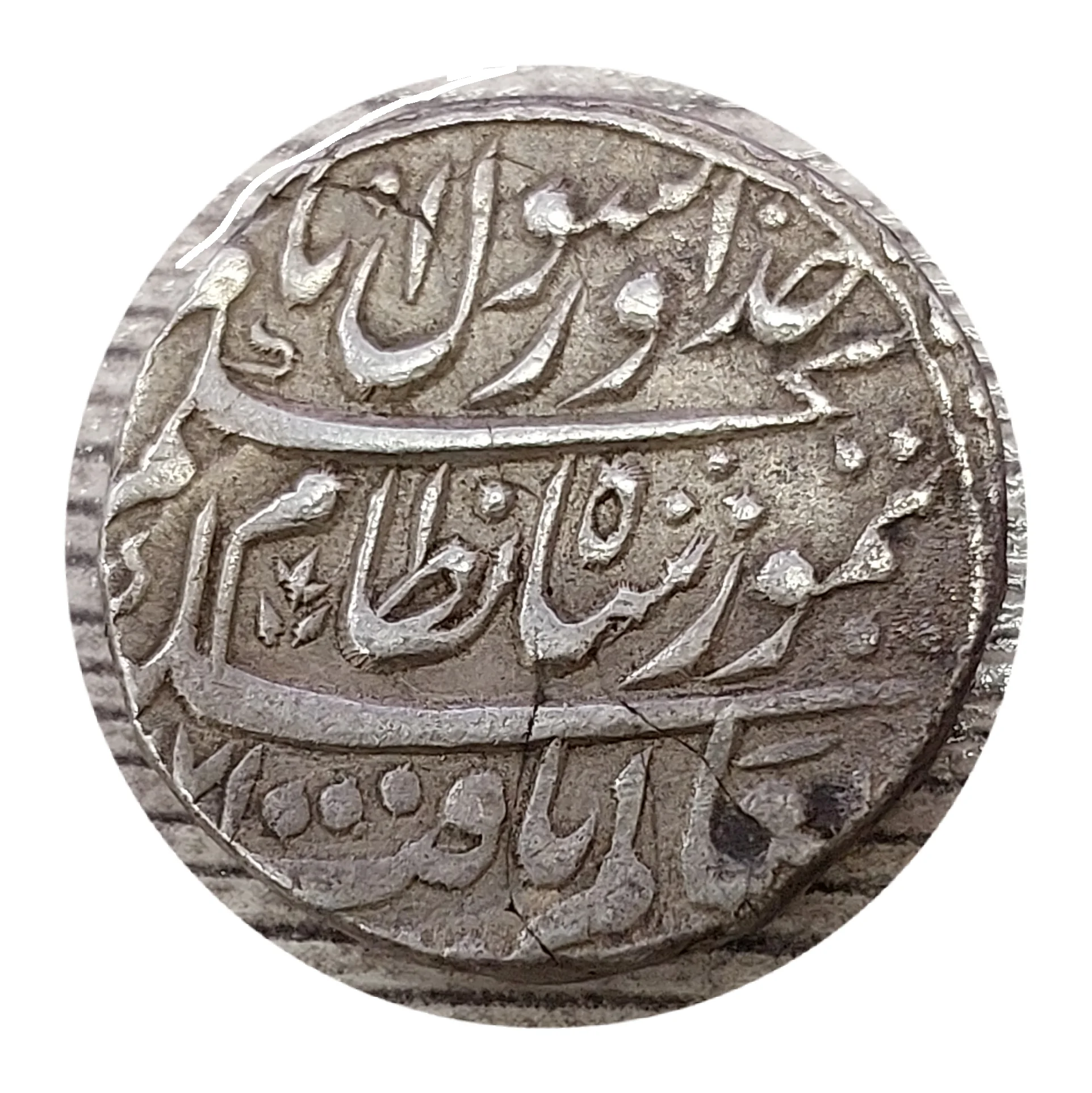
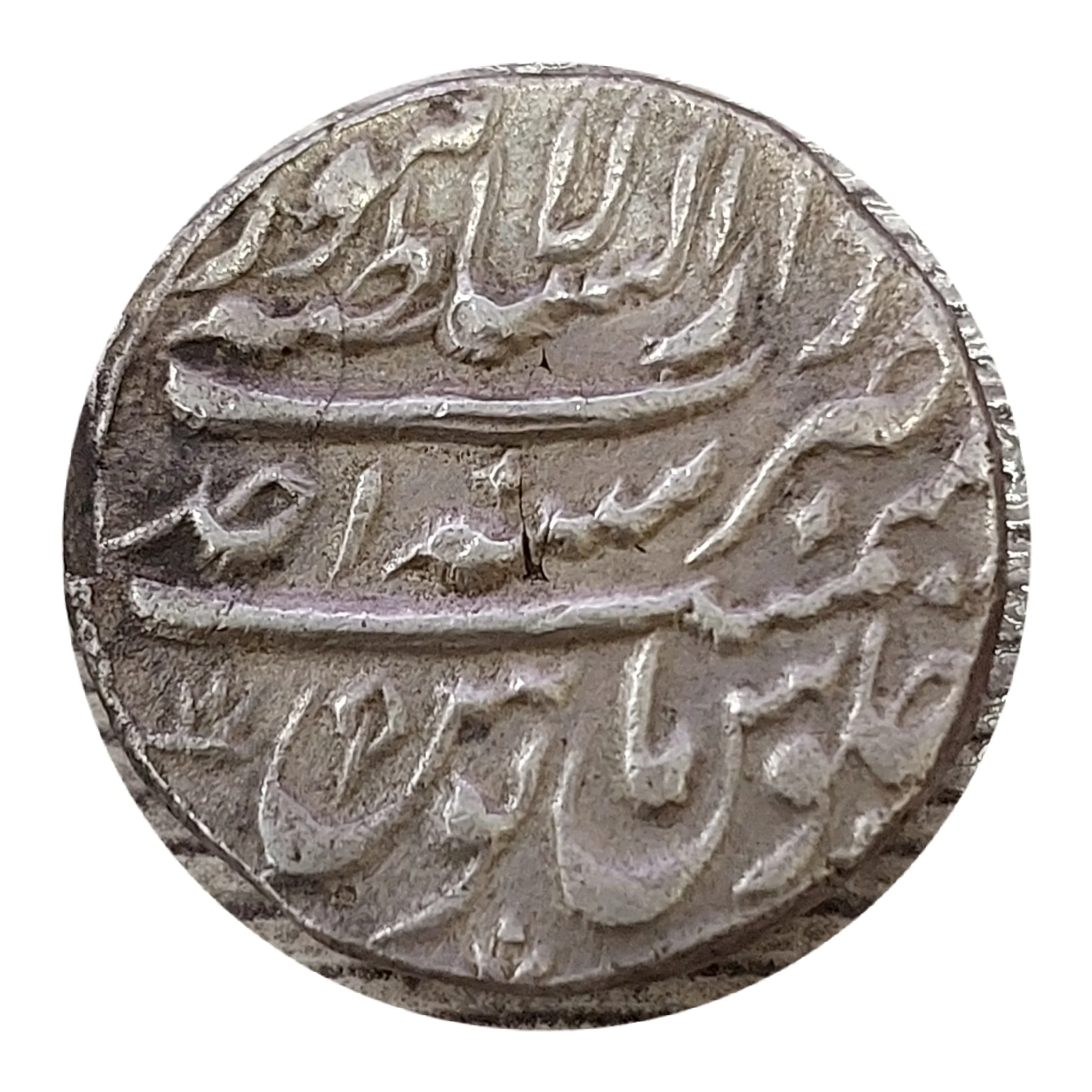
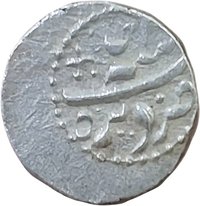
1 Rupee – Punjab
Afghanistan
Context
Material
Diameter: 21 mm
Weight: 11.47 g
Silver weight: 11.47 g
Shape: Irregular round
Composition: Silver
Magnetic: No
Technique: Hammered
References
KM: #Click to copy to clipboard628
Numista: #367000
Value
Bullion value: $33.32
Obverse
Description:
Khuda aur Rasool Taimur Shah Nizam, 1171 AH
Script: Arabic
Reverse
Description:
Mint Lahore, Sanaa Ahd (RY 1), Julus Manoos
Script: Arabic
Edge
Plain
Mints
| Name | Mark |
|---|---|
| Lahore | — |
Mintings
| Year | Mint Mark | Mintage | Quality | Collection |
|---|---|---|---|---|
| 1757 | — | — | ||
| 1758 | — | — | ||
| 1759 | — | — | ||
| 1760 | — | — | ||
| 1761 | — | — |
Historical background
In 1757, the currency situation in Punjab was a complex and fragmented reflection of its turbulent political landscape. The region was in the final decades of the Mughal Empire's effective control, with authority devolving to competing powers: the Durrani Empire of Ahmad Shah Abdali, who levied annual tribute, and the rising Sikh Misls, which were confederacies asserting local control. There was no single, authoritative currency. Instead, circulation was a chaotic mix of older Mughal silver rupees (from the Delhi and Lahore mints), newer Durrani coins from Afghan mints, and various regional and feudal issues. The value and acceptance of these coins depended entirely on the political and military power of the entity that minted them in any given area.
This monetary fragmentation was exacerbated by continuous warfare and looting, which saw vast quantities of coinage seized and re-minted by successive victors. Ahmad Shah Abdali's invasions, particularly his sack of Delhi in 1757, flooded Punjab with looted treasure, including Mughal coins, which were often overstruck with Durrani markings. Simultaneously, Sikh Misls, gaining strength in the countryside, began striking their own crude coins in the name of Guru Nanak and Guru Gobind Singh, establishing the early prototype of the "Nanak Shahi" rupee. The result was a market where merchants and peasants had to constantly assess the weight, purity, and legitimacy of coins from multiple unstable sources.
Consequently, trade and taxation were fraught with difficulty. The absence of a uniform standard led to discounting ("batta") and uncertainty, hindering economic activity. The currency chaos was both a symptom and a cause of the breakdown of central authority, as control over minting was a key sovereign right and revenue source. This unstable monetary environment would persist until the process of Sikh unification under Maharaja Ranjit Singh at the turn of the century, who would later systematize the rupee and introduce a more stable provincial currency.
This monetary fragmentation was exacerbated by continuous warfare and looting, which saw vast quantities of coinage seized and re-minted by successive victors. Ahmad Shah Abdali's invasions, particularly his sack of Delhi in 1757, flooded Punjab with looted treasure, including Mughal coins, which were often overstruck with Durrani markings. Simultaneously, Sikh Misls, gaining strength in the countryside, began striking their own crude coins in the name of Guru Nanak and Guru Gobind Singh, establishing the early prototype of the "Nanak Shahi" rupee. The result was a market where merchants and peasants had to constantly assess the weight, purity, and legitimacy of coins from multiple unstable sources.
Consequently, trade and taxation were fraught with difficulty. The absence of a uniform standard led to discounting ("batta") and uncertainty, hindering economic activity. The currency chaos was both a symptom and a cause of the breakdown of central authority, as control over minting was a key sovereign right and revenue source. This unstable monetary environment would persist until the process of Sikh unification under Maharaja Ranjit Singh at the turn of the century, who would later systematize the rupee and introduce a more stable provincial currency.
✨ Legendary