

20 Poltura – Hungary
Hungary
Context
Years: 1748–1751
Issuer: Hungary 
Ruler: Maria Theresa
Currency:
(1526—1754)
Demonetized: Yes
Total mintage: 106,000
References
KM: #Click to copy to clipboard347
Numista: #39190
Value
Bullion value: $19.72
Obverse
Description:
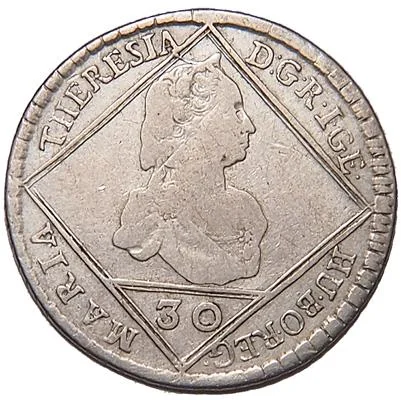
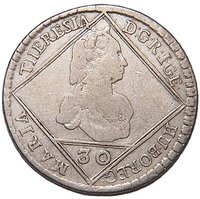
Small bust in square stamp, value divided below. Legend on four sides.
Inscription:
MARIA THERESIA D · G · R · I · GE · HU · BO · REG ·
30
30
Script: Latin
Reverse
Description:
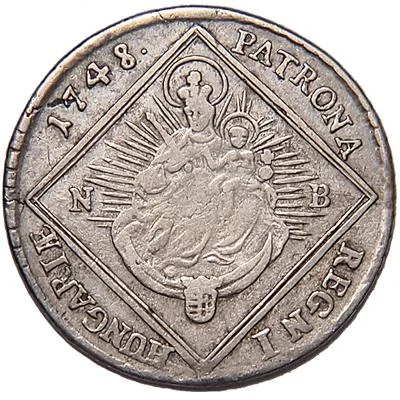
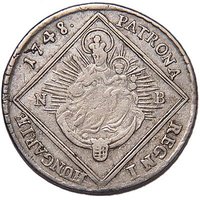
Radiant crowned Madonna seated, holding child on left arm. "N B" mintmark in square stamp, legend and date segmented around.
Inscription:
PATRONA REGNI HUNGARIÆ 1748·
N B
N B
Script: Latin
Edge
Mints
| Name | Mark |
|---|---|
| Baia Mare | N B |
Mintings
| Year | Mint Mark | Mintage | Quality | Collection |
|---|---|---|---|---|
| 1748 | N | 31,000 | ||
| 1750 | N | 75,000 | ||
| 1751 | — | — |
Historical background
In 1748, Hungary’s currency situation was characterized by profound instability and complexity, a direct legacy of its integration into the Habsburg Monarchy. The region operated within a bimetallic system of silver gulden (forints) and copper kreutzers, but the monetary landscape was fragmented. Alongside official Habsburg coinage, older Hungarian and Turkish coins circulated, as did a proliferation of debased coins and counterfeit money, creating a chaotic and unreliable medium for everyday exchange. This instability was exacerbated by the economic strains of recent conflicts, including the War of the Austrian Succession (1740-1748), which had just concluded.
The core of the problem lay in Vienna’s fiscal policy, which often treated Hungary as a source of revenue rather than an integrated economic partner. To finance imperial wars, the Habsburg state frequently manipulated coinage, reducing the precious metal content to mint more coins from the same silver reserves, a practice known as debasement. This led to a severe loss of public trust in the currency, price inflation, and a disconnect between the official and market value of coins. Furthermore, the government’s heavy reliance on copper coinage for small transactions placed a disproportionate burden on the peasantry and lower classes, worsening social tensions.
Consequently, 1748 fell within a period of mounting pressure for monetary reform. While the immediate post-war year did not see a major overhaul, the persistent crises set the stage for the significant reforms that would follow under Empress Maria Theresa. These later efforts, including the standardization of coinage and the establishment of a more unified monetary system, were direct responses to the dysfunctional environment evident in 1748—a year that exemplified the challenges of managing an early modern economy within a vast, multi-ethnic empire.
The core of the problem lay in Vienna’s fiscal policy, which often treated Hungary as a source of revenue rather than an integrated economic partner. To finance imperial wars, the Habsburg state frequently manipulated coinage, reducing the precious metal content to mint more coins from the same silver reserves, a practice known as debasement. This led to a severe loss of public trust in the currency, price inflation, and a disconnect between the official and market value of coins. Furthermore, the government’s heavy reliance on copper coinage for small transactions placed a disproportionate burden on the peasantry and lower classes, worsening social tensions.
Consequently, 1748 fell within a period of mounting pressure for monetary reform. While the immediate post-war year did not see a major overhaul, the persistent crises set the stage for the significant reforms that would follow under Empress Maria Theresa. These later efforts, including the standardization of coinage and the establishment of a more unified monetary system, were direct responses to the dysfunctional environment evident in 1748—a year that exemplified the challenges of managing an early modern economy within a vast, multi-ethnic empire.
✨ Legendary