

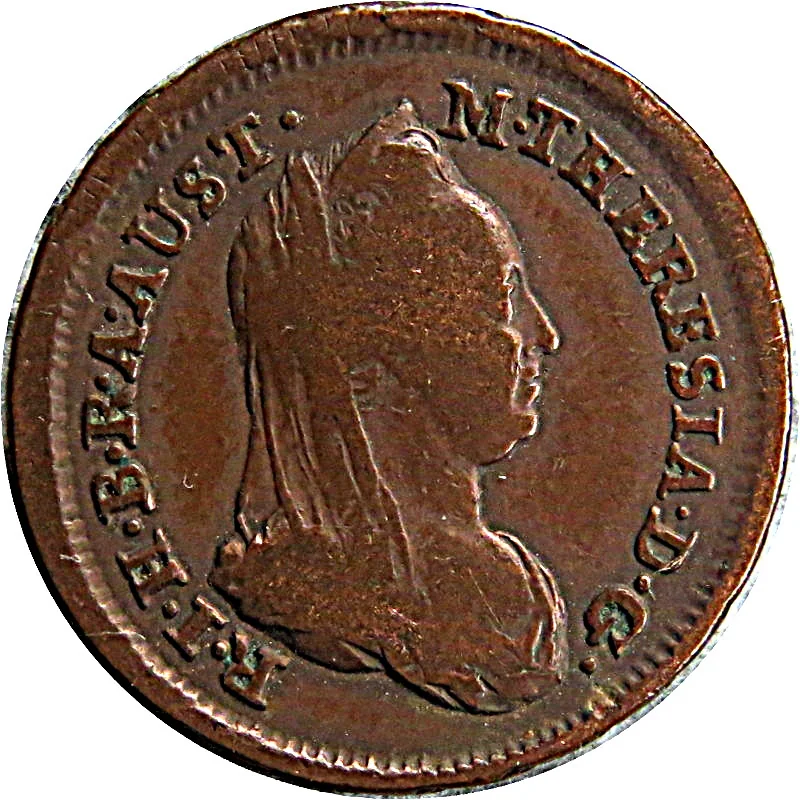
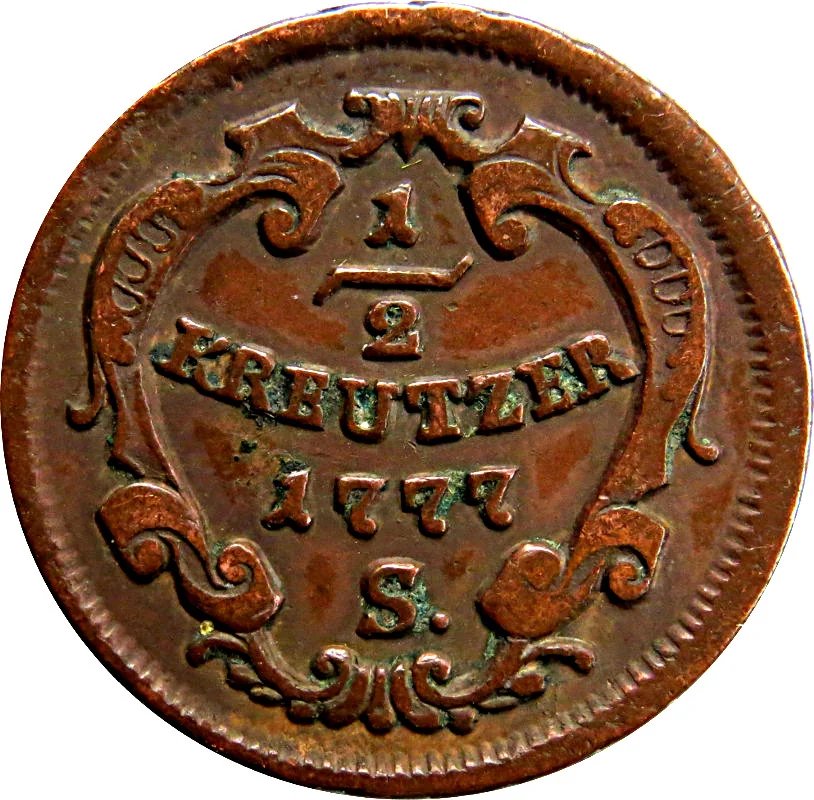
½ Kreuzer – Austrian Empire
Austria
Context
Years: 1772–1779
Country: Austria 
Issuer: Austrian Empire
Ruler: Maria Theresa
Currency:
(1754—1857)
Demonetized: Yes
Material
References
KM: #Click to copy to clipboard1987
Numista: #39180
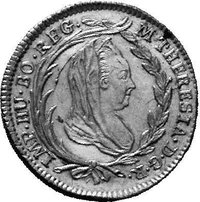
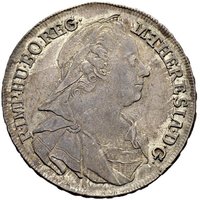
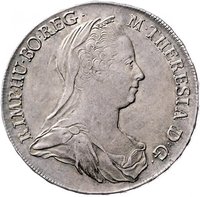
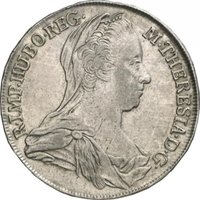
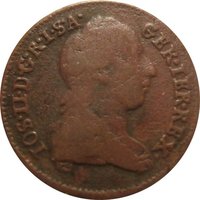
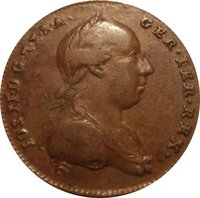
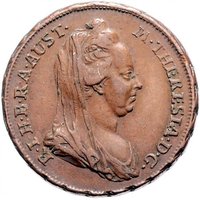
Obverse
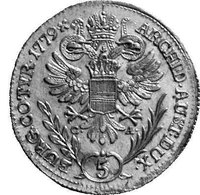
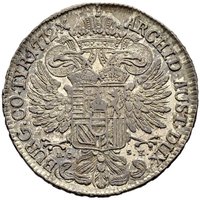
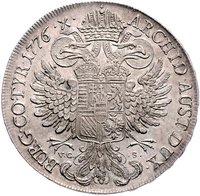
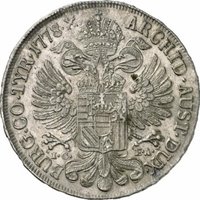
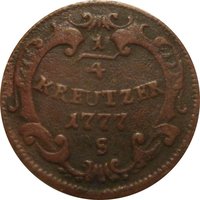
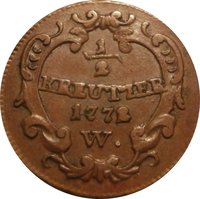
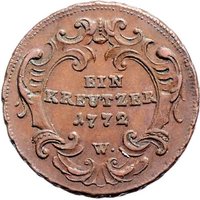
Reverse
Edge
Mints
| Name | Mark |
|---|---|
| Kremnica | K |
| Smolník / Szomolnok / Schmöllnitz | S |
| Münze Österreich | W |
Historical background
In 1772, the currency situation within the Habsburg Monarchy (often referred to as the Austrian Empire) was characterized by significant complexity and instability, a legacy of the costly Seven Years' War (1756-1763). The state treasury was deeply indebted, and the government, under Empress Maria Theresa, had resorted to debasing the coinage to raise funds. This involved reducing the precious metal content in coins, most notably the standard silver Conventionsthaler, leading to a proliferation of different coin types with varying intrinsic values across the empire's diverse lands. The result was a confusing monetary system where the official face value of coins often exceeded their actual metal worth, undermining public trust and facilitating widespread counterfeiting.
The primary framework was the Conventionsmünzfuß (Convention Coin Standard) established in 1753, which set a fixed exchange rate between silver and gold. However, by 1772, this system was under severe strain. Alongside debased official coinage, a vast quantity of low-quality, small-denomination Scheidemünze (token coinage) flooded the market to facilitate everyday transactions. Furthermore, the empire's various provinces, such as Hungary and the Austrian Netherlands, often operated with their own regional monetary practices, adding another layer of fragmentation. This chaotic environment hindered domestic trade, complicated tax collection, and created arbitrage opportunities that drained silver from the monarchy.
Recognizing the crisis, Maria Theresa's government had already begun important reforms. The most significant was the introduction of paper money in 1762—the Wiener Stadt Banco-Zettel—to help finance the war. By 1772, these banknotes were in circulation, representing one of the earliest state-issued paper currencies in Europe. While they provided a temporary fiscal tool, they also introduced the new challenge of managing a dual metal-and-paper system. Thus, the monetary landscape of 1772 was one of transition, caught between the inherited chaos of war finance and the early, uncertain steps toward a more modern, centralized financial system under the guiding hand of the state.
The primary framework was the Conventionsmünzfuß (Convention Coin Standard) established in 1753, which set a fixed exchange rate between silver and gold. However, by 1772, this system was under severe strain. Alongside debased official coinage, a vast quantity of low-quality, small-denomination Scheidemünze (token coinage) flooded the market to facilitate everyday transactions. Furthermore, the empire's various provinces, such as Hungary and the Austrian Netherlands, often operated with their own regional monetary practices, adding another layer of fragmentation. This chaotic environment hindered domestic trade, complicated tax collection, and created arbitrage opportunities that drained silver from the monarchy.
Recognizing the crisis, Maria Theresa's government had already begun important reforms. The most significant was the introduction of paper money in 1762—the Wiener Stadt Banco-Zettel—to help finance the war. By 1772, these banknotes were in circulation, representing one of the earliest state-issued paper currencies in Europe. While they provided a temporary fiscal tool, they also introduced the new challenge of managing a dual metal-and-paper system. Thus, the monetary landscape of 1772 was one of transition, caught between the inherited chaos of war finance and the early, uncertain steps toward a more modern, centralized financial system under the guiding hand of the state.
⭐ Somewhat Rare