

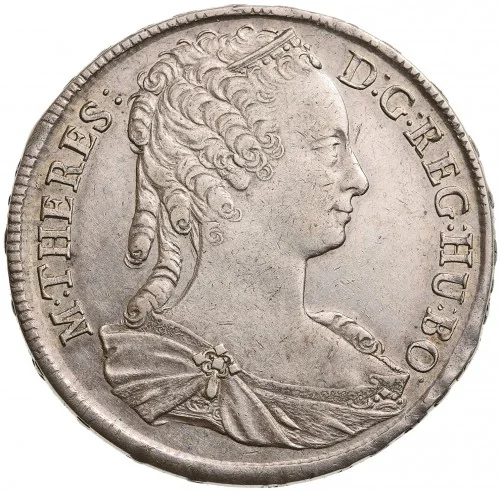

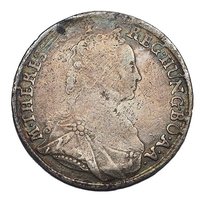
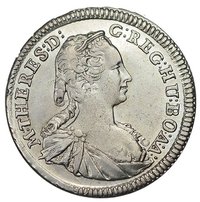
Obverse
Description:
Young portrait with a crown, three curls at the back.
Inscription:
M : THERES : D : G : REG : HU : BO :
Script: Latin
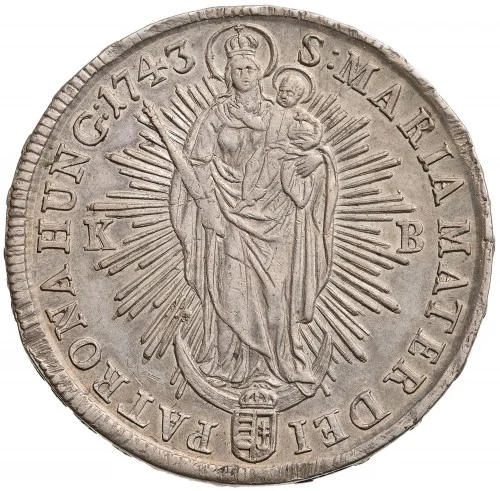
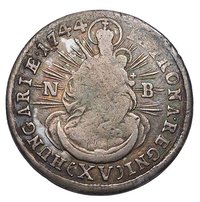
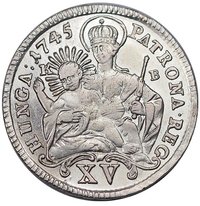
Reverse
Description:
A crowned Madonna stands on a crescent, holding the child, a scepter, and an orb. The Hungarian coat of arms below separates the mintmark and lettering.
Inscription:
S : MARIA MATER DEI PATRONA HUNG:
Script: Latin
Edge
Inscripted
Legend:
IUSTITIA ET CLEMENTIA
Mints
| Name | Mark |
|---|---|
| Kremnica | K B |
Mintings
| Year | Mint Mark | Mintage | Quality | Collection |
|---|---|---|---|---|
| 1743 | K | — | ||
| 1744 | K | — |
Historical background
In 1743, Hungary was part of the Habsburg Monarchy, and its currency situation was characterized by complexity and instability, heavily influenced by Vienna's fiscal policies. The primary currency was the silver guilder (forint or Gulden), but the monetary system was not uniform. Alongside official coinage, a proliferation of lower-quality domestic and foreign coins, particularly copper and debased silver, circulated widely. This created a confusing multi-currency environment where exchange rates fluctuated, harming trade and daily transactions.
The root of this instability lay in the monarchy's chronic need to finance its wars, especially against the Ottoman Empire and in the ongoing War of the Austrian Succession (1740-1748). To raise funds, the Habsburg state frequently resorted to debasement—reducing the precious metal content in coins—and the increased minting of low-denomination copper coins like kreutzers. This led to inflation, a loss of public trust in the currency, and a disconnect between the nominal and intrinsic value of money, causing significant economic hardship.
Furthermore, Hungary's economy was still largely agrarian and manorial, with limited domestic minting control. While the Nagybánya (now Baia Mare, Romania) mint operated, monetary policy was dictated from Vienna to serve the crown's empire-wide needs rather than local Hungarian economic conditions. This period thus reflects a currency system under strain, where the financial demands of imperial warfare directly undermined monetary stability, creating a fragmented and inflationary environment that burdened the Hungarian population.
The root of this instability lay in the monarchy's chronic need to finance its wars, especially against the Ottoman Empire and in the ongoing War of the Austrian Succession (1740-1748). To raise funds, the Habsburg state frequently resorted to debasement—reducing the precious metal content in coins—and the increased minting of low-denomination copper coins like kreutzers. This led to inflation, a loss of public trust in the currency, and a disconnect between the nominal and intrinsic value of money, causing significant economic hardship.
Furthermore, Hungary's economy was still largely agrarian and manorial, with limited domestic minting control. While the Nagybánya (now Baia Mare, Romania) mint operated, monetary policy was dictated from Vienna to serve the crown's empire-wide needs rather than local Hungarian economic conditions. This period thus reflects a currency system under strain, where the financial demands of imperial warfare directly undermined monetary stability, creating a fragmented and inflationary environment that burdened the Hungarian population.
Series: 1743 Hungary circulation coins
✨ Legendary