

1 poltura – Hungary
Add to wishlist
Hungary
Context
Material
Diameter: 19.4 mm
Weight: 0.92 g
Silver Weight:: 0.92 g
Thickness: 0.6 mm
Shape: Irregular round
Composition: Silver
Magnetic: No
Alignment: Medal alignment
flip
References
KM: #
Numista: #39139
Value
Bullion value: $2.35
Obverse
Description:
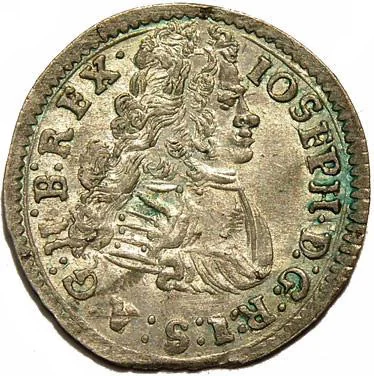
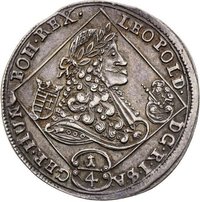
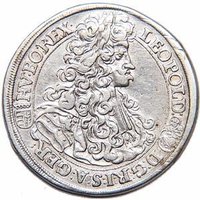
Laureate bust in curly wig and necklace, facing right. No inner circle.
Inscription:
IOSEPH · D · G · R · I · S · A · G · H · B · REX ·
Script: Latin
Reverse
Edge
Plain
Mintings
| Year | Mint Mark | Mintage | Quality | Collection |
|---|---|---|---|---|
| 1701 | ICB | — | ||
| 1702 | ICB | — | ||
| 1703 | ICB | — | ||
| 1706 | KB | — | ||
| 1709 | KB | 3,013,000 | ||
| 1710 | KB | — | ||
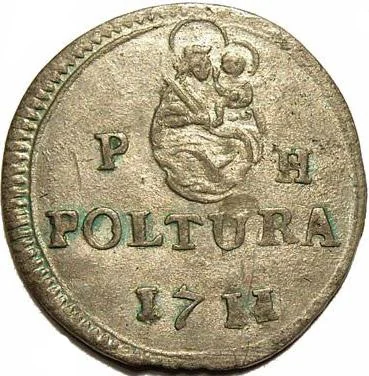
| 1711 | PH | — |
Historical background
In 1701, Hungary’s currency situation was deeply unstable and reflective of the kingdom’s turbulent political state. The country was divided, with the Habsburg monarchy controlling Royal Hungary, the Ottoman Empire holding the central plains, and the Principality of Transylvania acting as a semi-independent entity. This fragmentation led to a chaotic monetary landscape where various coins—Habsburg thalers and kreutzers, Ottoman akçe, and independent Transylvanian issues—all circulated simultaneously, causing confusion and facilitating debasement.
The primary currency in Habsburg-controlled territories was the silver thaler (or forint), but its value was under severe pressure. To finance the ongoing War of the Spanish Succession and the continuing conflicts against the Ottomans (the Great Turkish War had officially ended in 1699), the Vienna court frequently resorted to debasing the lower-value copper and silver kreutzer coins minted for Hungarian circulation. This practice, known as "coinage deterioration," increased the money supply to fund military expenses but triggered inflation and a loss of public trust, as the intrinsic metal value of coins fell below their face value.
Consequently, the year 1701 was marked by a stark disparity between "good" and "bad" money. Older, full-weight silver coins were hoarded or used for foreign trade, following Gresham’s Law that "bad money drives out good." This exacerbated economic hardship for the general population, particularly peasants paying taxes and rents, who often received degraded coinage while being required to pay in sound money. The monetary disorder thus mirrored the broader struggles of a war-ravaged and partitioned kingdom striving for economic coherence under Habsburg rule.
The primary currency in Habsburg-controlled territories was the silver thaler (or forint), but its value was under severe pressure. To finance the ongoing War of the Spanish Succession and the continuing conflicts against the Ottomans (the Great Turkish War had officially ended in 1699), the Vienna court frequently resorted to debasing the lower-value copper and silver kreutzer coins minted for Hungarian circulation. This practice, known as "coinage deterioration," increased the money supply to fund military expenses but triggered inflation and a loss of public trust, as the intrinsic metal value of coins fell below their face value.
Consequently, the year 1701 was marked by a stark disparity between "good" and "bad" money. Older, full-weight silver coins were hoarded or used for foreign trade, following Gresham’s Law that "bad money drives out good." This exacerbated economic hardship for the general population, particularly peasants paying taxes and rents, who often received degraded coinage while being required to pay in sound money. The monetary disorder thus mirrored the broader struggles of a war-ravaged and partitioned kingdom striving for economic coherence under Habsburg rule.

⭐ Rare