

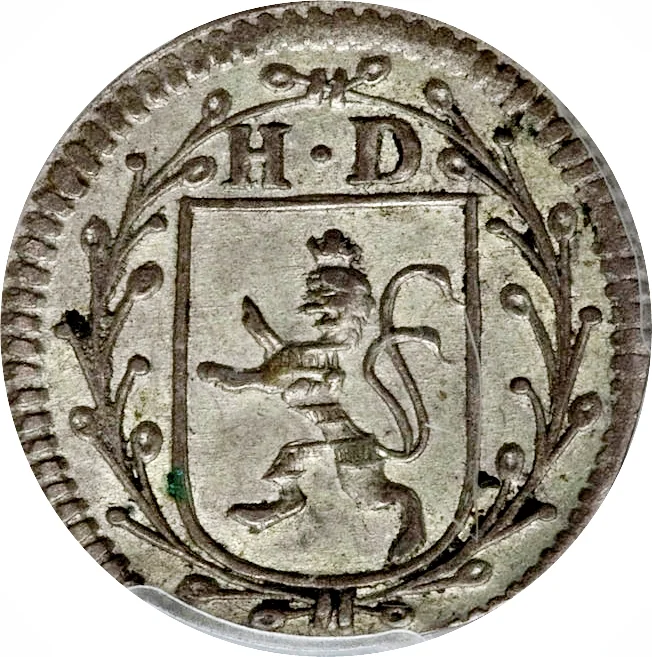
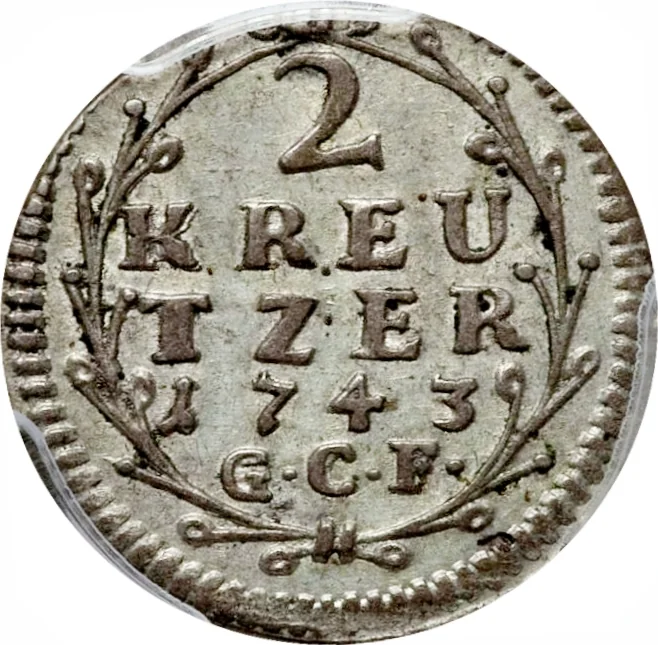
2 Kreuzers – Landgraviate of Hesse-Darmstadt
Context
Years: 1741–1744
Issuer: Landgraviate of Hesse-Darmstadt
Ruler: Louis VIII
Currency:
(1568—1805)
Demonetized: Yes
Material
References
KM: #Click to copy to clipboard173
Numista: #38692
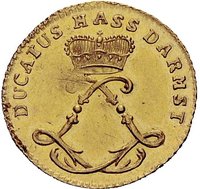
Obverse
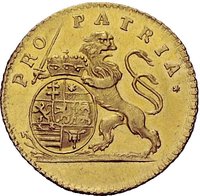
Reverse
Edge
Plain
Mints
| Name | Mark |
|---|---|
| Darmstadt | — |
Mintings
| Year | Mint Mark | Mintage | Quality | Collection |
|---|---|---|---|---|
| 1741 | — | — | ||
| 1743 | — | — | ||
| 1744 | — | — |
Historical background
In 1741, the currency situation in the Landgraviate of Hesse-Darmstadt was characterized by significant complexity and instability, a common challenge within the fragmented Holy Roman Empire. The landgraviate did not have a monopoly on coinage; it circulated a multitude of foreign and domestic coins alongside its own issues. These included Reichsthalers, Gulden, Kreuzers, and Albus from various neighboring states, each with fluctuating values based on their intrinsic silver or gold content. This created a chaotic monetary environment where exchange rates were difficult to standardize and trust in any given coin's value was low.
The root of this instability lay in the broader economic and political context. The War of the Austrian Succession (1740-1748) had erupted the previous year, causing widespread financial strain across the region. Hesse-Darmstadt, under Landgrave Louis VIII, faced increased military expenditures and the need to subsidize troops. This fiscal pressure often led to the debasement of coinage—reducing the precious metal content in coins to create more money from the same silver reserves—a practice that further eroded confidence in the currency and spurred inflation. The landgraviate's economy, still largely agrarian, struggled under this monetary uncertainty, hampering trade and commerce.
Consequently, authorities in Darmstadt were engaged in a continuous, and often losing, battle to regulate this system. They issued periodic minting ordinances (Münzordnungen) that attempted to fix the value of the myriad coins in circulation relative to the Reichsthaler, the Empire's theoretical standard. However, these decrees were difficult to enforce, and the inflow of debased foreign coins, alongside the pressures of war finance, made a stable and uniform currency an elusive goal. Thus, in 1741, the monetary landscape was one of official proclamations clashing with the reality of a disordered and inflationary circulation of coinage.
The root of this instability lay in the broader economic and political context. The War of the Austrian Succession (1740-1748) had erupted the previous year, causing widespread financial strain across the region. Hesse-Darmstadt, under Landgrave Louis VIII, faced increased military expenditures and the need to subsidize troops. This fiscal pressure often led to the debasement of coinage—reducing the precious metal content in coins to create more money from the same silver reserves—a practice that further eroded confidence in the currency and spurred inflation. The landgraviate's economy, still largely agrarian, struggled under this monetary uncertainty, hampering trade and commerce.
Consequently, authorities in Darmstadt were engaged in a continuous, and often losing, battle to regulate this system. They issued periodic minting ordinances (Münzordnungen) that attempted to fix the value of the myriad coins in circulation relative to the Reichsthaler, the Empire's theoretical standard. However, these decrees were difficult to enforce, and the inflow of debased foreign coins, alongside the pressures of war finance, made a stable and uniform currency an elusive goal. Thus, in 1741, the monetary landscape was one of official proclamations clashing with the reality of a disordered and inflationary circulation of coinage.
⭐ Somewhat Rare