Logo Title
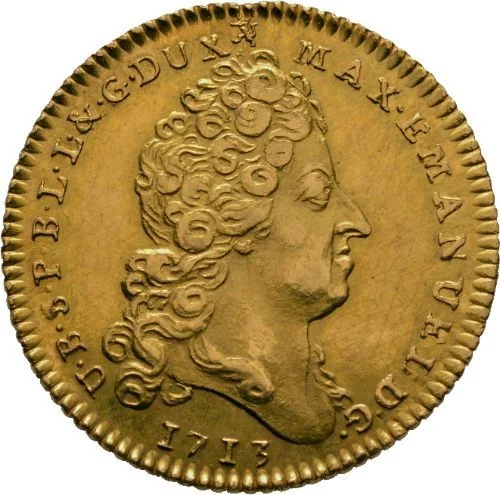
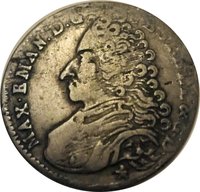
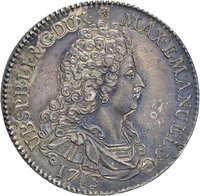
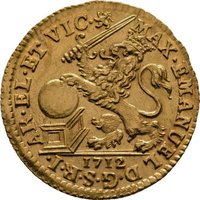
obverse
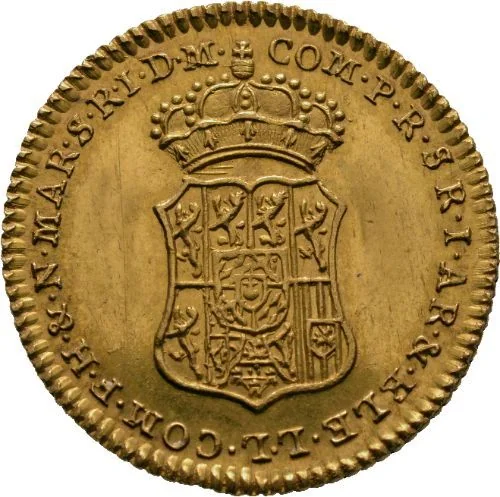
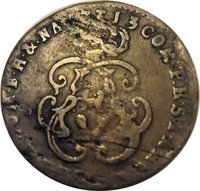
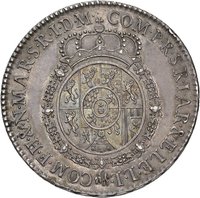
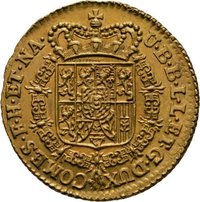
reverse
Staatliche Münzsammlung München CC BY-NC-SA 4.0 DE
Context
Year: 1713
Country: Belgium Country flag
Currency:
(1506—1713)
Demonetized: Yes
Material
Diameter: 22.8 mm
Weight: 5.58 g
Gold weight: 5.13 g
Shape: Round
Composition: 91.9% Gold
Magnetic: No
References
KM: #Click to copy to clipboard25
Numista: #385500
Value
Bullion value: $855.01

Obverse

Description:
Bust right.
Inscription:
MAX EMANUEL D G U B S P B L L & G DUX

1713
Script: Latin

Reverse

Description:
Crowned coat of arms.
Inscription:
COM P R S R I AR & ELE L L COM F H & N MAR S R I D M
Script: Latin

Edge

Mints

NameMark
Namur

Mintings

YearMint MarkMintageQualityCollection
1713

Historical background

In 1713, the County of Namur found itself in a complex monetary situation, deeply influenced by its political status. Following the 1713 Treaty of Utrecht, Namur was formally transferred from Spanish to Austrian Habsburg rule, becoming part of the Austrian Netherlands. However, this political shift did not immediately simplify its currency system. Namur operated within a fragmented monetary landscape where numerous foreign coins, particularly French livres, Dutch guilders, and Brabant patards, circulated alongside local issues. The lack of a strong, unified regional currency led to chronic instability, confusion in trade, and the problem of worn or debased coins.

The county's economy was fundamentally agrarian, with limited industrial activity beyond some ironworking and leather production. This meant that daily transactions for most citizens were small-scale, relying heavily on low-value copper and billon (debased silver) coins. The valuation of these coins was often arbitrary and subject to local proclamation, creating discrepancies between Namur's standards and those of neighbouring territories like Brabant or Liège. This fragmentation was a significant hindrance to commerce and economic development, as merchants constantly faced exchange risks and calculation difficulties.

Ultimately, the currency situation in Namur in 1713 was one of transition and disorder, awaiting reform from its new Austrian rulers. While the Habsburgs desired to impose greater monetary uniformity across their Netherlands possessions to facilitate taxation and administration, effective centralised control remained a future prospect. Therefore, the county's daily reality was defined by a cumbersome multiplicity of coins, fluctuating values, and the practical challenges of an economy caught between old regional habits and the nascent authority of a distant imperial power.

Series: 1713 County of Namur circulation coins

1 Sovereign obverse
1 Sovereign reverse
1 Sovereign
1713
1 Liard obverse
1 Liard reverse
1 Liard
1713
1 Ecu obverse
1 Ecu reverse
1 Ecu
1713-1714
Legendary