

1 Fanon – Puducherry
India
Context

Material
Weight: 1.55 g
Silver weight: 1.55 g
Shape: Irregular round
Composition: Silver
Standard: Gold twentieth ounce
Magnetic: No
References
KM: #Click to copy to clipboard44
Numista: #113460
Value
Bullion value: $4.44
Obverse
Description:
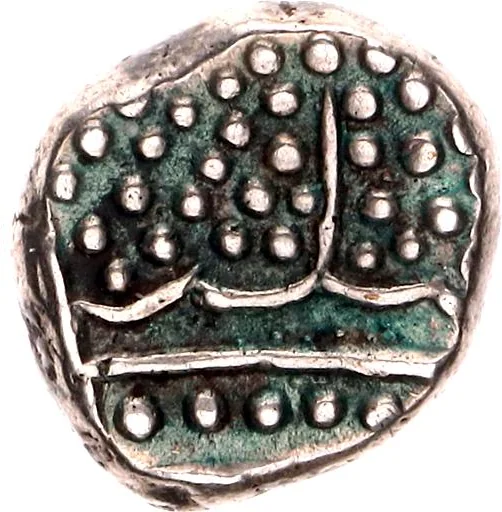
Pearl crown.
Reverse
Description:
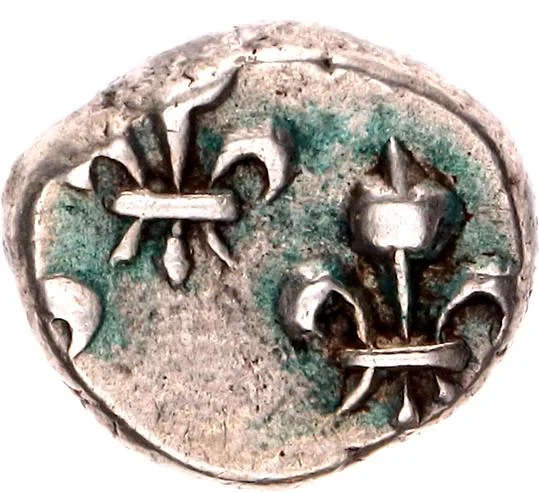
Five fleurs-de-lis.
Edge
Mintings
| Year | Mint Mark | Mintage | Quality | Collection |
|---|---|---|---|---|
| 1760 | — | — |
Historical background
In 1760, Puducherry (then Pondicherry) was a French colonial enclave amidst a complex monetary landscape. The primary currency in circulation was the French Indian rupee, a silver coin minted by the French East India Company to facilitate local trade. However, this coin competed directly with a multitude of other silver rupees issued by various Indian powers, most notably the Arcot rupee of the nearby Nawab of Carnatic, which was widely accepted and often preferred in regional commerce. This created a dual-system where French administrative transactions used the French rupee, while the bazaars and wider economy operated on a blend of local and European currencies.
The situation was further complicated by the ongoing military and political turmoil of the Third Carnatic War (1756-1763), part of the global Seven Years' War. British forces had captured Puducherry in 1760, disrupting French administrative control and its monetary authority. During this brief British occupation (1760-1761), the British East India Company's currency and the Arcot rupee likely gained even greater prominence, while the French rupee's legitimacy and supply were severely undermined. The instability made transactions precarious, with the value of coins heavily dependent on their silver content and the credibility of the issuing authority.
Overall, the currency situation in 1760 Puducherry was characterized by competitive pluralism and wartime instability. No single currency held absolute sway, leading to a practical, if inefficient, system of concurrent circulation where merchants and moneychangers (shroffs) played a critical role in assessing and exchanging coins. This fragmented monetary environment reflected Puducherry's position as a contested European trading post embedded within the vibrant and diverse economy of 18th-century South India.
The situation was further complicated by the ongoing military and political turmoil of the Third Carnatic War (1756-1763), part of the global Seven Years' War. British forces had captured Puducherry in 1760, disrupting French administrative control and its monetary authority. During this brief British occupation (1760-1761), the British East India Company's currency and the Arcot rupee likely gained even greater prominence, while the French rupee's legitimacy and supply were severely undermined. The instability made transactions precarious, with the value of coins heavily dependent on their silver content and the credibility of the issuing authority.
Overall, the currency situation in 1760 Puducherry was characterized by competitive pluralism and wartime instability. No single currency held absolute sway, leading to a practical, if inefficient, system of concurrent circulation where merchants and moneychangers (shroffs) played a critical role in assessing and exchanging coins. This fragmented monetary environment reflected Puducherry's position as a contested European trading post embedded within the vibrant and diverse economy of 18th-century South India.


✨ Legendary