


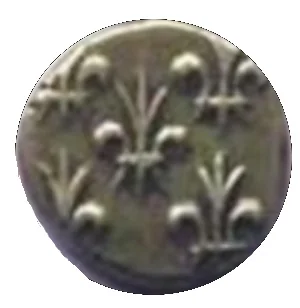
1 Fanon – Puducherry
India

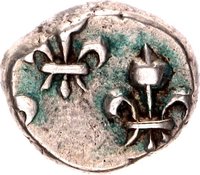
Obverse
Description:
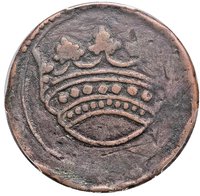
Royal headpiece.
Reverse
Description:
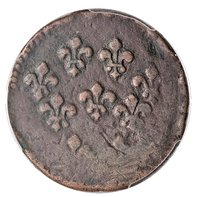
Five fleurs-de-lis.
Edge
Mintings
| Year | Mint Mark | Mintage | Quality | Collection |
|---|---|---|---|---|
| 1750 | — | — |
Historical background
In the mid-18th century, Puducherry (then Pondicherry) was a thriving French colonial enclave on the Coromandel Coast, and its currency situation reflected its unique position as a European trading post embedded within the Indian economic landscape. The primary currency in daily circulation was the Indian rupee, along with its smaller denominations like fanams and cash, which were essential for local and regional trade. However, these rupees were not uniform; a variety of issues were in use, including those minted by the neighboring Mughal successor states like the Nawab of Arcot, as well as coins from other European companies and Indian kingdoms.
Alongside this local currency, the French administration introduced distinct European-style coins. The French East India Company minted silver rupees and half-rupees as well as copper coins, often bearing the monogram of the Company or the French crown. These issues were an attempt to assert monetary sovereignty, facilitate commerce within the colony, and simplify accounting for the Company's trade, which centered on textiles, spices, and other goods. The value of these French issues was pegged to the more dominant local rupee to ensure their acceptance.
Thus, the monetary environment was one of competitive hybridity. Merchants and inhabitants navigated a complex system where French colonial coins, various Indian rupees, and other European currencies like the Portuguese xerafim all circulated simultaneously. Exchange rates fluctuated based on the intrinsic silver content, the credibility of the issuing authority, and trade demands. This situation underscored Puducherry's dual identity: a French administrative center striving for economic control, yet fundamentally dependent on integration into the wider, pluralistic monetary networks of South India.
Alongside this local currency, the French administration introduced distinct European-style coins. The French East India Company minted silver rupees and half-rupees as well as copper coins, often bearing the monogram of the Company or the French crown. These issues were an attempt to assert monetary sovereignty, facilitate commerce within the colony, and simplify accounting for the Company's trade, which centered on textiles, spices, and other goods. The value of these French issues was pegged to the more dominant local rupee to ensure their acceptance.
Thus, the monetary environment was one of competitive hybridity. Merchants and inhabitants navigated a complex system where French colonial coins, various Indian rupees, and other European currencies like the Portuguese xerafim all circulated simultaneously. Exchange rates fluctuated based on the intrinsic silver content, the credibility of the issuing authority, and trade demands. This situation underscored Puducherry's dual identity: a French administrative center striving for economic control, yet fundamentally dependent on integration into the wider, pluralistic monetary networks of South India.
✨ Legendary