

1 Zecchino – Habsburg Venetian Province
Italy
Context
Year: 1798
Country: Italy 
Issuer: Habsburg Venetian Province
Ruler: Francis II
Currency:
(1752—1805)
Demonetized: Yes
Material
References
KM: #Click to copy to clipboard107
Numista: #113327
Value
Bullion value: $574.34
Obverse
Description:
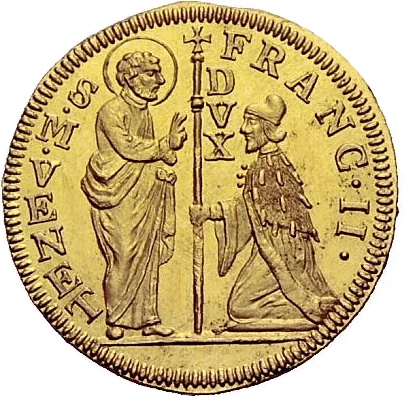
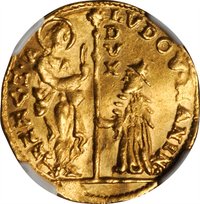
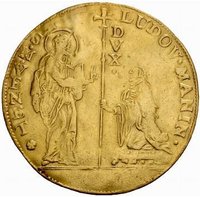
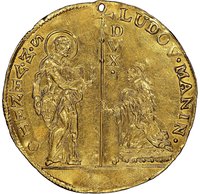
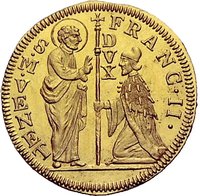
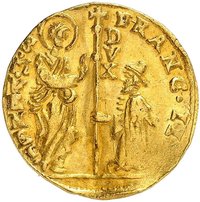
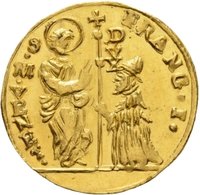
Saint Mark presents his cross-topped staff to a kneeling doge.
Inscription:
FRANC • II • S • M • VENET •
Script: Latin
Reverse
Description:
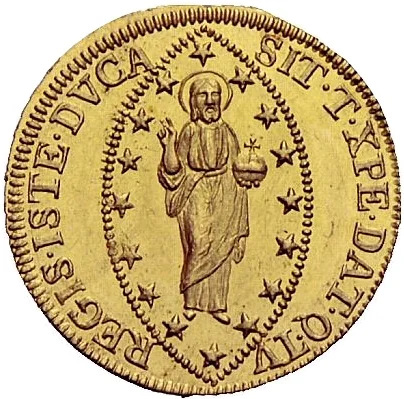
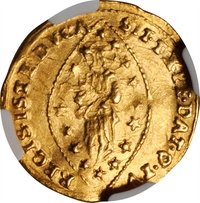
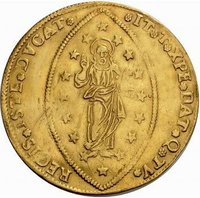
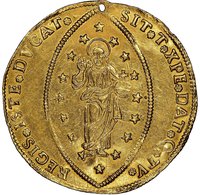
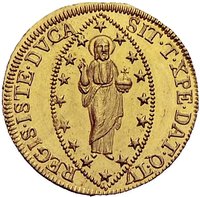
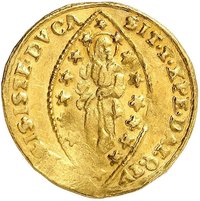
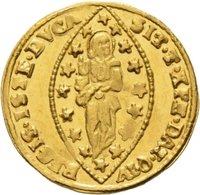
Christ facing forward, holding a globe within a beaded, star-filled oval.
Inscription:
SIT • T • XPE • DAT • Q • TV - REGIS • ISTE • DVCA
Script: Latin
Edge
Mints
| Name | Mark |
|---|---|
| Venice | — |
Mintings
| Year | Mint Mark | Mintage | Quality | Collection |
|---|---|---|---|---|
| 1798 | — | — |
Historical background
In 1798, the Habsburg-controlled Venetian Province (formally the Venetian Provinces, Province Venete) was grappling with a severe and chaotic currency crisis, a direct legacy of its recent violent transfer of power. The province, comprising the former mainland territories of the defunct Venetian Republic, had been ceded to Austria in the 1797 Treaty of Campo Formio. The Habsburg administration, under Emperor Francis II, inherited a monetary system flooded with devalued Venetian silver coins, such as the lira and ducato, and a vast quantity of nearly worthless paper money (cedole) issued by the old republic in its final, desperate years. This created a dual problem of establishing imperial fiscal authority and restoring public trust in the circulating medium.
The core of the crisis lay in the clash between the inherited Venetian monetary stock and the Habsburg government's need to integrate the new province into its own fiscal and monetary structures. The Austrian authorities, led by the central Hofkammer in Vienna, declared the old Venetian paper money invalid, ruining many holders and causing widespread economic distress. They sought to replace the mixed Venetian coinage with the stable Austrian Convention Coinage system (Konventionsmünzfuss), based on the silver Conventionsthaler. However, the process of recall, exchange, and reintroduction was slow and inefficient, leading to acute shortages of acceptable coin. This liquidity crisis stifled commerce and tax collection, as the population hoarded older coins whose intrinsic silver value was higher than their official face value.
Consequently, by 1798, the provincial economy was characterized by monetary confusion, with multiple coinages (old Venetian, new Austrian, and foreign currencies) circulating at fluctuating and disputed rates. Black markets for coin exchange thrived, and provincial authorities in cities like Verona and Padua filed constant reports to Vienna on the paralyzing effects. The situation undermined the Habsburg goal of stable and profitable administration, making the currency question a primary administrative and political challenge as they attempted to consolidate their rule over a restive and economically strained population.
The core of the crisis lay in the clash between the inherited Venetian monetary stock and the Habsburg government's need to integrate the new province into its own fiscal and monetary structures. The Austrian authorities, led by the central Hofkammer in Vienna, declared the old Venetian paper money invalid, ruining many holders and causing widespread economic distress. They sought to replace the mixed Venetian coinage with the stable Austrian Convention Coinage system (Konventionsmünzfuss), based on the silver Conventionsthaler. However, the process of recall, exchange, and reintroduction was slow and inefficient, leading to acute shortages of acceptable coin. This liquidity crisis stifled commerce and tax collection, as the population hoarded older coins whose intrinsic silver value was higher than their official face value.
Consequently, by 1798, the provincial economy was characterized by monetary confusion, with multiple coinages (old Venetian, new Austrian, and foreign currencies) circulating at fluctuating and disputed rates. Black markets for coin exchange thrived, and provincial authorities in cities like Verona and Padua filed constant reports to Vienna on the paralyzing effects. The situation undermined the Habsburg goal of stable and profitable administration, making the currency question a primary administrative and political challenge as they attempted to consolidate their rule over a restive and economically strained population.
Series: Venitian Sequin
✨ Legendary