

4 Riksdaler – Sweden
Sweden
Context
Material
References
KM: #Click to copy to clipboard30
Numista: #113246
Value
Bullion value: $294.90
Obverse
Description:
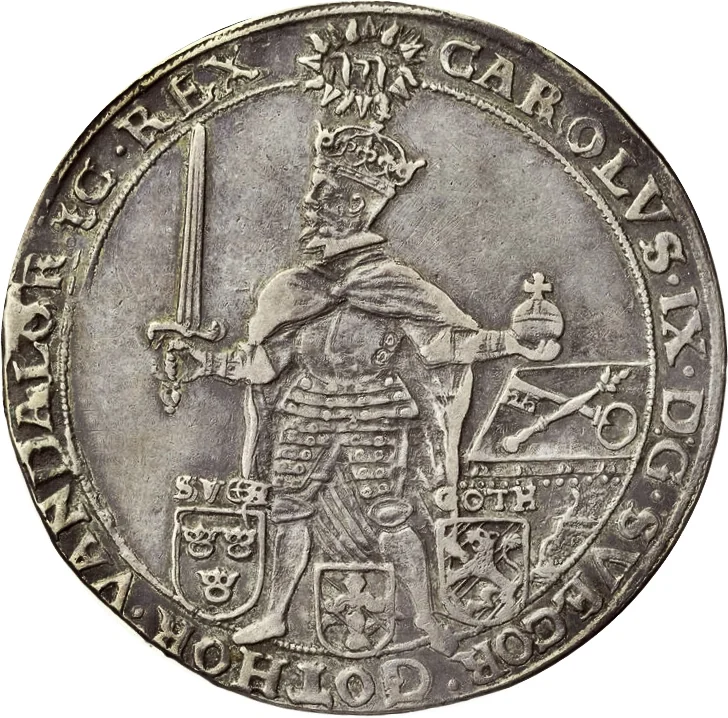
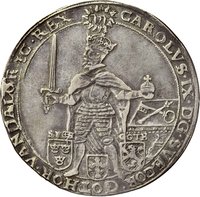
Crowned and armored Karl IX stands facing left, holding a raised sword and Globus Cruciger. A table beside him holds a crossed scepter and key. Three shields at his feet display the Three Crowns, the Vasa arms, and the Folkungs Lion. The scene is encircled, with the Hebrew name of Jehovah radiant above him.
Inscription:
(יהוה) CAROLVS·IX·D:G·SVECOR·GOTHOR·VANDALOR·ETC·REX·
SVEC GOTH
SVEC GOTH
Script: Latin
Reverse
Description:
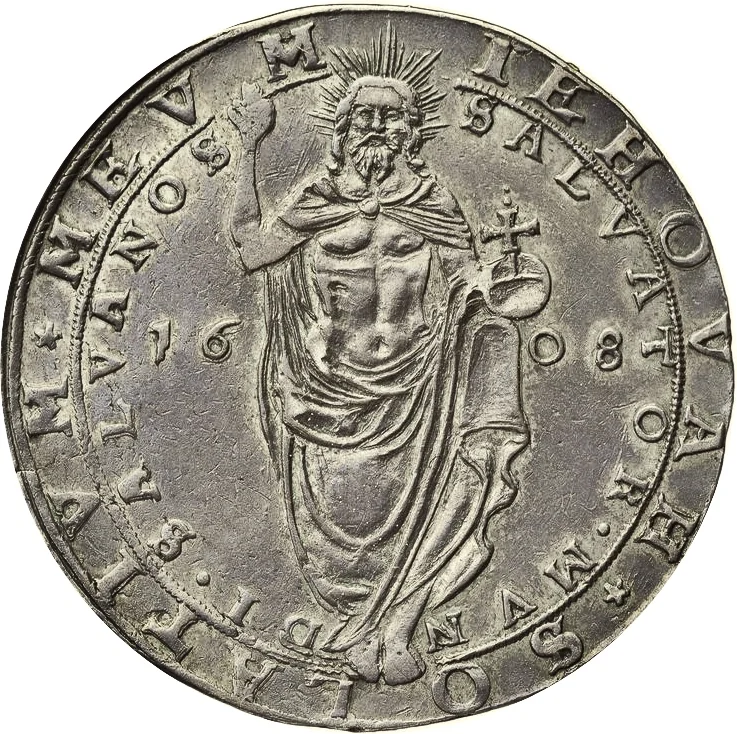
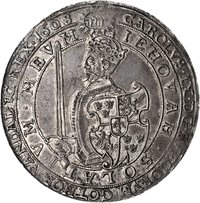
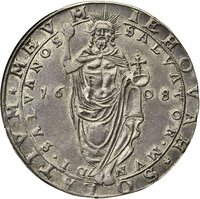
Veiled figure of Jesus blessing, holding a Globus Cruciger, dividing the date within a beaded circle. The King's motto and another inscription encircle the figure.
Inscription:
IEHOVAH * SOLATIVM * MEV | M
SALVATOR · MVN | DI · SALVA NOS
16 08
SALVATOR · MVN | DI · SALVA NOS
16 08
Script: Latin
Edge
Mintings
| Year | Mint Mark | Mintage | Quality | Collection |
|---|---|---|---|---|
| 1608 | — | — |
Historical background
In 1608, Sweden was grappling with a severe and complex monetary crisis rooted in the policies of King Karl IX. The kingdom was entangled in the ongoing Kalmar War with Denmark-Norway (1611-1613), and the immense costs of military mobilization and fortification were draining the royal treasury. To finance these endeavours, the crown had resorted to repeated and severe debasement of the coinage, notably the silver öre and mark. By reducing the silver content in coins while maintaining their face value, the state created short-term revenue but triggered rampant inflation and a collapse in public trust in the currency.
The domestic economy was in disarray as a result. Good-quality full-weight coins were hoarded or exported, while the debased, lightweight coins flooded the market, a classic example of Gresham's Law ("bad money drives out good"). This led to a chaotic multi-currency system where foreign coins, particularly German and Dutch, circulated alongside Swedish ones, with merchants and markets assigning them different values based on their actual metal content. Prices soared, causing hardship for the population and complicating all trade and state finances, as the real value of tax revenues plummeted.
This unsustainable situation set the stage for sweeping reforms. The crisis of 1608 was a direct precursor to the major monetary reorganisation undertaken by Karl IX's successor, his son Gustavus Adolphus, after his accession in 1611. The new king, with the help of his skilled Chancellor Axel Oxenstierna, would eventually stabilize the currency by introducing a standardised national coinage and stricter control over the royal mint, laying the financial foundation for Sweden's rise as a great power during the Thirty Years' War. Thus, 1608 represents a low point of monetary chaos immediately preceding a period of decisive state-building.
The domestic economy was in disarray as a result. Good-quality full-weight coins were hoarded or exported, while the debased, lightweight coins flooded the market, a classic example of Gresham's Law ("bad money drives out good"). This led to a chaotic multi-currency system where foreign coins, particularly German and Dutch, circulated alongside Swedish ones, with merchants and markets assigning them different values based on their actual metal content. Prices soared, causing hardship for the population and complicating all trade and state finances, as the real value of tax revenues plummeted.
This unsustainable situation set the stage for sweeping reforms. The crisis of 1608 was a direct precursor to the major monetary reorganisation undertaken by Karl IX's successor, his son Gustavus Adolphus, after his accession in 1611. The new king, with the help of his skilled Chancellor Axel Oxenstierna, would eventually stabilize the currency by introducing a standardised national coinage and stricter control over the royal mint, laying the financial foundation for Sweden's rise as a great power during the Thirty Years' War. Thus, 1608 represents a low point of monetary chaos immediately preceding a period of decisive state-building.
✨ Legendary