

¼ Mohar – Kathmandu Kingdom
Nepal
Context
Year: 1715
Nepal Sambat Year: 835
Country: Nepal 
Issuer: Kathmandu Kingdom
Ruler: Mahindra Simha
Currency:
(1546—1932)
Demonetized: Yes
Material
Diameter: 17 mm
Weight: 1.26 g
Silver weight: 1.26 g
Shape: Irregular round
Composition: Silver
Magnetic: No
Alignment: Medal alignment
flip
References
KM: #Click to copy to clipboard223
Numista: #383161
Value
Bullion value: $3.66
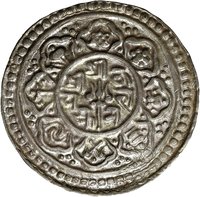
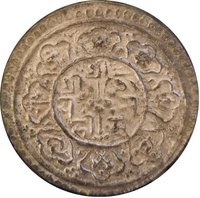
Obverse
Description:
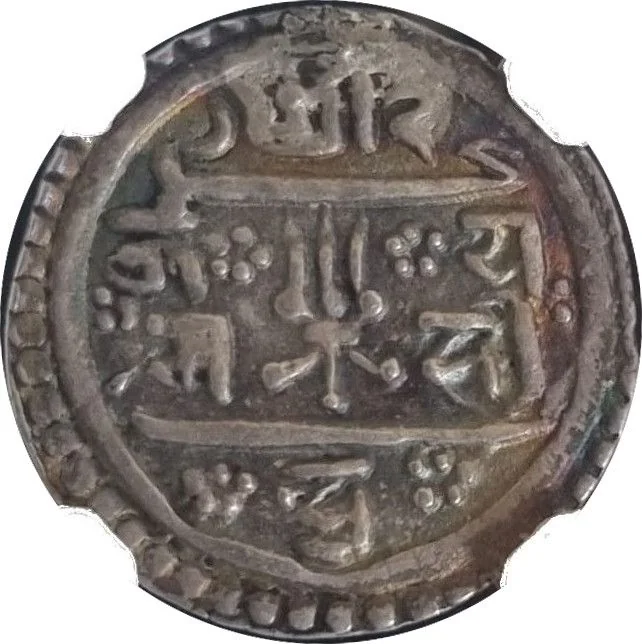
Trident logo with "Shri Jaya Mahindra"
Inscription:
श्री २
जय महिन्द्र
जय महिन्द्र
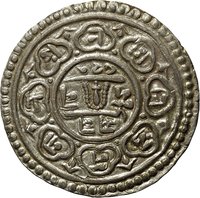
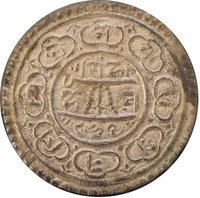
Reverse
Description:
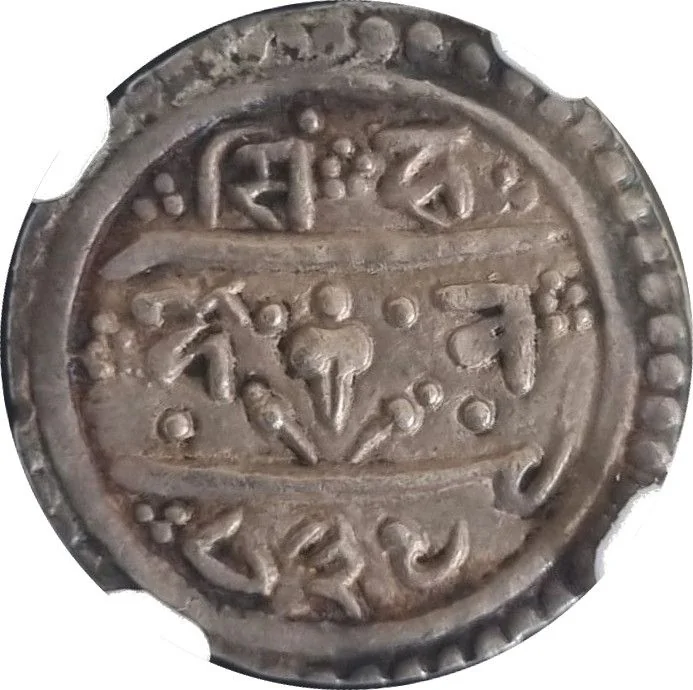
Conch with "Simha Dev 835" below.
Inscription:
सिम्ह देव
८३५
८३५
Edge
Mintings
| Year | Mint Mark | Mintage | Quality | Collection |
|---|---|---|---|---|
| 1715 | — | — |
Historical background
In 1715, the Kathmandu Valley was not a unified kingdom but a constellation of three rival city-states: Kathmandu, Patan, and Bhaktapur. Each was ruled by its own Malla king, engaged in constant political and economic competition. This fragmentation was directly reflected in the monetary system. While trade and culture flourished, the absence of a central minting authority meant that a variety of coins circulated, primarily silver mohars issued independently by each kingdom. These coins often bore similar iconography—such as the goddess Kali or symbols like the crescent moon—but subtle differences in weight, purity, and design underscored their separate origins, creating a complex environment for merchants.
The primary currency was silver, with the basic unit being the dam, and 128 dams equaling one silver mohar. However, the monetary landscape was notably heterogeneous. Alongside the local Malla coinage, older coins from previous regimes, as well as significant quantities of Mughal Indian rupees, circulated freely due to robust trans-Himalayan trade. This influx of foreign currency was essential, as the valley's economy was deeply integrated into broader South Asian trade networks, importing precious metals, spices, and textiles. The simultaneous use of multiple coinages required merchants and money changers (sarrafs) to be highly skilled in assessing the intrinsic metal value of each coin.
Furthermore, the period was one of relative stability and prosperity, which supported standardized minting within each city-state. Kings used coinage as a tool of legitimacy, inscribing their names and titles to assert sovereignty. However, this stability was precarious. The competitive minting and the reliance on external silver supplies made the economies vulnerable. The currency situation of 1715, therefore, was a microcosm of the valley's political state: sophisticated and commercially active, yet inherently fragmented and dependent on the delicate balance of power between the three Malla courts and the flow of trade from the plains of India.
The primary currency was silver, with the basic unit being the dam, and 128 dams equaling one silver mohar. However, the monetary landscape was notably heterogeneous. Alongside the local Malla coinage, older coins from previous regimes, as well as significant quantities of Mughal Indian rupees, circulated freely due to robust trans-Himalayan trade. This influx of foreign currency was essential, as the valley's economy was deeply integrated into broader South Asian trade networks, importing precious metals, spices, and textiles. The simultaneous use of multiple coinages required merchants and money changers (sarrafs) to be highly skilled in assessing the intrinsic metal value of each coin.
Furthermore, the period was one of relative stability and prosperity, which supported standardized minting within each city-state. Kings used coinage as a tool of legitimacy, inscribing their names and titles to assert sovereignty. However, this stability was precarious. The competitive minting and the reliance on external silver supplies made the economies vulnerable. The currency situation of 1715, therefore, was a microcosm of the valley's political state: sophisticated and commercially active, yet inherently fragmented and dependent on the delicate balance of power between the three Malla courts and the flow of trade from the plains of India.
✨ Legendary