

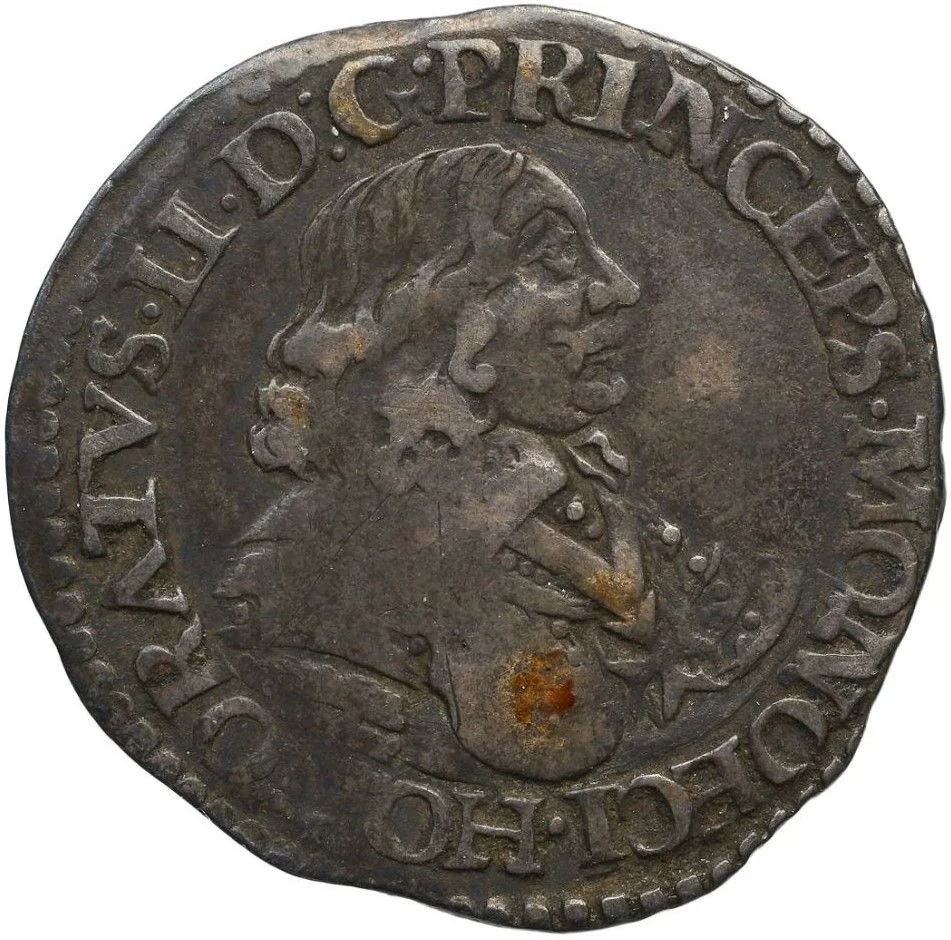
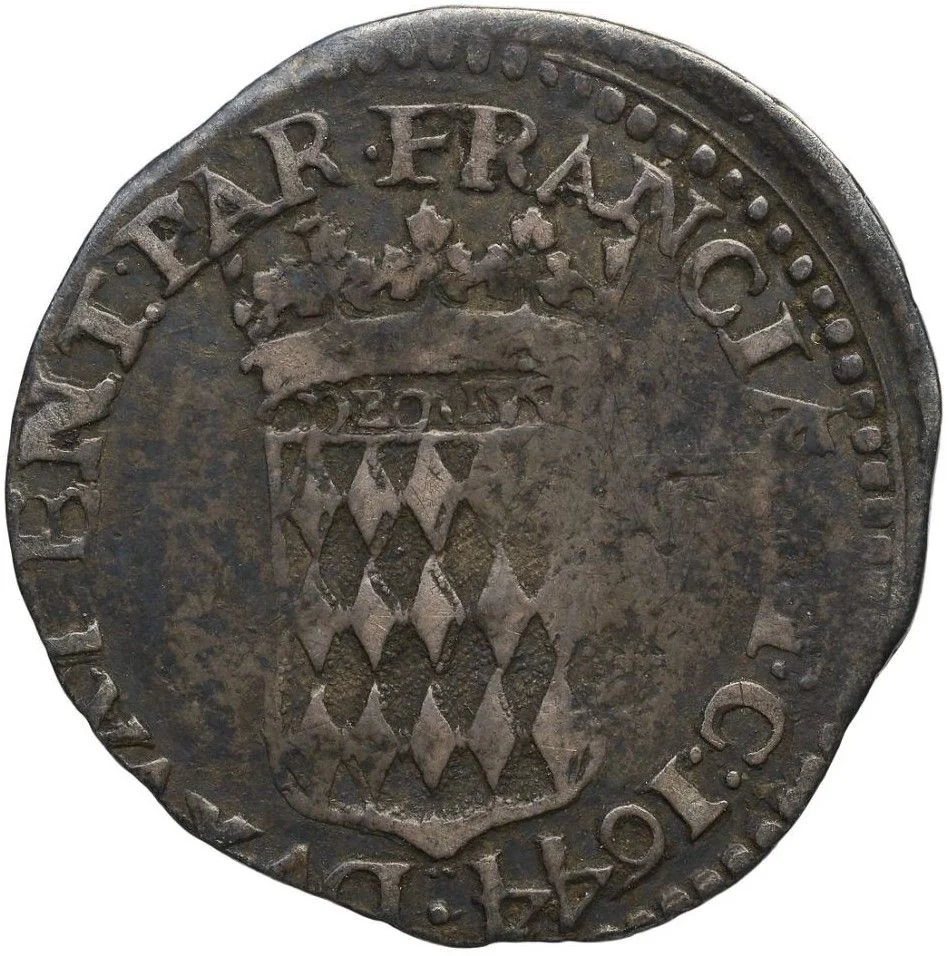
1⁄12 Ecu – Monaco
Monaco

Obverse
Description:
Honoré II, bust facing right.
Inscription:
HONORATVS. II. DG. PRINCEPS. MONOECI.
Script: Latin
Reverse
Edge
Plain
Mints
| Name | Mark |
|---|---|
| Monaco | — |
Mintings
| Year | Mint Mark | Mintage | Quality | Collection |
|---|---|---|---|---|
| 1644 | — | — |
Historical background
In 1644, Monaco’s currency situation was a complex tapestry woven from its political dependence and strategic Mediterranean location. As a protectorate of Spain since 1641, following a shift from French influence, the principality was nominally within the Spanish monetary sphere. The Spanish silver real and its larger unit, the peso or "piece of eight," were dominant in large trade and state finance, circulating alongside a plethora of other coins due to Monaco’s port and commercial activity. However, Spanish currency was often scarce at the local level, leading to a practical reliance on French, Italian (particularly Genoese and Savoyard), and even Ottoman coins for everyday transactions.
The real monetary authority in Monaco at this time was the Prince, Honoré II, who had notably secured his sovereign title and strengthened the principality’s institutions. While he did not mint a national currency in 1644, he exercised the right of battre monnaie (coinage rights), a key sovereign privilege. Any local minting would have been on a very limited scale, likely producing low-denomination copper or billon coins for local use to facilitate market exchanges and reduce dependence on fragmented foreign small change. The primary purpose was practical and symbolic, asserting autonomy within the constraints of Spanish hegemony.
Overall, the monetary landscape was one of de facto pluralism and inconsistency. The coexistence of multiple foreign currencies created challenges for commerce, requiring constant exchange and valuation based on metal weight and purity. This system was inherently unstable, subject to the fluctuating quality and supply of imported coinage. Therefore, while politically aligned with Spain, Monaco’s economy in 1644 operated on a heterogeneous mix of currencies, managed by the Prince’s pragmatic efforts to ensure liquidity and project a measure of independent princely authority.
The real monetary authority in Monaco at this time was the Prince, Honoré II, who had notably secured his sovereign title and strengthened the principality’s institutions. While he did not mint a national currency in 1644, he exercised the right of battre monnaie (coinage rights), a key sovereign privilege. Any local minting would have been on a very limited scale, likely producing low-denomination copper or billon coins for local use to facilitate market exchanges and reduce dependence on fragmented foreign small change. The primary purpose was practical and symbolic, asserting autonomy within the constraints of Spanish hegemony.
Overall, the monetary landscape was one of de facto pluralism and inconsistency. The coexistence of multiple foreign currencies created challenges for commerce, requiring constant exchange and valuation based on metal weight and purity. This system was inherently unstable, subject to the fluctuating quality and supply of imported coinage. Therefore, while politically aligned with Spain, Monaco’s economy in 1644 operated on a heterogeneous mix of currencies, managed by the Prince’s pragmatic efforts to ensure liquidity and project a measure of independent princely authority.

✨ Legendary