

1⁄16 Silver Ecu – France
France

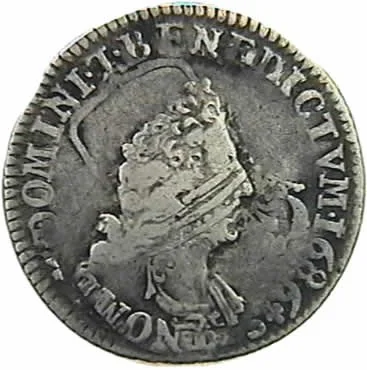
Obverse
Description:
Second Reformation issue, crescent after date. Right-facing bust of Louis XIV in cuirass and wig, sun above.
Inscription:
LVD. XIIII. D G. FR. ET. NAV. REX
Script: Latin
Engraver: Joseph Roëttiers
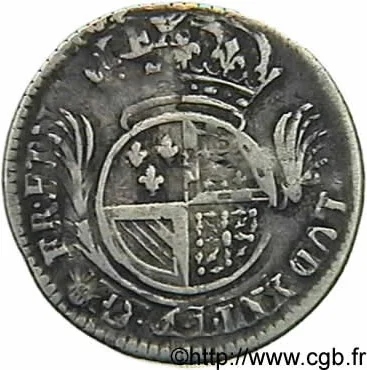
Reverse
Description:
Shield of France-Navarre-Burgundy, crowned, flanked by palms.
Inscription:
SIT. NOMEN. DOMINI BENEDICTVM. 1686
Script: Latin
Engraver: Joseph Roëttiers
Edge
Plain
Mints
| Name | Mark |
|---|---|
| Lille | W |
Historical background
In 1693, France was in the grip of a severe monetary and economic crisis, a direct consequence of King Louis XIV's relentless foreign wars, most notably the ongoing Nine Years' War (1688-1697). The state's finances were exhausted by the colossal cost of maintaining Europe's largest army and funding widespread military campaigns. To meet these obligations, the government, under Finance Minister Pontchartrain, resorted to desperate measures, including the sale of offices, borrowing at exorbitant rates, and most critically, the systematic debasement of the coinage.
This deliberate debasement took the form of repeated augmentations and diminutions: the official face value of existing gold and silver coins was arbitrarily raised by royal edict to draw more coin into the treasury, only to be later lowered to profit the crown when it re-minted them. Simultaneously, the mint began striking new coins with the same face value but containing significantly less precious metal. This practice shattered public confidence, as people hoarded old, full-weight coins (Gresham's Law in action) and the value of the currency became wildly unstable. The scarcity of sound money crippled commerce, while prices, particularly for grain, soared.
The situation was catastrophically compounded in 1693 by a harvest failure, leading to a devastating famine that killed an estimated two million people. The monetary chaos amplified the economic distress, as wages paid in debased coin bought less and less food. Thus, the currency crisis of 1693 was not an isolated financial event but a key component of a "general crisis" encompassing war finance, agricultural collapse, and immense human suffering, exposing the severe limitations of the Sun King's absolutist state when pushed beyond its fiscal means.
This deliberate debasement took the form of repeated augmentations and diminutions: the official face value of existing gold and silver coins was arbitrarily raised by royal edict to draw more coin into the treasury, only to be later lowered to profit the crown when it re-minted them. Simultaneously, the mint began striking new coins with the same face value but containing significantly less precious metal. This practice shattered public confidence, as people hoarded old, full-weight coins (Gresham's Law in action) and the value of the currency became wildly unstable. The scarcity of sound money crippled commerce, while prices, particularly for grain, soared.
The situation was catastrophically compounded in 1693 by a harvest failure, leading to a devastating famine that killed an estimated two million people. The monetary chaos amplified the economic distress, as wages paid in debased coin bought less and less food. Thus, the currency crisis of 1693 was not an isolated financial event but a key component of a "general crisis" encompassing war finance, agricultural collapse, and immense human suffering, exposing the severe limitations of the Sun King's absolutist state when pushed beyond its fiscal means.
Series: 1693 France circulation coins

✨ Legendary