

½ gold louis – France
Add to wishlist
France
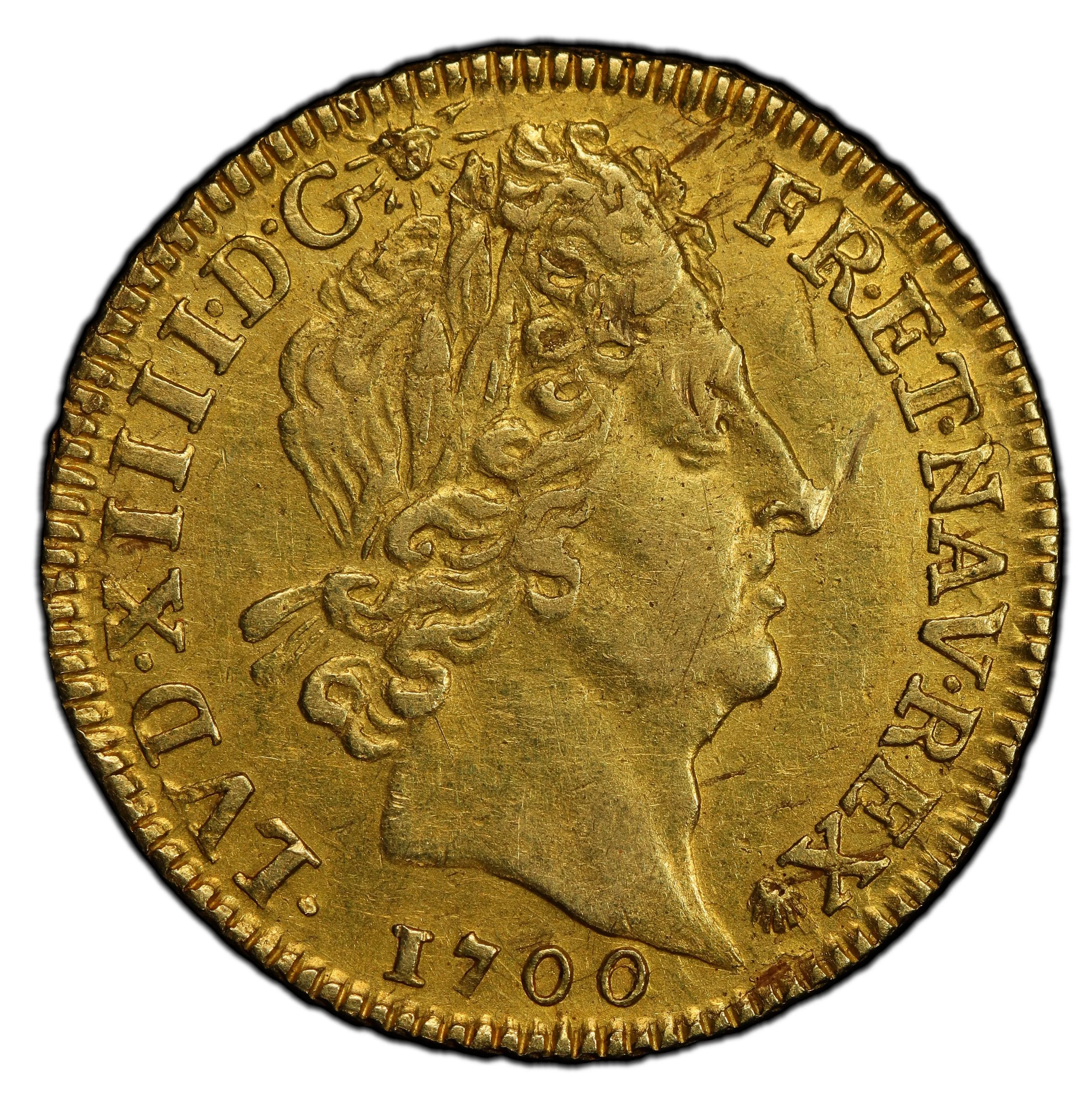
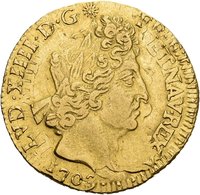
Obverse
Description:
Louis XIV laureate head right.
Inscription:
LVD. XIIII. D. G. FR. ET. NAV. REX
1700
1700
Script: Latin
Engraver: Joseph Roëttiers
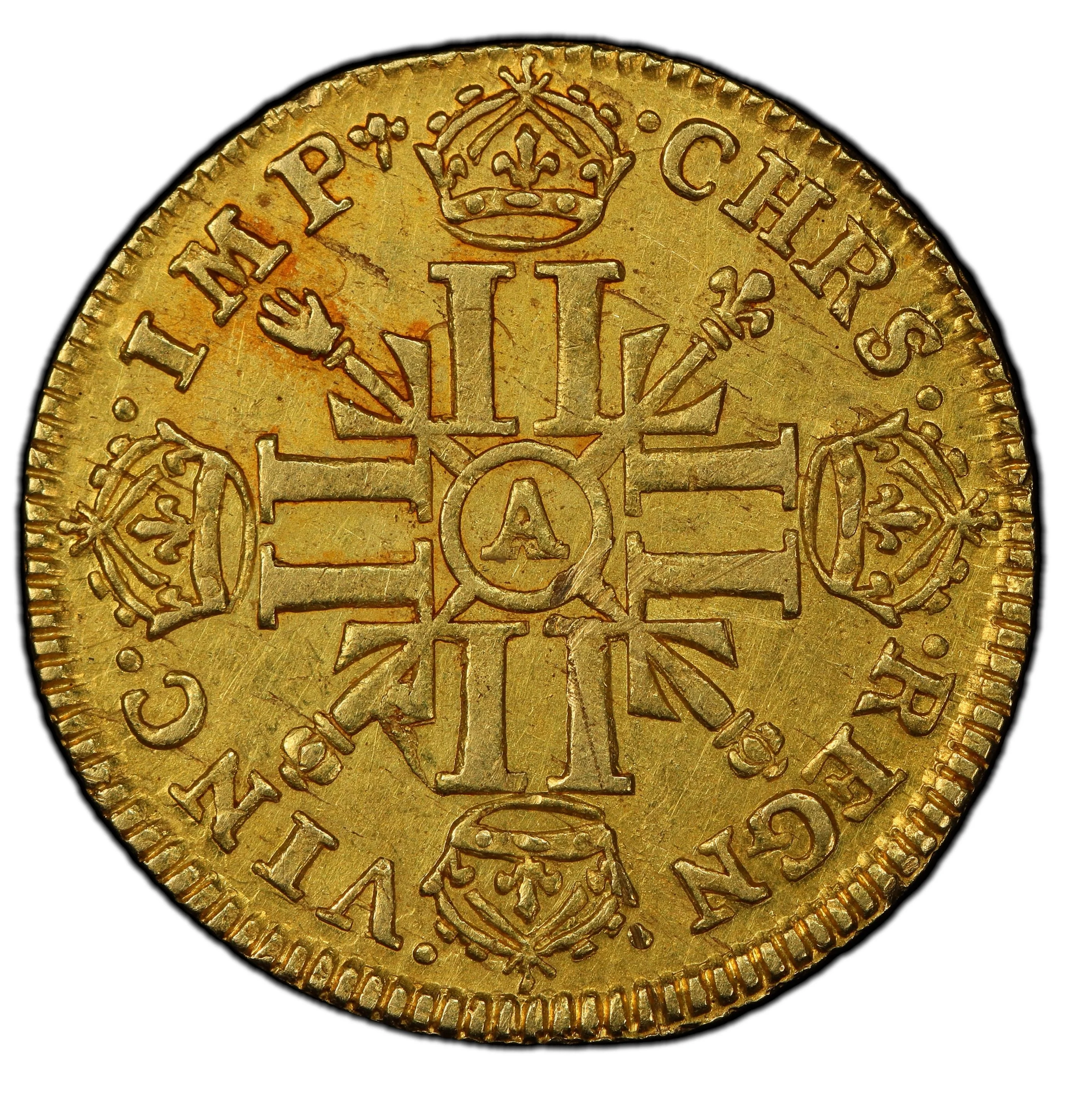
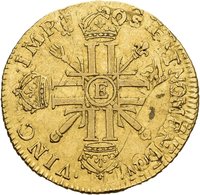
Reverse
Description:
Crowned cruciform with eight Ls, batons in angles, central mint mark.
Inscription:
CHRS. REGN. VINC. IMP.
A
A
Script: Latin
Engraver: Joseph Roëttiers
Edge
Corded slice
Mints
Mintings
| Year | Mint Mark | Mintage | Quality | Collection |
|---|---|---|---|---|
| 1700 | A | — | ||
| 1701 | & | — | ||
| 1701 | 9 | — | ||
| 1701 | A | — | ||
| 1701 | AA | — | ||
| 1701 | B | — | ||
| 1701 | C | — | ||
| 1701 | D | — | ||
| 1701 | G | — | ||
| 1701 | I | — | ||
| 1701 | K | — | ||
| 1701 | N | — | ||
| 1701 | O | — | ||
| 1701 | P | — | ||
| 1701 | S | — | ||
| 1701 | T | — | ||
| 1701 | W | — | ||
| 1701 | ↄc | — | ||
| 1702 | 9 | — | ||
| 1702 | A | — | ||
| 1702 | B | — | ||
| 1702 | C | — | ||
| 1702 | D | — | ||
| 1702 | E | — | ||
| 1702 | G | — | ||
| 1702 | H | — | ||
| 1702 | L | — | ||
| 1702 | M | — | ||
| 1702 | N | — | ||
| 1702 | O | — | ||
| 1702 | P | — | ||
| 1702 | S | — | ||
| 1702 | T | — | ||
| 1702 | V | — | ||
| 1702 | W | — | ||
| 1702 | X | — | ||
| 1702 | Y | — | ||
| 1703 | A | — | ||
| 1703 | B | — | ||
| 1703 | D | — | ||
| 1703 | H | — | ||
| 1703 | N | — | ||
| 1703 | O | — | ||
| 1703 | V | — | ||
| 1703 | W | — | ||
| 1704 | A | — | ||
| 1704 | T | — |
Historical background
In 1700, France was under the absolute monarchy of Louis XIV, and its currency system was a complex and often unstable relic of medieval practices. The nation operated on a bimetallic standard, with both gold (louis d'or) and silver (écu) coins in circulation. However, the official face value of these coins was not fixed to their precious metal content; instead, the royal government frequently issued edicts to alter their valuation in livres tournois (the money of account used for bookkeeping). This practice, known as augmentation (raising the coin's value) or diminution (lowering it), was a crude form of monetary policy used to manipulate state finances, often to fund the king's lavish spending and near-constant wars.
This system created profound economic uncertainty. The frequent re-evaluations of coinage disrupted trade, confused financial transactions, and led to widespread hoarding of older, intrinsically more valuable coins (Gresham's Law in action). Merchants and the public struggled with fluctuating prices and the confusion of calculating values between the actual coins and the abstract livre tournois. Furthermore, the monarchy often faced severe liquidity crises, as the intrinsic value of French coinage frequently fell below that of neighboring countries, leading to an outflow of gold and silver.
The situation was exacerbated by the dire state of royal finances, burdened by debt from previous conflicts and the immense cost of maintaining the Court of Versailles. The upcoming War of the Spanish Succession (1701-1714) would place even greater strain on this fragile system. While the Sun King's controller general of finances sought stability, the fundamental weakness of a manipulable bimetallic system, combined with fiscal desperation, set the stage for the severe monetary turmoil and experimental paper currency schemes, most notably John Law's System, that would characterize the early 18th century in France.
This system created profound economic uncertainty. The frequent re-evaluations of coinage disrupted trade, confused financial transactions, and led to widespread hoarding of older, intrinsically more valuable coins (Gresham's Law in action). Merchants and the public struggled with fluctuating prices and the confusion of calculating values between the actual coins and the abstract livre tournois. Furthermore, the monarchy often faced severe liquidity crises, as the intrinsic value of French coinage frequently fell below that of neighboring countries, leading to an outflow of gold and silver.
The situation was exacerbated by the dire state of royal finances, burdened by debt from previous conflicts and the immense cost of maintaining the Court of Versailles. The upcoming War of the Spanish Succession (1701-1714) would place even greater strain on this fragile system. While the Sun King's controller general of finances sought stability, the fundamental weakness of a manipulable bimetallic system, combined with fiscal desperation, set the stage for the severe monetary turmoil and experimental paper currency schemes, most notably John Law's System, that would characterize the early 18th century in France.
✨ Legendary