

1 copper öre – Sweden
Add to wishlist
Sweden
Context
Years: 1772–1778
Issuer: Sweden
Ruler: Gustav III
Currency:
(1719—1798)
Demonetized: Yes
Total mintage: 642,240
Material
References
KM: #
Numista: #37392
Obverse
Description:
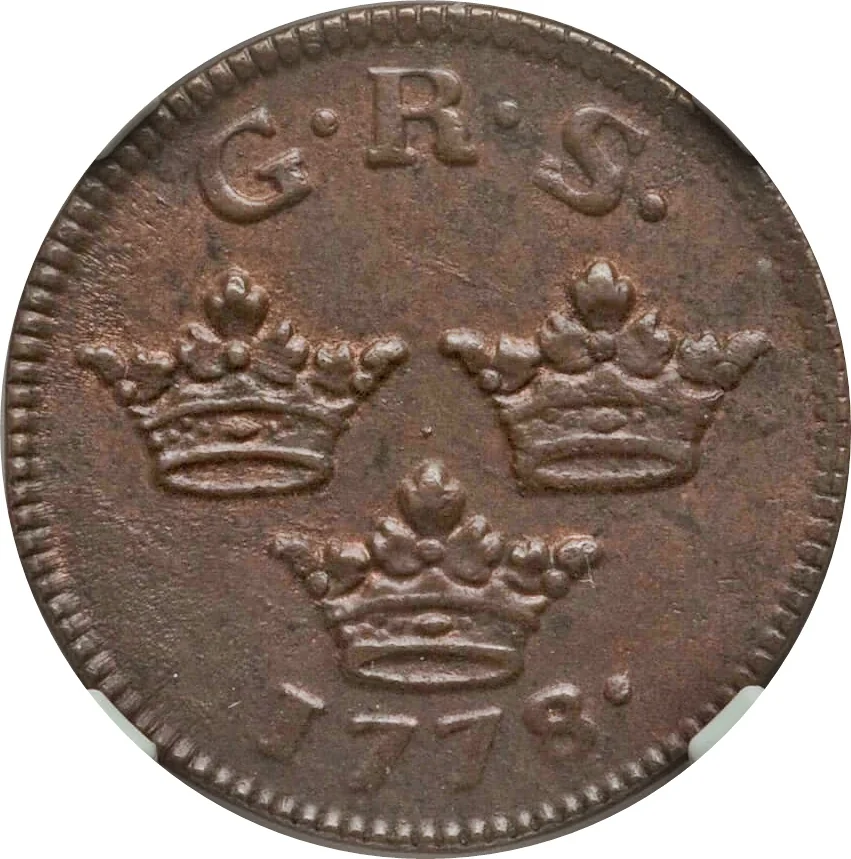
GRS above the Swedish Three Crowns. Date beneath.
Inscription:
G · R · S ·
1778 ·
1778 ·
Script: Latin
Reverse
Description:
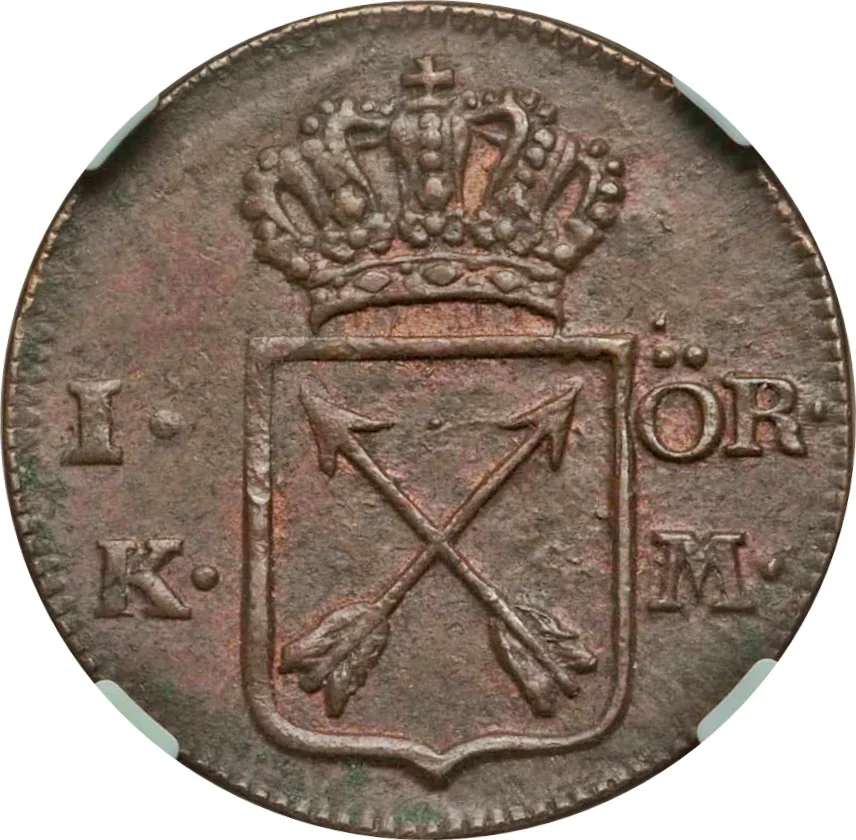
Shield with crown and crossed arrows divides value.
Inscription:
1 ÖR
K. M.
K. M.
Script: Latin
Edge
Plain
Mintings
| Year | Mint Mark | Mintage | Quality | Collection |
|---|---|---|---|---|
| 1772 | — | 66,240 | ||
| 1778 | — | 576,000 |
Historical background
In 1772, Sweden’s currency was in a state of profound crisis, a direct legacy of the extravagant spending and foreign subsidies of the "Age of Liberty" (1719-1772). To finance prolonged wars and domestic political machinations, the Riksdag (parliament) had for decades authorized the Riksbank to issue vast quantities of copper and silver mynt (coins) and, more destructively, paper credit notes called sedlar. This was done without adequate metallic backing, leading to severe inflation and a catastrophic loss of confidence in the paper money. By the early 1770s, the riksdaler specie (a unit of account for silver) was trading at a massive premium against the rapidly depreciating paper riksdaler, creating a chaotic dual-currency system that disrupted trade and public finances.
The situation reached a breaking point during the parliament of 1771-1772, where the competing "Hats" and "Caps" factions were deadlocked over monetary policy. The Hats, who had been primarily responsible for the reckless issuance, resisted drastic measures to protect their creditor allies, while the Caps demanded a painful stabilization through devaluation and reduced circulation. The result was a weak compromise that failed to address the core issue: the enormous overhang of unbacked paper notes. Public debt was staggering, and the metallic reserve of the Riksbank was nearly exhausted, rendering the paper currency almost worthless outside of forced official use.
This financial turmoil provided a crucial backdrop for the coup d'état of King Gustav III in August 1772. He explicitly cited the economic chaos and political paralysis over the currency as justification for seizing absolute power, promising to restore stability and national credit. Thus, the currency crisis of 1772 was not merely an economic problem but a pivotal political catalyst, directly undermining the fragile parliamentary system and enabling the return of royal autocracy in Sweden.
The situation reached a breaking point during the parliament of 1771-1772, where the competing "Hats" and "Caps" factions were deadlocked over monetary policy. The Hats, who had been primarily responsible for the reckless issuance, resisted drastic measures to protect their creditor allies, while the Caps demanded a painful stabilization through devaluation and reduced circulation. The result was a weak compromise that failed to address the core issue: the enormous overhang of unbacked paper notes. Public debt was staggering, and the metallic reserve of the Riksbank was nearly exhausted, rendering the paper currency almost worthless outside of forced official use.
This financial turmoil provided a crucial backdrop for the coup d'état of King Gustav III in August 1772. He explicitly cited the economic chaos and political paralysis over the currency as justification for seizing absolute power, promising to restore stability and national credit. Thus, the currency crisis of 1772 was not merely an economic problem but a pivotal political catalyst, directly undermining the fragile parliamentary system and enabling the return of royal autocracy in Sweden.
⭐ Rare