

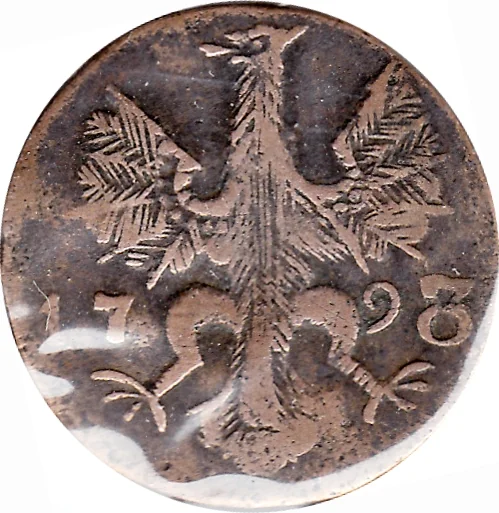

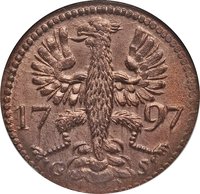
Obverse
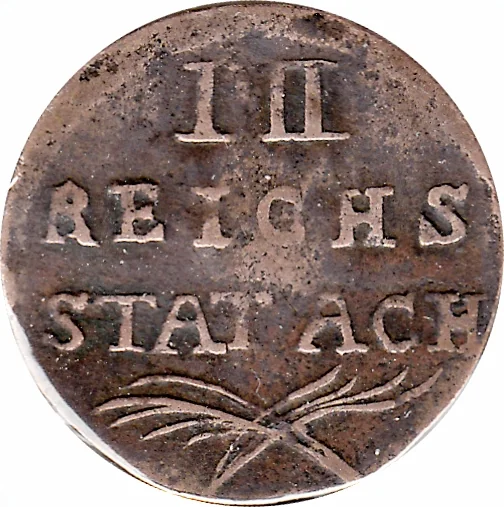
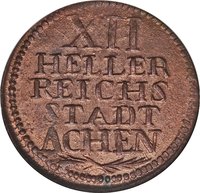
Reverse
Description:
Denomination above palm branches on three lines.
Inscription:
IIII
REICHS
STAT ACH
REICHS
STAT ACH
Script: Latin
Edge
Mintings
| Year | Mint Mark | Mintage | Quality | Collection |
|---|---|---|---|---|
| 1763 | — | — | ||
| 1765 | — | 185,000 | ||
| 1767 | — | 460,000 | ||
| 1790 | — | — | ||
| 1791 | — | — | ||
| 1792 | — | 400,000 | ||
| 1793 | — | 600,000 | ||
| 1795 | — | — | ||
| 1798 | — | — |
Historical background
In 1763, the Free Imperial City of Aachen, a historic center of trade and industry within the Holy Roman Empire, grappled with a complex and fragmented monetary landscape. The city did not possess the sovereign right to mint its own coinage; instead, it operated within a multi-layered system. Officially, it used the Reichsthaler and Gulden of the Holy Roman Empire, but in daily commerce, a plethora of circulating coins from neighboring territories like the Austrian Netherlands (featuring Patagon and Kreuzer coins), the United Provinces, and various German states created constant confusion. This proliferation of foreign currencies, each with fluctuating values and metal content, made trade cumbersome and facilitated fraud, posing a significant challenge to the city's merchants and guilds.
The situation was further complicated by the recent conclusion of the Seven Years' War in 1763, which had strained economies across Europe. The post-war period often saw currency debasement and inflationary pressures as states rebuilt their finances. For a commercial hub like Aachen, this meant increased uncertainty in the value of the foreign coins flooding its markets. The city council attempted to regulate exchange rates through official ordinances (Kurantordnungen), periodically publishing fixed values for the myriad of coins in circulation relative to the Reichsthaler. However, these official rates frequently conflicted with market-driven realities, leading to a dual system of "current money" (Kurantgeld) for official business and "common money" (Banco Geld) for everyday trade, with often unfavorable exchange premiums for citizens.
Ultimately, Aachen's currency woes in 1763 were a microcosm of the broader political fragmentation of the Holy Roman Empire. The city's lack of monetary sovereignty and its dependence on the unstable monetary policies of its powerful neighbors hindered efficient commerce and financial stability. This environment underscored the growing need for standardized and reliable currency, a challenge that would only be fully addressed centuries later with the unification of German currency systems. For Aachen's artisans and traders in 1763, however, daily business required navigating a dizzying and economically hazardous array of coins.
The situation was further complicated by the recent conclusion of the Seven Years' War in 1763, which had strained economies across Europe. The post-war period often saw currency debasement and inflationary pressures as states rebuilt their finances. For a commercial hub like Aachen, this meant increased uncertainty in the value of the foreign coins flooding its markets. The city council attempted to regulate exchange rates through official ordinances (Kurantordnungen), periodically publishing fixed values for the myriad of coins in circulation relative to the Reichsthaler. However, these official rates frequently conflicted with market-driven realities, leading to a dual system of "current money" (Kurantgeld) for official business and "common money" (Banco Geld) for everyday trade, with often unfavorable exchange premiums for citizens.
Ultimately, Aachen's currency woes in 1763 were a microcosm of the broader political fragmentation of the Holy Roman Empire. The city's lack of monetary sovereignty and its dependence on the unstable monetary policies of its powerful neighbors hindered efficient commerce and financial stability. This environment underscored the growing need for standardized and reliable currency, a challenge that would only be fully addressed centuries later with the unification of German currency systems. For Aachen's artisans and traders in 1763, however, daily business required navigating a dizzying and economically hazardous array of coins.
⭐ Rare