

1 Rupee – Mughal Empire
India
Context
Years: 1557–1577
Country: India 
Issuer: Mughal Empire
Ruler: Akbar
Currency:
(1540—1842)
Demonetized: Yes
Material
References
KM: #Click to copy to clipboard80.10
Numista: #367009
Value
Bullion value: $32.39
Obverse
Description:
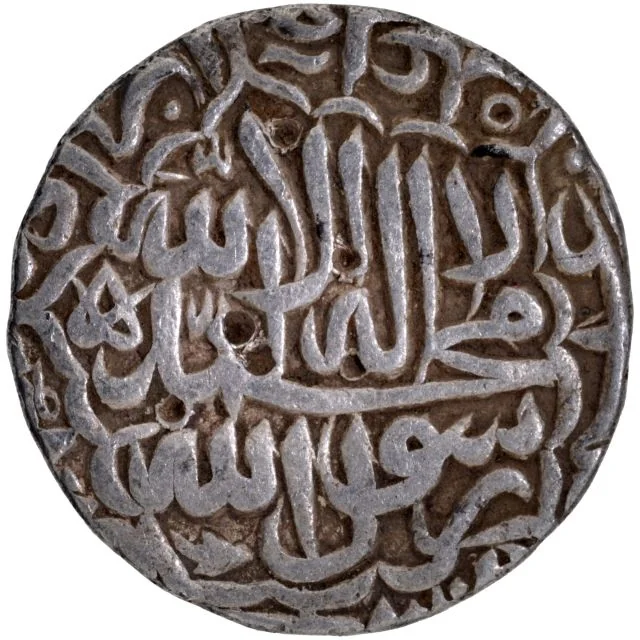
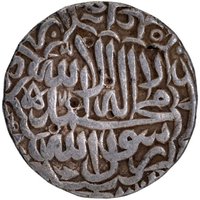
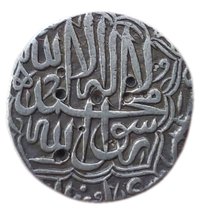
The Shahada and four Caliphs' names within a pentafoil.
Reverse
Description:
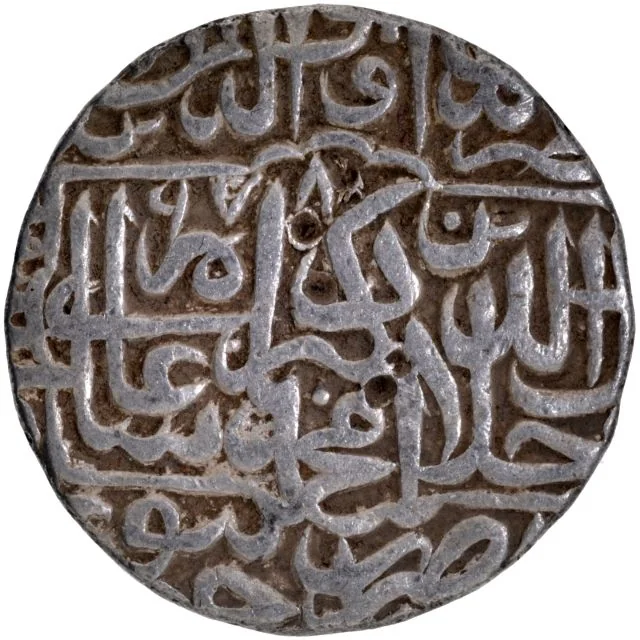
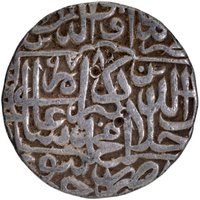
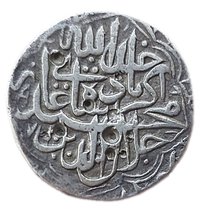
Top: Arabic "Nasir ud-Dunya wa'l din"
Middle: Persian "Jalal ud din Muhammad Akbar Badshah Ghazi" with Hijri year
Bottom: "zarb Jaunpur"
Middle: Persian "Jalal ud din Muhammad Akbar Badshah Ghazi" with Hijri year
Bottom: "zarb Jaunpur"
Edge
Mintings
| Year | Mint Mark | Mintage | Quality | Collection |
|---|---|---|---|---|
| 1557 | — | — | ||
| 1559 | — | — | ||
| 1560 | — | — | ||
| 1561 | — | — | ||
| 1563 | — | — | ||
| 1564 | — | — | ||
| 1565 | — | — | ||
| 1566 | — | — | ||
| 1566 | — | — | ||
| 1567 | — | — | ||
| 1568 | — | — | ||
| 1569 | — | — | ||
| 1570 | — | — | ||
| 1571 | — | — | ||
| 1572 | — | — | ||
| 1573 | — | — | ||
| 1574 | — | — | ||
| 1575 | — | — | ||
| 1576 | — | — | ||
| 1577 | — | — |
Historical background
In 1557, the Mughal Empire's currency system was in a formative stage under the reign of its second emperor, Humayun, who had recently regained his throne after a period of exile. The monetary framework was largely inherited from the preceding Delhi Sultanate and the Sur Empire, which had established a sophisticated tri-metallic system. The primary coins were the silver rupiya (the precursor to the modern rupee), the gold mohur, and the copper dam. The dam, valued at 1/40th of a silver rupiya, served as the essential small-change currency for daily market transactions and revenue assessments.
However, the political instability of the mid-16th century directly impacted the currency's uniformity and authority. While the imperial mints in major cities like Delhi, Agra, and Lahore produced coins of reliable weight and purity, the control over minting was not yet fully centralized. Regional satraps and powerful nobles often operated their own mints, leading to variations in coinage across the empire. Furthermore, the extensive circulation of older Sultanate, Suri, and even foreign coins, like the silver tanka, meant the monetary landscape was diverse but not yet standardized under a single, imperially enforced standard.
The situation was poised for a major transformation. Humayun died in early 1556, and by 1557, his young son Akbar was on the throne, with Bayram Khan acting as regent. The empire was still consolidating its military and political control after the Second Battle of Panipat (1556). Therefore, in 1557, the currency system was functional and inherited a strong legacy, but it awaited the administrative genius of Emperor Akbar, who would later, from the 1560s onward, rigorously centralize minting, standardize weights and designs across the empire, and fully integrate the coinage system with the land revenue administration, creating one of the pre-modern world's most stable and prestigious currencies.
However, the political instability of the mid-16th century directly impacted the currency's uniformity and authority. While the imperial mints in major cities like Delhi, Agra, and Lahore produced coins of reliable weight and purity, the control over minting was not yet fully centralized. Regional satraps and powerful nobles often operated their own mints, leading to variations in coinage across the empire. Furthermore, the extensive circulation of older Sultanate, Suri, and even foreign coins, like the silver tanka, meant the monetary landscape was diverse but not yet standardized under a single, imperially enforced standard.
The situation was poised for a major transformation. Humayun died in early 1556, and by 1557, his young son Akbar was on the throne, with Bayram Khan acting as regent. The empire was still consolidating its military and political control after the Second Battle of Panipat (1556). Therefore, in 1557, the currency system was functional and inherited a strong legacy, but it awaited the administrative genius of Emperor Akbar, who would later, from the 1560s onward, rigorously centralize minting, standardize weights and designs across the empire, and fully integrate the coinage system with the land revenue administration, creating one of the pre-modern world's most stable and prestigious currencies.
✨ Legendary