

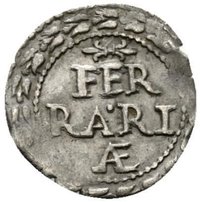
1 Quattrino – Ferrara
Italy
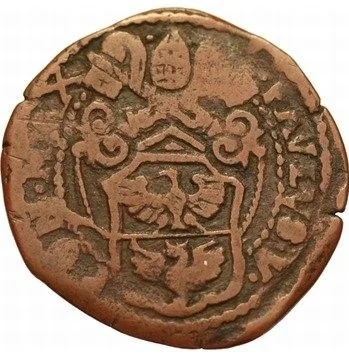
Obverse
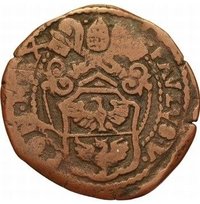
Description:
Borghese arms beneath the Papal tiara and crossed keys.
Inscription:
⠂PAVLVS ⠂V PON ⠂MAX
Script: Latin
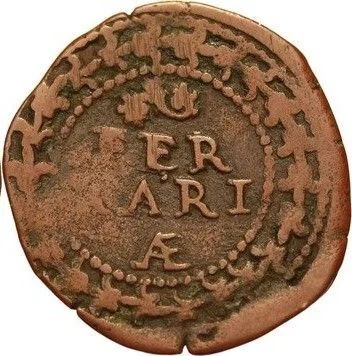
Reverse
Edge
Mints
| Name | Mark |
|---|---|
| Ferrara | — |
Mintings
| Year | Mint Mark | Mintage | Quality | Collection |
|---|---|---|---|---|
| — | — | — |
Historical background
In 1605, the currency situation in the Duchy of Ferrara was defined by a complex and unstable monetary environment, a direct consequence of the Devolution of Ferrara to the Papal States in 1598. Following the death of the last Este duke, Alfonso II, without a legitimate heir, Pope Clement VIII reclaimed the territory as a lapsed fief. This political transition severed Ferrara from the Este monetary system that had historically linked it to the minting traditions of Modena and Reggio, integrating it instead into the sprawling and often chaotic Papal monetary sphere.
The city now operated under a bimetallic system of silver scudi and copper baiocchi, but faced significant practical challenges. Papal coinage circulated alongside a multitude of foreign currencies, particularly Venetian ducats and Florentine florins, due to Ferrara's key position in the trade routes of the Po Valley. This led to frequent exchange rate fluctuations and rampant currency speculation. Furthermore, the Papal administration struggled with the chronic debasement of subsidiary coinage, a common issue across Italy, where the intrinsic metal value often fell below the face value, causing inflation in everyday transactions and eroding public trust.
Consequently, merchants and citizens in Ferrara in 1605 navigated a precarious financial landscape. The coexistence of multiple coinages, combined with the inflationary pressure from debased copper coins, created uncertainty in both local markets and regional commerce. This monetary instability reflected the broader administrative and economic adjustments—and growing pains—of a city under new sovereign rule, still finding its footing within the Papal States' fiscal system nearly a decade after the devolution.
The city now operated under a bimetallic system of silver scudi and copper baiocchi, but faced significant practical challenges. Papal coinage circulated alongside a multitude of foreign currencies, particularly Venetian ducats and Florentine florins, due to Ferrara's key position in the trade routes of the Po Valley. This led to frequent exchange rate fluctuations and rampant currency speculation. Furthermore, the Papal administration struggled with the chronic debasement of subsidiary coinage, a common issue across Italy, where the intrinsic metal value often fell below the face value, causing inflation in everyday transactions and eroding public trust.
Consequently, merchants and citizens in Ferrara in 1605 navigated a precarious financial landscape. The coexistence of multiple coinages, combined with the inflationary pressure from debased copper coins, created uncertainty in both local markets and regional commerce. This monetary instability reflected the broader administrative and economic adjustments—and growing pains—of a city under new sovereign rule, still finding its footing within the Papal States' fiscal system nearly a decade after the devolution.
✨ Legendary