

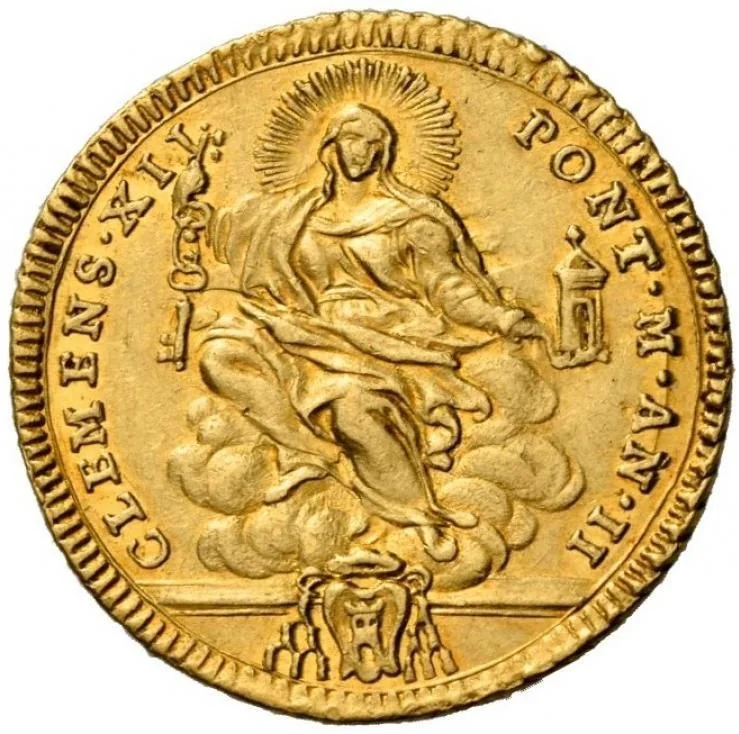
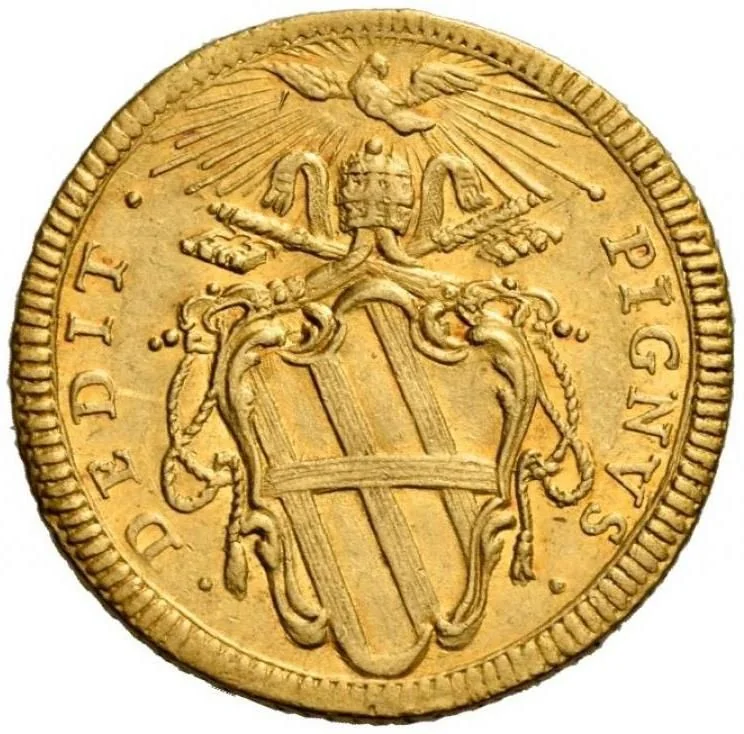
2 Zecchini – Papal States
Vatican City
Context
Years: 1731–1739
Country: Vatican City 
Issuer: Papal States
Ruler: Clement XII
Currency:
(1534—1835)
Demonetized: Yes
Material
References
KM: #Click to copy to clipboard855
Numista: #363914
Value
Bullion value: $1149.31
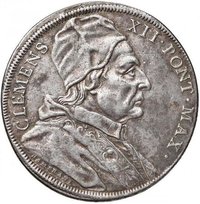
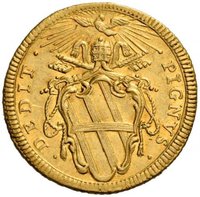
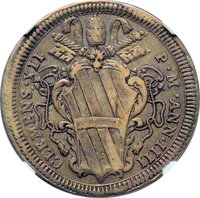
Obverse
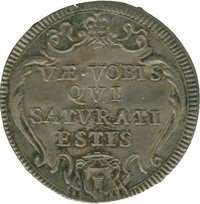
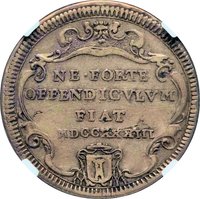
Reverse
Edge
Stringed
Mints
| Name | Mark |
|---|---|
| Rome | — |
Mintings
| Year | Mint Mark | Mintage | Quality | Collection |
|---|---|---|---|---|
| 1731 | — | — | ||
| 1739 | — | — |
Historical background
In 1731, the Papal States' currency system was a complex and fragmented mosaic, reflecting its political and economic reality. The state lacked a unified, centrally managed coinage. Instead, multiple minting authorities—primarily in Rome and Bologna, but also in other cities like Ancona and Avignon—issued their own coins. These included silver scudi, giuli, and baiochi, and copper quattrini, often with varying weights and fineness. This proliferation created a confusing monetary landscape where the value of a coin depended not only on its metal content but also on its place of origin, leading to frequent disputes and inefficiency in regional trade.
Economically, the Papal States faced significant pressure from a chronic shortage of precious metals, particularly silver. This scarcity was exacerbated by a negative trade balance, as imports from Northern Europe often exceeded exports of agricultural goods and silk. Consequently, the government frequently resorted to debasement—reducing the silver content in coins while maintaining their face value—as a short-term fiscal measure to raise revenue. This practice, however, eroded public trust in the currency, encouraged hoarding of older, purer coins (Gresham's Law in action), and fueled inflation, placing a burden on the populace.
The situation was further complicated by the circulation of a vast array of foreign coins, especially Spanish silver reales and gold doppie from Genoa and Florence, which were essential for larger commercial transactions. The papal monetary authorities, under the Camera Apostolica, struggled to set and enforce consistent exchange rates (corso) between these foreign currencies and the local issues. Therefore, the monetary picture in 1731 was one of weak central control, inflationary pressures from debasement, and a reliance on external currencies, highlighting the broader administrative and economic challenges facing the Papal States in the early 18th century.
Economically, the Papal States faced significant pressure from a chronic shortage of precious metals, particularly silver. This scarcity was exacerbated by a negative trade balance, as imports from Northern Europe often exceeded exports of agricultural goods and silk. Consequently, the government frequently resorted to debasement—reducing the silver content in coins while maintaining their face value—as a short-term fiscal measure to raise revenue. This practice, however, eroded public trust in the currency, encouraged hoarding of older, purer coins (Gresham's Law in action), and fueled inflation, placing a burden on the populace.
The situation was further complicated by the circulation of a vast array of foreign coins, especially Spanish silver reales and gold doppie from Genoa and Florence, which were essential for larger commercial transactions. The papal monetary authorities, under the Camera Apostolica, struggled to set and enforce consistent exchange rates (corso) between these foreign currencies and the local issues. Therefore, the monetary picture in 1731 was one of weak central control, inflationary pressures from debasement, and a reliance on external currencies, highlighting the broader administrative and economic challenges facing the Papal States in the early 18th century.
✨ Legendary