

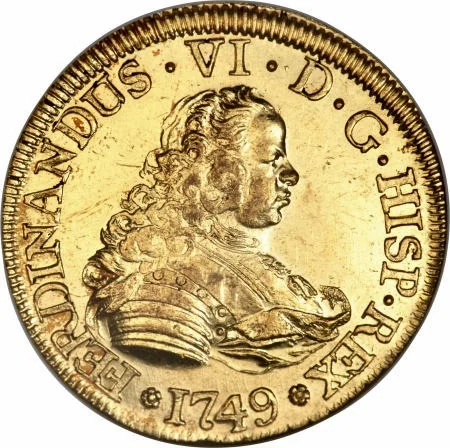
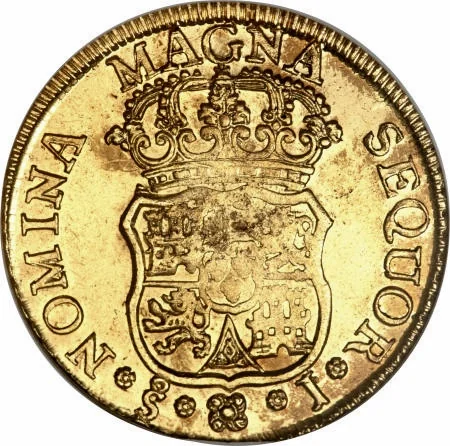
4 Escudos – Chile
Chile
Context
Years: 1749–1758
Issuer: Chile 
Ruler: Ferdinand VI
Currency:
(1541—1852)
Demonetized: Yes
Total mintage: 37,418
Material
References
KM: #Click to copy to clipboard2
Numista: #36351
Value
Bullion value: $2068.67
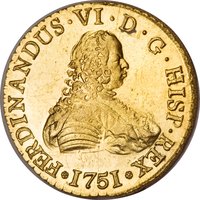
Obverse
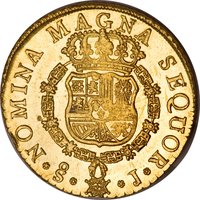
Reverse
Edge
Mints
| Name | Mark |
|---|---|
| Casa de Moneda de Chile | (So) |
Mintings
| Year | Mint Mark | Mintage | Quality | Collection |
|---|---|---|---|---|
| 1749 | So | 26,693 | ||
| 1750 | So | 9,580 | ||
| 1752 | So | 678 | ||
| 1758 | So | 467 |
Historical background
In 1749, the currency situation in the Kingdom of Chile, a remote captaincy general of the Spanish Empire, was characterized by severe scarcity and the circulation of a chaotic mix of official and improvised monies. The Spanish Crown's official silver reales and gold escudos were chronically in short supply due to the colony's economic structure; Chile exported primarily agricultural products to Peru, but its imports and royal administrative costs required sending its limited precious metals north. This created a persistent monetary drain, leaving the local economy starved for a reliable medium of exchange.
To facilitate daily trade, Chileans relied heavily on moneda macuquina—crudely cut and clipped cob coins from various Spanish American mints—as well as a substantial volume of debased and counterfeit coins. Most notably, due to the sheer lack of small change, common commodities themselves became de facto currency. Tobacco, wheat, barley, and even dried chili peppers were widely used in transactions and for paying obligations, a system that was cumbersome and inefficient. The situation was exacerbated by the distance from the viceregal capital in Lima and the slowness of communication with Spain, making coordinated monetary policy nearly impossible.
The year 1749 fell within a period of attempted reform. The Spanish Bourbon monarchs were seeking to centralize and regulate colonial economies, but effective solutions for Chile were elusive. While the Royal Mint in Santiago had been established in 1743, it operated intermittently and could not alone solve the structural deficit. Therefore, the background of 1749 is one of transition and frustration: a colonial administration grappling with the disconnect between imperial monetary ideals and the local reality of a cash-poor society functioning on a patchwork of commodity money and irregular coin.
To facilitate daily trade, Chileans relied heavily on moneda macuquina—crudely cut and clipped cob coins from various Spanish American mints—as well as a substantial volume of debased and counterfeit coins. Most notably, due to the sheer lack of small change, common commodities themselves became de facto currency. Tobacco, wheat, barley, and even dried chili peppers were widely used in transactions and for paying obligations, a system that was cumbersome and inefficient. The situation was exacerbated by the distance from the viceregal capital in Lima and the slowness of communication with Spain, making coordinated monetary policy nearly impossible.
The year 1749 fell within a period of attempted reform. The Spanish Bourbon monarchs were seeking to centralize and regulate colonial economies, but effective solutions for Chile were elusive. While the Royal Mint in Santiago had been established in 1743, it operated intermittently and could not alone solve the structural deficit. Therefore, the background of 1749 is one of transition and frustration: a colonial administration grappling with the disconnect between imperial monetary ideals and the local reality of a cash-poor society functioning on a patchwork of commodity money and irregular coin.
✨ Legendary