

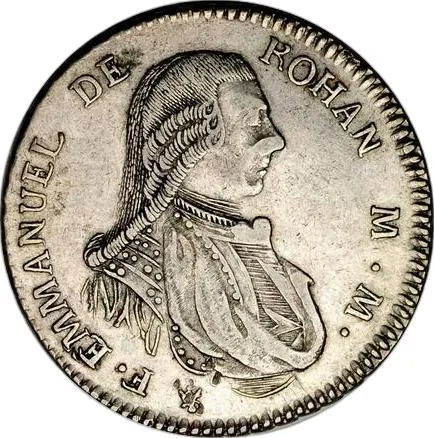
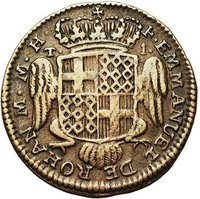
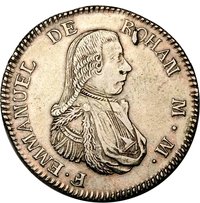
Obverse
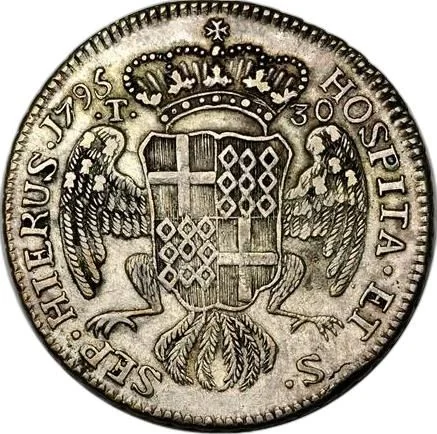
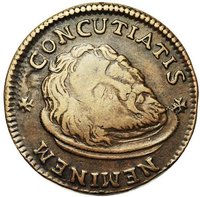
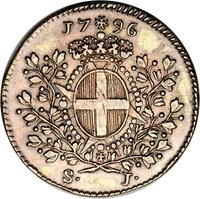
Reverse
Edge
Flaky in relief
Mintings
| Year | Mint Mark | Mintage | Quality | Collection |
|---|---|---|---|---|
| 1789 | — | — | ||
| 1790 | — | — | ||
| 1795 | — | — | ||
| 1796 | — | — |
Historical background
In 1789, Malta's currency situation was complex and reflected its unique position as a strategic Mediterranean hub under the rule of the Sovereign Military Order of St. John. The islands did not have a single, unified monetary system. Instead, circulation was dominated by a multitude of foreign coins, primarily Spanish silver reales (particularly the famous "piece of eight") and their fractional units. These coins were the de facto standard for larger transactions and international trade, which was the lifeblood of the Maltese economy. Alongside these, various Italian, French, and Ottoman coins also circulated, their value determined by their precious metal content and prevailing exchange rates set by merchants.
The Order of St. John attempted to impose order by minting its own copper and silver coins, such as the scudo, tarì, and grani. However, these local issues often struggled to gain full public confidence and were insufficient in volume to displace the entrenched foreign currencies. This created a dual system: official accounting by the Order's treasury was done in scudi, tarì, and grani, while actual commerce was conducted using a patchwork of foreign specie. The constant inflow and outflow of coins from merchants, corsairs, and the Order's own European estates made the money supply unstable.
Furthermore, the period was one of growing financial strain for the Order. By 1789, its resources were stretched thin due to costly fortification projects and a gradual decline in traditional revenue from European holdings. This fiscal pressure, combined with the chaotic circulation, led to periodic shortages of small change, complicating everyday transactions for the populace. The system was therefore fragile, reliant on external monetary flows, and ill-prepared for the coming European upheavals of the Napoleonic Wars, which would culminate in the French invasion of Malta just a decade later in 1798.
The Order of St. John attempted to impose order by minting its own copper and silver coins, such as the scudo, tarì, and grani. However, these local issues often struggled to gain full public confidence and were insufficient in volume to displace the entrenched foreign currencies. This created a dual system: official accounting by the Order's treasury was done in scudi, tarì, and grani, while actual commerce was conducted using a patchwork of foreign specie. The constant inflow and outflow of coins from merchants, corsairs, and the Order's own European estates made the money supply unstable.
Furthermore, the period was one of growing financial strain for the Order. By 1789, its resources were stretched thin due to costly fortification projects and a gradual decline in traditional revenue from European holdings. This fiscal pressure, combined with the chaotic circulation, led to periodic shortages of small change, complicating everyday transactions for the populace. The system was therefore fragile, reliant on external monetary flows, and ill-prepared for the coming European upheavals of the Napoleonic Wars, which would culminate in the French invasion of Malta just a decade later in 1798.
✨ Legendary