

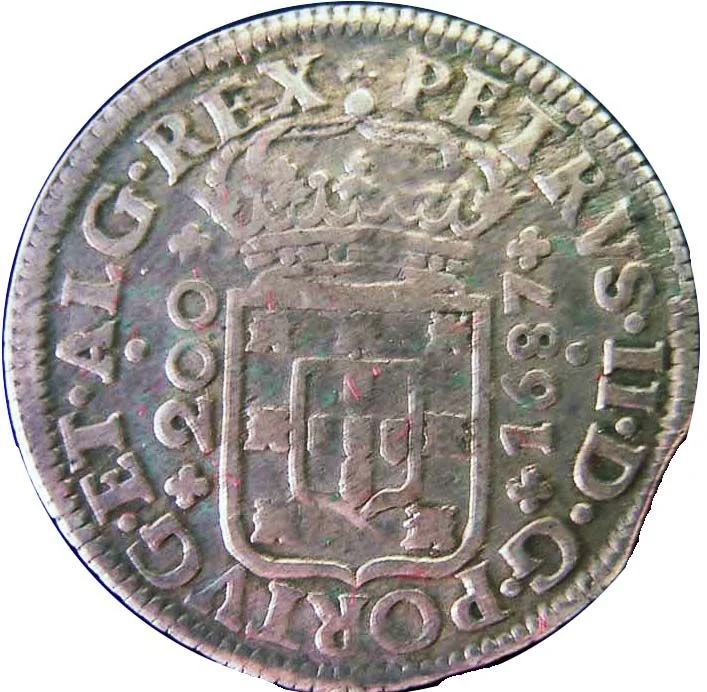
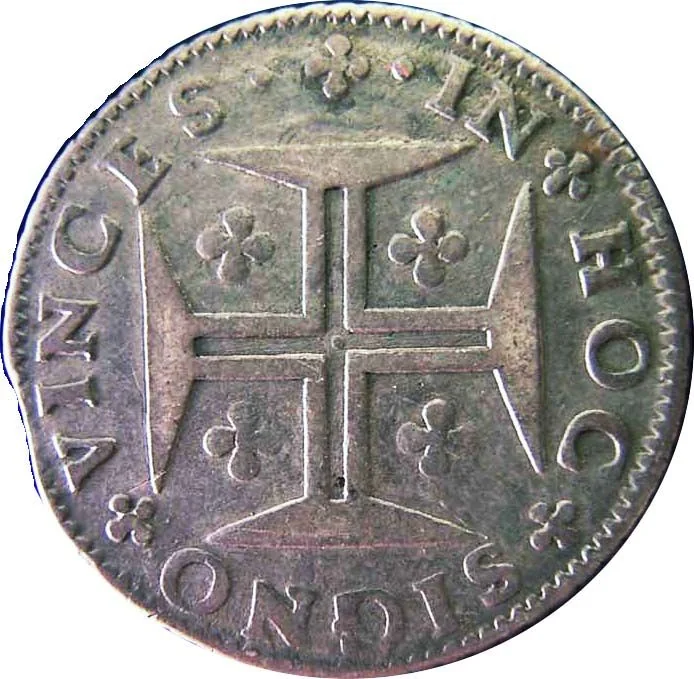
½ Cruzado/200 Réis – Portugal
Portugal
Context

Material
References
KM: #Click to copy to clipboard148
Numista: #362052
Value
Bullion value: $22.93
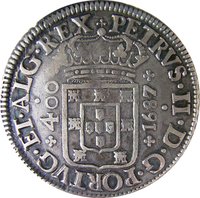
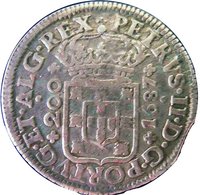
Obverse
Inscription:
PETRVS • II • D • G • PORT • ET • ALG • REX
200
1687
200
1687
Script: Latin
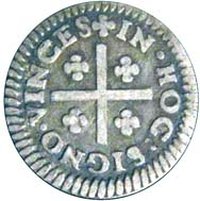
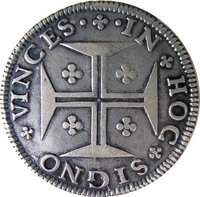
Reverse
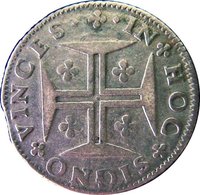
Inscription:
+ IN • HOC • SIGNO • VINCES
Script: Latin
Edge
Rope shaped
Categories
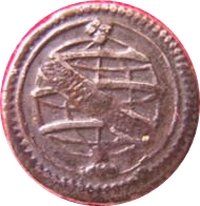
| Symbols> Coat of Arms |
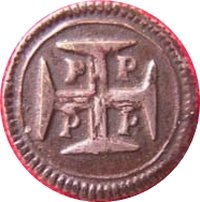
| Symbol> Cross |
Mints
| Name | Mark |
|---|---|
| Imprensa Nacional - Casa da Moeda | — |
Mintings
| Year | Mint Mark | Mintage | Quality | Collection |
|---|---|---|---|---|
| 1686 | — | — | ||
| 1687 | — | — |
Historical background
In 1686, Portugal's currency situation was characterized by significant instability and a chronic shortage of circulating coinage, a legacy of the preceding decades. The kingdom was still recovering from the Restoration War (1640-1668) with Spain, which had drained the treasury and disrupted trade. Furthermore, the Brazilian gold boom, which would soon flood Portugal with precious metals and stabilize its currency, had not yet begun in earnest. Consequently, the circulating medium was a chaotic mix of undervalued Portuguese coins (which were hoarded or exported), worn Spanish reales from the period of Iberian Union, and a variety of foreign coins, leading to erratic valuations and hampering commerce.
The government of King Pedro II attempted to address this through a major monetary reform in 1688, the planning for which was actively underway in 1686. The primary goal was to re-establish a strong, unified national currency. This involved recalling old, debased coinage and minting new silver cruzados and tostões at a higher intrinsic value. The reform aimed to restore public confidence in the currency, attract foreign coin into the royal mints for recoinage, and simplify the complex and dysfunctional system of accounting, where values were often stated in the abstract real of account rather than in physical coins.
Therefore, the currency situation in 1686 was one of transition and anticipation. It was a period defined by the pressures of a strained economy operating with a degraded and inadequate monetary stock, while the state prepared a decisive intervention. The success of the 1688 reform would be limited in the short term, as the fundamental scarcity of precious metals persisted. True monetary stability would only arrive in the early 18th century with the massive influx of gold from Minas Gerais in Brazil, which finally provided the bullion base for a robust and stable currency system.
The government of King Pedro II attempted to address this through a major monetary reform in 1688, the planning for which was actively underway in 1686. The primary goal was to re-establish a strong, unified national currency. This involved recalling old, debased coinage and minting new silver cruzados and tostões at a higher intrinsic value. The reform aimed to restore public confidence in the currency, attract foreign coin into the royal mints for recoinage, and simplify the complex and dysfunctional system of accounting, where values were often stated in the abstract real of account rather than in physical coins.
Therefore, the currency situation in 1686 was one of transition and anticipation. It was a period defined by the pressures of a strained economy operating with a degraded and inadequate monetary stock, while the state prepared a decisive intervention. The success of the 1688 reform would be limited in the short term, as the fundamental scarcity of precious metals persisted. True monetary stability would only arrive in the early 18th century with the massive influx of gold from Minas Gerais in Brazil, which finally provided the bullion base for a robust and stable currency system.
Series: 1686 Portugal circulation coins

✨ Legendary