

6 Sols – Duchy of Luxembourg
Luxembourg
Context
Years: 1775–1777
Country: Luxembourg 
Issuer: Duchy of Luxembourg
Demonetized: Yes
Total mintage: 149,369
Material
References
KM: #Click to copy to clipboard8
Numista: #36179
Value
Bullion value: $6.01
Obverse
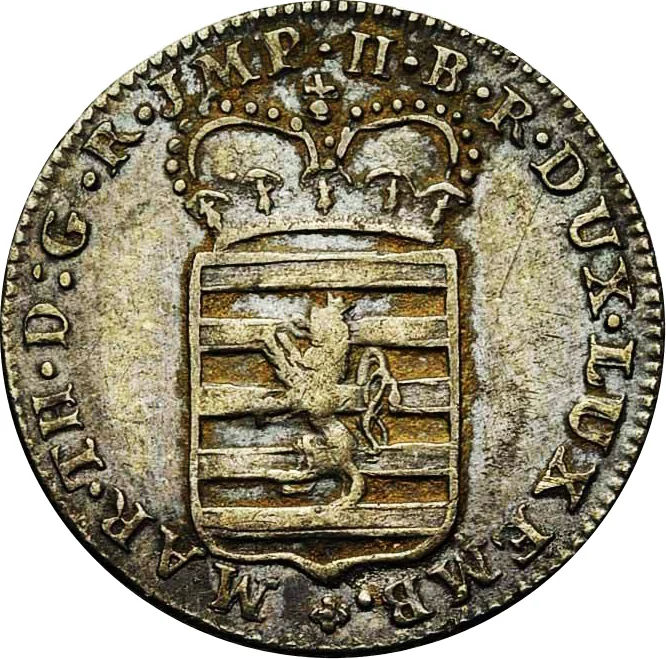
Description:
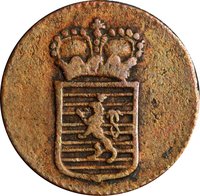
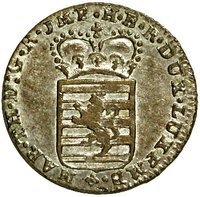
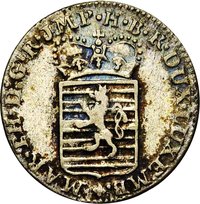
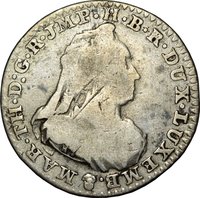
Luxembourgish shield with legend, angel's head below, surrounded by pearling.
Inscription:
MAR•TH•D:G•R•JMP•H•B•R•DUX•LUXEMB•+
Script: Latin
Reverse
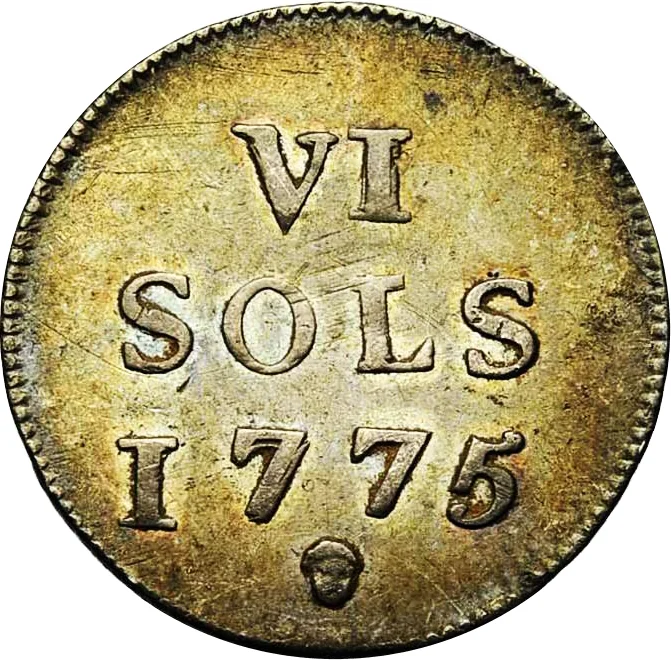
Description:
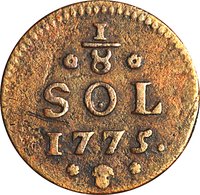
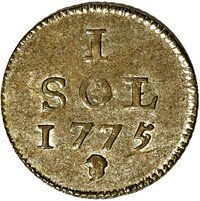
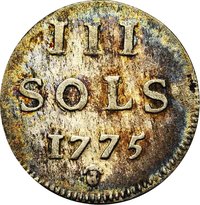
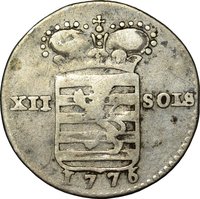
Face value and year
in three lines,
below an angel's head (Brussels).
in three lines,
below an angel's head (Brussels).
Inscription:
VI
SOLS
1775
SOLS
1775
Script: Latin
Edge
Plain
Mints
| Name | Mark |
|---|---|
| Royal Mint of Belgium | — |
Mintings
| Year | Mint Mark | Mintage | Quality | Collection |
|---|---|---|---|---|
| 1775 | — | 71,477 | ||
| 1777 | — | 77,892 |
Historical background
In 1775, the Duchy of Luxembourg, then part of the Austrian Netherlands under Habsburg rule, faced a complex and challenging monetary landscape. The circulation was dominated not by a single, authoritative currency, but by a chaotic mix of foreign and domestic coins. Austrian kronenthalers and stuivers circulated alongside French louis d'or and livres, Dutch guilders, and even older Spanish and Brabantian issues. This proliferation created significant confusion in trade, as the value of transactions depended on constantly fluctuating exchange rates between these various metallic coins, many of which were worn or clipped, reducing their intrinsic silver or gold content.
The root of this disorder lay in Luxembourg's geopolitical position as a crossroads of European powers and its lack of sovereign minting authority. While the Habsburg authorities in Brussels issued decrees attempting to fix exchange rates, their control was limited in practice. The monetary system was essentially commodity-based, reliant on the bullion value of the coins themselves, which made it vulnerable to arbitrage and speculation. Merchants and money changers held significant power, often to the detriment of peasants and smaller tradesmen who struggled with the inconsistent valuations.
Consequently, economic activity in the Duchy was hampered by this instability, which increased transaction costs and fostered uncertainty. While not unique in 18th-century Europe, Luxembourg's particular blend of circulating currencies reflected its fragmented political allegiances and the weakness of central monetary policy from Vienna. This situation would persist until the sweeping reforms of the French Revolutionary and Napoleonic eras, which later imposed a unified franc-based system across the region.
The root of this disorder lay in Luxembourg's geopolitical position as a crossroads of European powers and its lack of sovereign minting authority. While the Habsburg authorities in Brussels issued decrees attempting to fix exchange rates, their control was limited in practice. The monetary system was essentially commodity-based, reliant on the bullion value of the coins themselves, which made it vulnerable to arbitrage and speculation. Merchants and money changers held significant power, often to the detriment of peasants and smaller tradesmen who struggled with the inconsistent valuations.
Consequently, economic activity in the Duchy was hampered by this instability, which increased transaction costs and fostered uncertainty. While not unique in 18th-century Europe, Luxembourg's particular blend of circulating currencies reflected its fragmented political allegiances and the weakness of central monetary policy from Vienna. This situation would persist until the sweeping reforms of the French Revolutionary and Napoleonic eras, which later imposed a unified franc-based system across the region.
✨ Legendary