

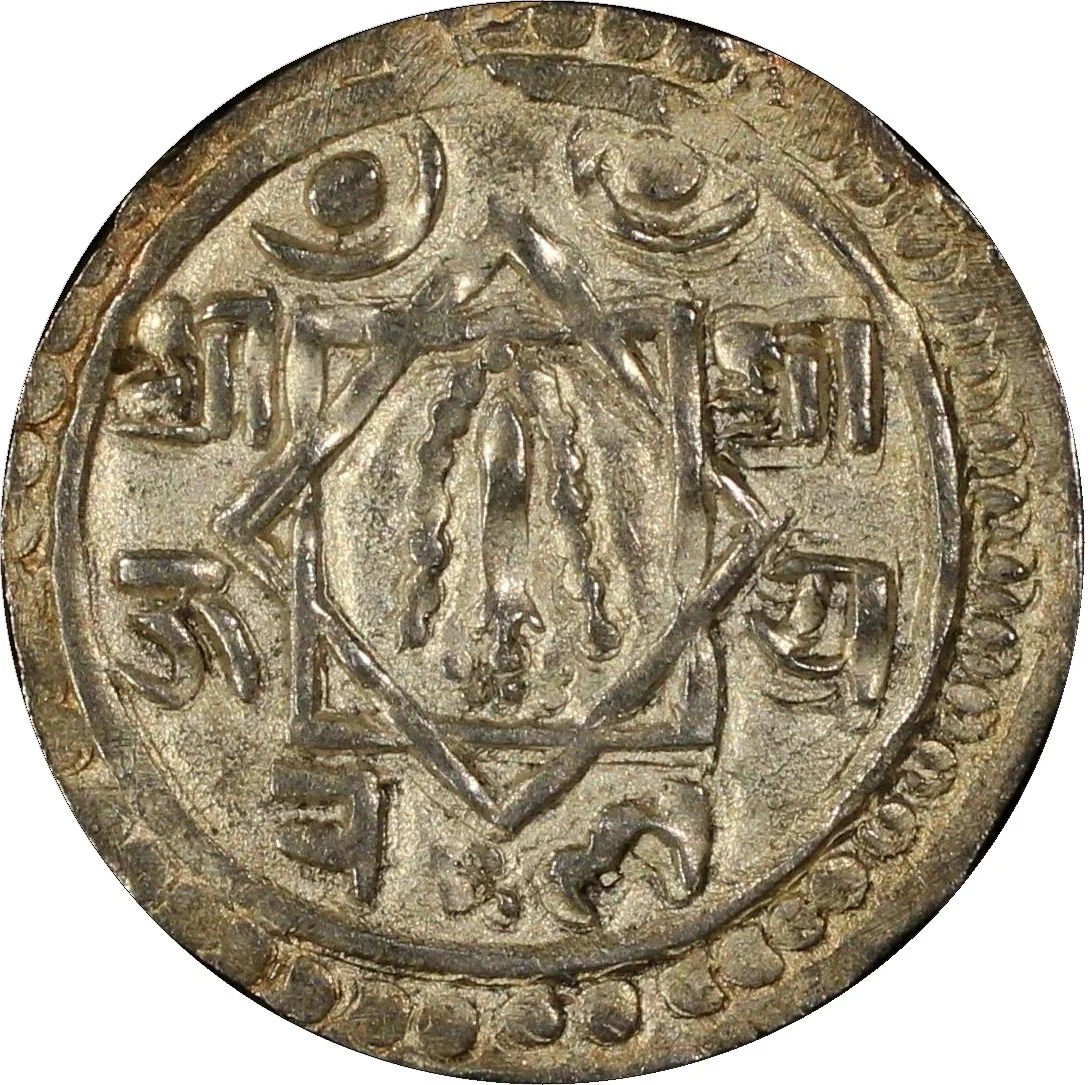
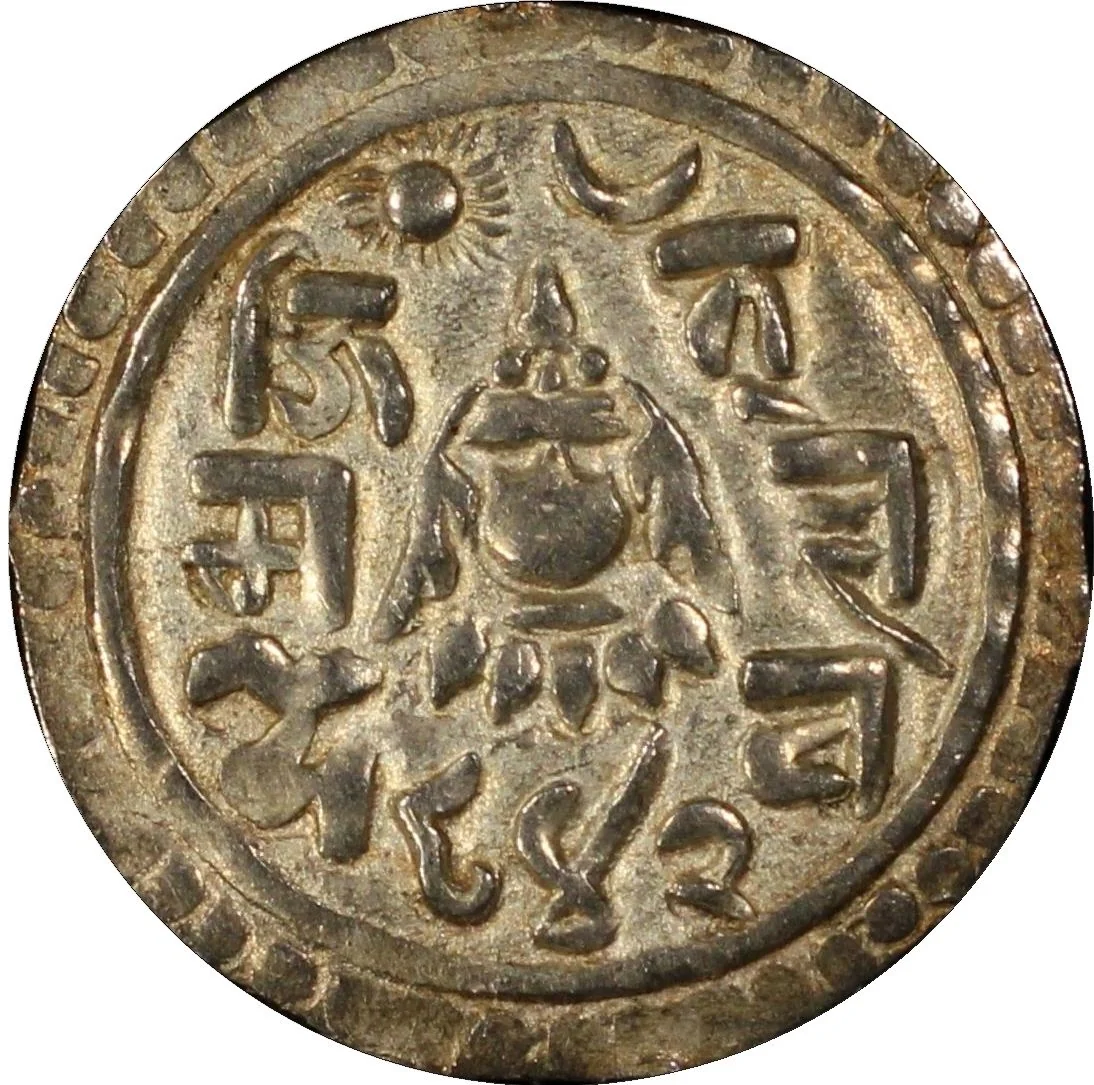
¼ mohar – Bhaktapur Kingdom
Add to wishlist
Nepal
Context
Year: 1722
Nepal Sambat Year:: 842
Country: Nepal
Issuer: Bhaktapur Kingdom
Ruler: Ranajit Malla
Currency:
(1546—1932)
Demonetized: Yes
Material
References
KM: #
Numista: #361685
Value
Bullion value: $3.37
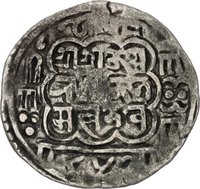
Obverse
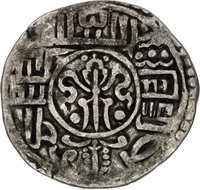
Reverse
Edge
Mintings
| Year | Mint Mark | Mintage | Quality | Collection |
|---|---|---|---|---|
| 1722 | — | — |
Historical background
In 1722, the Bhaktapur Kingdom, one of the three rival Newar city-states in the Kathmandu Valley (alongside Kathmandu and Patan), operated within a complex and sophisticated monetary system. The kingdom minted its own distinct coinage, primarily small silver dam or tanka coins, often stamped with the symbols of the ruling Malla dynasty, such as the goddess Kali or a conch shell. These coins were not just economic instruments but also statements of sovereignty and religious devotion, circulating alongside the coinage of the other Malla kingdoms and various Indian rupees that entered through robust trans-Himalayan trade.
The period was one of relative stability but underlying tension. While the Malla courts were renowned patrons of art and culture, the kingdoms were frequently in competition, leading to occasional warfare and shifting alliances. This political fragmentation meant that, despite shared cultural and economic ties, each city-state strictly controlled its own mint. The value and purity of Bhaktapur's coinage were therefore a direct reflection of its economic health and the authority of its king, Bhupatindra Malla (r. 1696-1722), whose reign was ending in this very year. His extensive architectural projects, like the magnificent Nyatapola Temple, demanded significant treasury reserves and a stable currency to finance labour and materials.
Economically, Bhaktapur's currency facilitated a vibrant urban and agricultural economy, as well as its critical role as a hub on the trade route between Tibet and India. Coins were essential for taxes, temple donations, and market transactions in its famed squares. However, the system faced pressures from the debasement of neighbouring coinages and the inflow of foreign silver. The death of Bhupatindra Malla in 1722 potentially introduced a period of uncertainty, as the succession could impact fiscal policy and coinage integrity, setting the stage for the continued struggles that would eventually lead to the valley's unification by the Gorkhas a few decades later.
The period was one of relative stability but underlying tension. While the Malla courts were renowned patrons of art and culture, the kingdoms were frequently in competition, leading to occasional warfare and shifting alliances. This political fragmentation meant that, despite shared cultural and economic ties, each city-state strictly controlled its own mint. The value and purity of Bhaktapur's coinage were therefore a direct reflection of its economic health and the authority of its king, Bhupatindra Malla (r. 1696-1722), whose reign was ending in this very year. His extensive architectural projects, like the magnificent Nyatapola Temple, demanded significant treasury reserves and a stable currency to finance labour and materials.
Economically, Bhaktapur's currency facilitated a vibrant urban and agricultural economy, as well as its critical role as a hub on the trade route between Tibet and India. Coins were essential for taxes, temple donations, and market transactions in its famed squares. However, the system faced pressures from the debasement of neighbouring coinages and the inflow of foreign silver. The death of Bhupatindra Malla in 1722 potentially introduced a period of uncertainty, as the succession could impact fiscal policy and coinage integrity, setting the stage for the continued struggles that would eventually lead to the valley's unification by the Gorkhas a few decades later.
✨ Legendary