

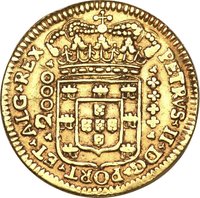
Obverse
Description:
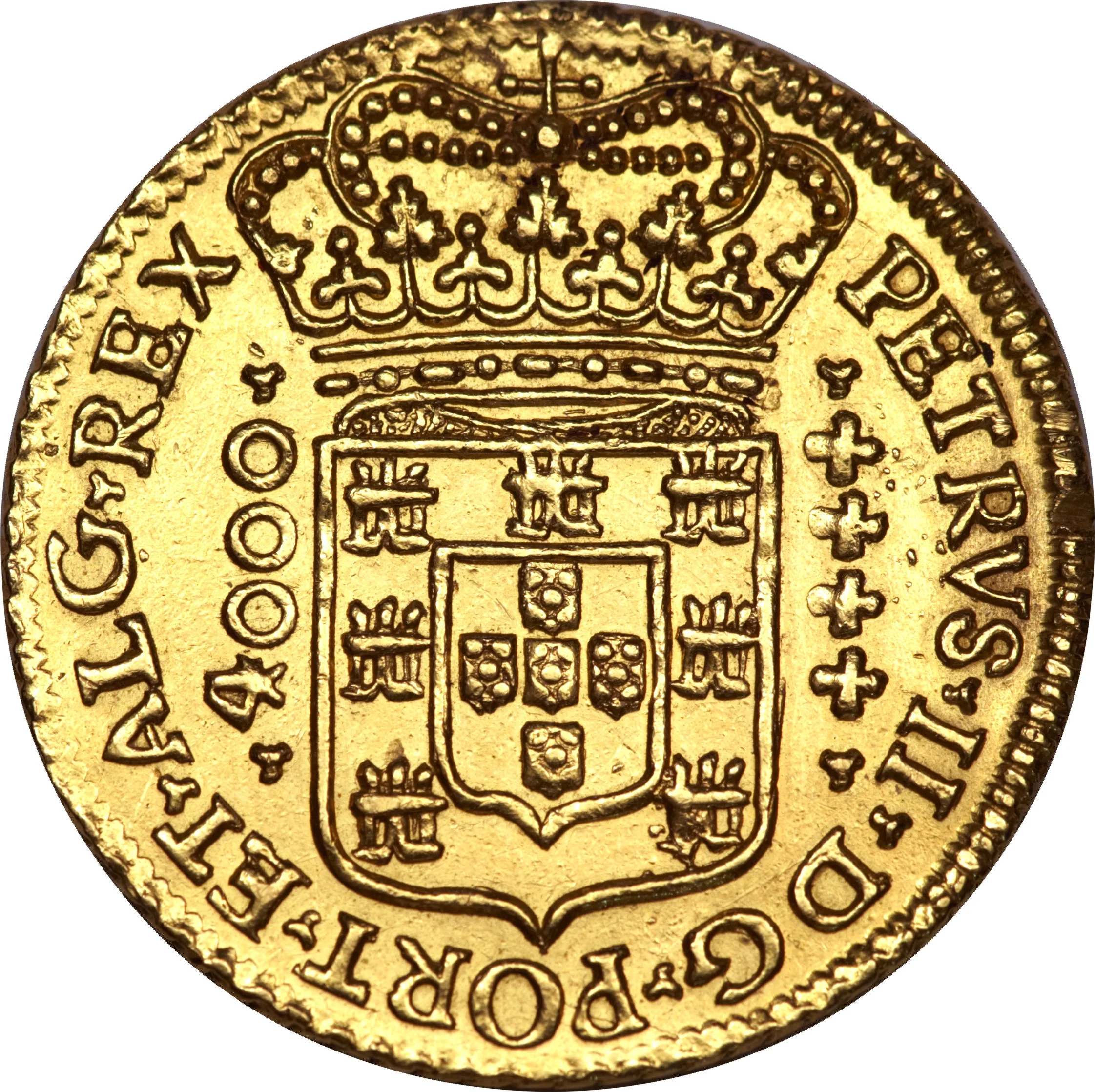
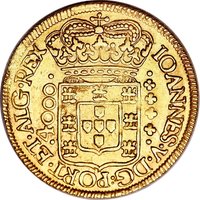
Portuguese arms, 4000 value, four crossheads.
Inscription:
PETRVS.II.DG.PORT.ET ALG.REX
Script: Latin
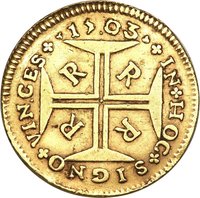
Reverse
Description:
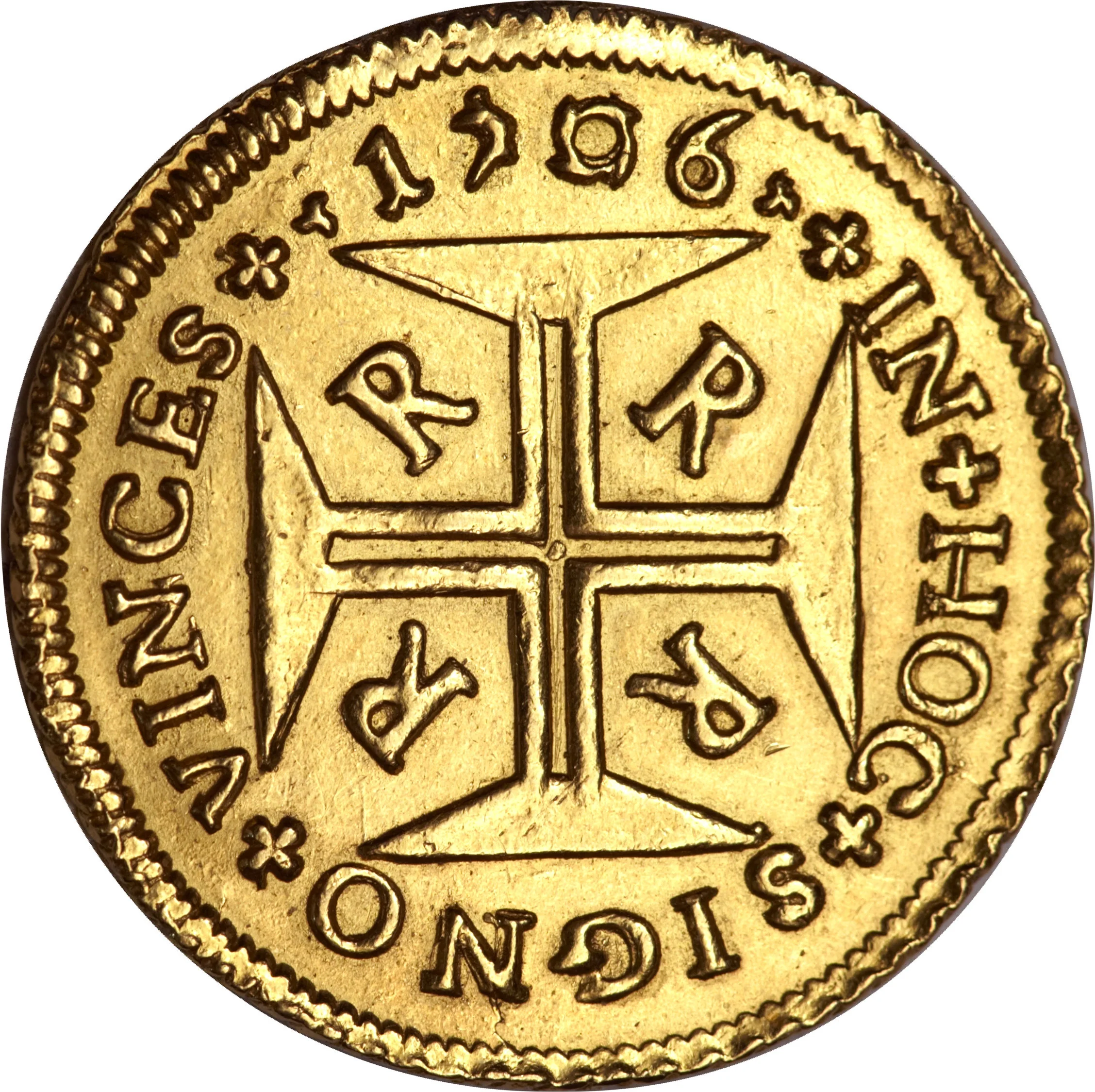
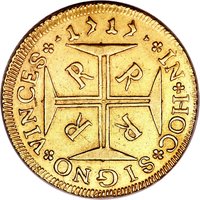
Cross of the Order of Christ with date and four diagonally-arranged "R" letters.
Inscription:
IN HOC SIGNO VINCES
RRRR
RRRR
Script: Latin
Edge
Reeded.
Mints
| Name | Mark |
|---|---|
| Casa da Moeda do Brasil | RRRR |
Mintings
Historical background
In 1703, Brazil's currency situation was intrinsically tied to its colonial status under Portugal and the transformative economic impact of the Minas Gerais gold rush, which had begun in earnest just a few years prior. The primary circulating medium was a chaotic mix of Portuguese coins, including réis (the base unit of account), Spanish-American pieces of eight, and a vast array of crudely minted local "clipped" coins that were often debased. This scarcity of official coinage, coupled with the sheer distance from Lisbon, led to widespread use of commodity money, most notably sugar, which served as a de facto currency for large transactions and tax payments, its value fluctuating with the volatile European market.
The discovery of vast gold deposits in the late 1690s was beginning to fundamentally alter this system, though its full effects were still in their infancy in 1703. Gold dust itself immediately entered circulation as a high-value medium of exchange, but the lack of a local mint meant it was traded by weight and purity, leading to fraud and disputes. The Portuguese Crown, recognizing the immense fiscal opportunity, had just implemented the quinto (a royal tax of one-fifth of all gold mined) in 1702, and was actively seeking to control and monetize the flow of wealth. The first official shipments of Brazilian gold to Lisbon were underway, destined to be minted into coin and, in time, recirculate back to the colony.
Consequently, the monetary landscape in 1703 was one of transition and strain. The sugar-based economy of the northeastern coast coexisted uneasily with the booming, gold-driven economy of the southeastern interior. Severe currency scarcity persisted outside the mining zones, hindering everyday commerce and perpetuating a system reliant on barter and unstable commodity valuations. The Portuguese monarchy, focused on extracting wealth, had not yet established the necessary infrastructure—like a mint in Brazil—to create a stable, unified currency system, leaving the colony in a period of monetary fragmentation on the cusp of a golden, but disruptive, transformation.
The discovery of vast gold deposits in the late 1690s was beginning to fundamentally alter this system, though its full effects were still in their infancy in 1703. Gold dust itself immediately entered circulation as a high-value medium of exchange, but the lack of a local mint meant it was traded by weight and purity, leading to fraud and disputes. The Portuguese Crown, recognizing the immense fiscal opportunity, had just implemented the quinto (a royal tax of one-fifth of all gold mined) in 1702, and was actively seeking to control and monetize the flow of wealth. The first official shipments of Brazilian gold to Lisbon were underway, destined to be minted into coin and, in time, recirculate back to the colony.
Consequently, the monetary landscape in 1703 was one of transition and strain. The sugar-based economy of the northeastern coast coexisted uneasily with the booming, gold-driven economy of the southeastern interior. Severe currency scarcity persisted outside the mining zones, hindering everyday commerce and perpetuating a system reliant on barter and unstable commodity valuations. The Portuguese monarchy, focused on extracting wealth, had not yet established the necessary infrastructure—like a mint in Brazil—to create a stable, unified currency system, leaving the colony in a period of monetary fragmentation on the cusp of a golden, but disruptive, transformation.
✨ Legendary