

1 silver ecu – France
Add to wishlist
France
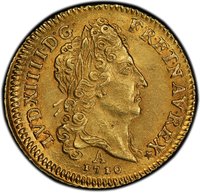
Obverse
Description:
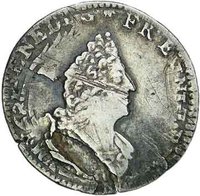
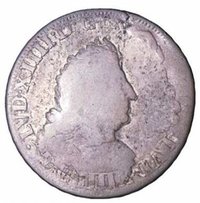
Louis XIV in right-facing bust.
Inscription:
.LVD.XIIII D.G.FR.ET.NAV.REX
Script: Latin
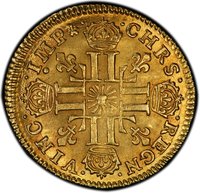
Reverse
Description:
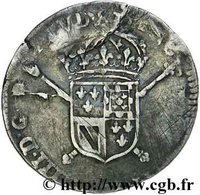
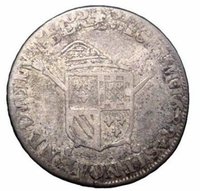
Quartered shield of France and Burgundy, crowned and flanked by scepters.
Inscription:
SIT.NOMEN.DOMINI BENEDICTVM 1705
Script: Latin
Edge
Embossed inscription.
Legend:
DOMINE SALVVM FAC REGEM CHRISTIANISSIMVM
Mints
| Name | Mark |
|---|---|
| Monnaie de Paris | A |
| Lille | W |
Historical background
In 1705, France was in the midst of the War of the Spanish Succession (1701-1714), a conflict of unprecedented scale that placed immense financial strain on Louis XIV's kingdom. The royal treasury, already depleted by decades of lavish expenditure and previous wars, was pushed to the brink. To fund the massive armies and naval engagements, the government resorted to a series of desperate financial measures, including the sale of offices, new taxes, and, most consequentially for the currency, the systematic debasement of the coinage. The Controller General of Finances, Michel Chamillart, repeatedly ordered the recoinage of existing silver and gold coins, reminting them with a lower precious metal content but the same face value, a practice that generated short-term profit for the crown but eroded public trust.
This monetary manipulation created a chaotic "two-tier" currency system. The older, full-weight coins (known as bonnes espèces) were hoarded by the public or exported, following Gresham's Law that "bad money drives out good." In daily circulation, people were left with the newer, lighter coins (mauvaises espèces), whose intrinsic value was significantly lower than their nominal worth. This led to widespread confusion, price inflation, and a thriving black market for currency exchange, as merchants adjusted prices based on the perceived quality of the coins being offered. The government's attempts to fix legal values for different coinages were largely ignored in the marketplace, where real value was dictated by weight and fineness.
The situation severely damaged France's economic stability and the credibility of the royal administration. It disrupted trade, punished creditors who were repaid in devalued currency, and caused hardship for the peasantry and wage-earners facing rising prices. The currency crisis of 1705 was a stark symptom of the fiscal overextension of the Sun King's later reign, demonstrating how wartime financial exigencies could unravel the very monetary foundations of the state, a problem that would continue to plague France throughout the 18th century.
This monetary manipulation created a chaotic "two-tier" currency system. The older, full-weight coins (known as bonnes espèces) were hoarded by the public or exported, following Gresham's Law that "bad money drives out good." In daily circulation, people were left with the newer, lighter coins (mauvaises espèces), whose intrinsic value was significantly lower than their nominal worth. This led to widespread confusion, price inflation, and a thriving black market for currency exchange, as merchants adjusted prices based on the perceived quality of the coins being offered. The government's attempts to fix legal values for different coinages were largely ignored in the marketplace, where real value was dictated by weight and fineness.
The situation severely damaged France's economic stability and the credibility of the royal administration. It disrupted trade, punished creditors who were repaid in devalued currency, and caused hardship for the peasantry and wage-earners facing rising prices. The currency crisis of 1705 was a stark symptom of the fiscal overextension of the Sun King's later reign, demonstrating how wartime financial exigencies could unravel the very monetary foundations of the state, a problem that would continue to plague France throughout the 18th century.

✨ Legendary