

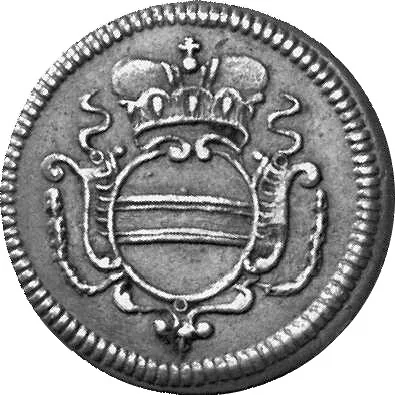
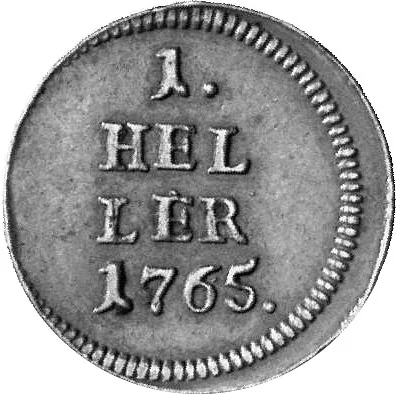
1 Heller – Austrian Empire
Austria
Context
Years: 1763–1765
Country: Austria 
Issuer: Austrian Empire
Ruler: Maria Theresa
Currency:
(1754—1857)
Demonetized: Yes
Material
References
KM: #Click to copy to clipboard1975
Numista: #35599
Obverse
Description:
Austrian crowned shield
Reverse
Edge
Mintings
| Year | Mint Mark | Mintage | Quality | Collection |
|---|---|---|---|---|
| 1763 | — | — | ||
| 1765 | — | — |
Historical background
By 1763, the Austrian Empire, under Empress Maria Theresa, was emerging from the immense financial strain of the Seven Years' War. The conflict had drained the imperial treasury, leading to a chronic shortage of specie (gold and silver coin) and a heavy reliance on debt. To meet wartime expenses, the state had significantly increased the minting of lower-value silver coins (known as Scheidemünze) and debased the currency, meaning their metal content was reduced below their official face value. This practice, while providing short-term liquidity, eroded public trust and set the stage for post-war monetary instability.
The core of the problem was a severe disparity between the overvalued, debased small coinage in daily circulation and the full-valued large silver thalers (Konventionstaler). According to the Konventionsfuß standard of 1753, one Convention thaler was officially equal to 2 gulden or 120 kreuzer. However, the proliferation of lightweight kreuzer coins meant that in reality, it took far more of them to equal the value of a single thaler. This effectively created a dual currency system, causing confusion, price inflation for everyday goods, and widespread hoarding of full-weight silver.
Recognizing the crisis, Maria Theresa's government embarked on a major monetary reform in 1763. The aim was to restore confidence by stabilizing the relationship between small and large denominations. The state recalled the debated Scheidemünze and issued new, full-weight small coins, while reaffirming the 1753 Konventionsfuß standard. This painful and expensive recoinage was a crucial step toward re-establishing monetary order, though the process of withdrawing the vast quantity of bad coinage from circulation across the sprawling empire would prove lengthy and challenging.
The core of the problem was a severe disparity between the overvalued, debased small coinage in daily circulation and the full-valued large silver thalers (Konventionstaler). According to the Konventionsfuß standard of 1753, one Convention thaler was officially equal to 2 gulden or 120 kreuzer. However, the proliferation of lightweight kreuzer coins meant that in reality, it took far more of them to equal the value of a single thaler. This effectively created a dual currency system, causing confusion, price inflation for everyday goods, and widespread hoarding of full-weight silver.
Recognizing the crisis, Maria Theresa's government embarked on a major monetary reform in 1763. The aim was to restore confidence by stabilizing the relationship between small and large denominations. The state recalled the debated Scheidemünze and issued new, full-weight small coins, while reaffirming the 1753 Konventionsfuß standard. This painful and expensive recoinage was a crucial step toward re-establishing monetary order, though the process of withdrawing the vast quantity of bad coinage from circulation across the sprawling empire would prove lengthy and challenging.
💎 Extremely Rare